Super Micro's New CFO Defends A 44% Customer Concentration: 'Quality Of The Exposure' Matters
Mark Long cited $3.1 billion in deferred revenue and faster collections as the company raised its full-year revenue outlook to $72 billion to $82 billion.


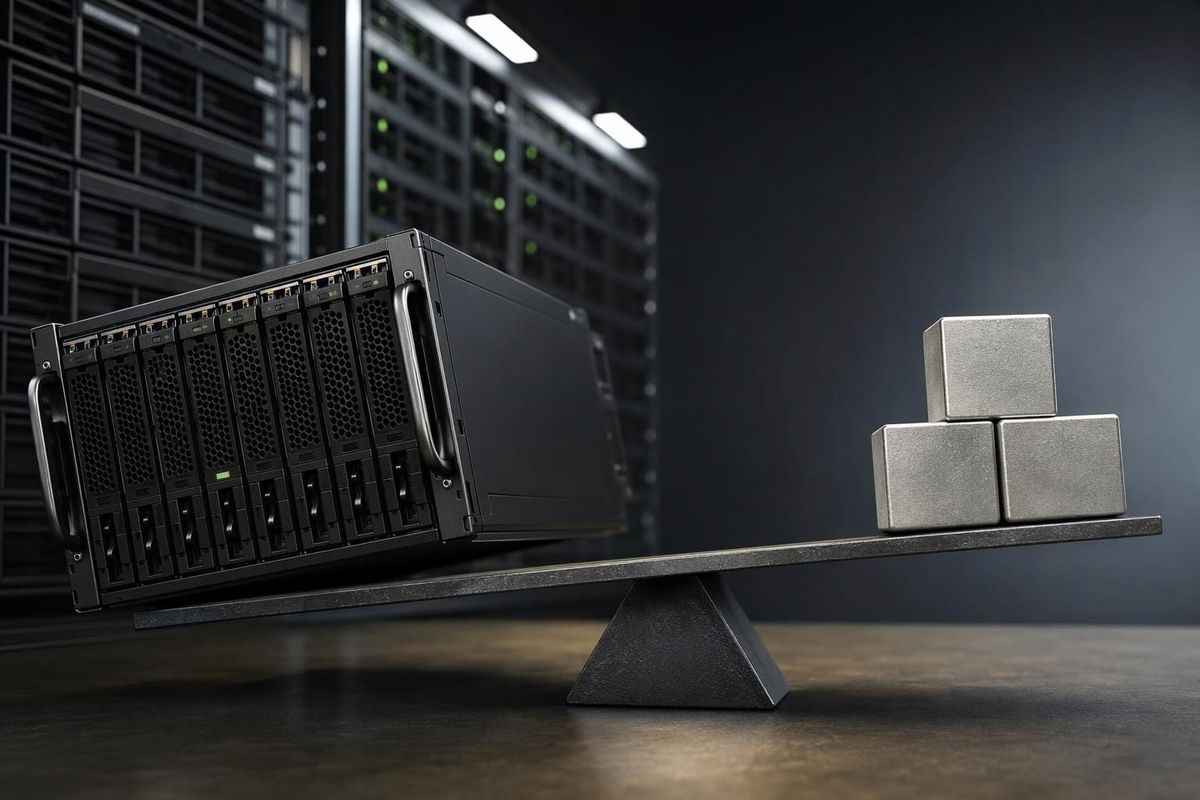
On Super Micro Computer's first-quarter earnings call on November 3, new CFO Mark Long defended the company's reliance on one data center customer, which accounted for 44% of revenue in the quarter versus 28% for fiscal 2026 as a whole. Long, who made his first call as finance chief, pointed to customer prepayments, faster collections and business the company turned down as evidence that the exposure is sound.
Concentration, and the case for it
Super Micro, which makes servers, storage systems and liquid-cooled rack-scale systems for AI and high-performance computing, also reported that two customers made up 49% and 17% of accounts receivable at quarter end, Long said. Revenue for the quarter was $19.9 billion.
"Concentration at this level is a consequence of the scale at which AI infrastructure is now being built," Long said, adding that "a single deployment today can exceed our total quarterly revenue from just one year ago." He expects concentration to stay elevated while the build-outs run and to moderate as enterprise and sovereign business grows.
"What matters alongside the concentration is the quality of the exposure," he said. Deferred revenue rose about $3.1 billion, the overwhelming majority of it customers paying ahead of delivery, and days sales outstanding, a measure of how long customers take to pay, improved from 59 days to 36. No material credit losses were recorded, and the company keeps a $1.8 billion receivables purchase facility.
Long said the company requires deposits on large deployments and evaluates counterparty credit before committing capacity. "We have declined business in this market on terms we were not comfortable with," he said, adding he expects that to continue.
Margins, and a higher outlook
Non-GAAP gross margin, an adjusted measure, was 12.8%, up 330 basis points from a year earlier, but the GAAP figure of 12.7% was down 480 basis points from 17.6% in the fourth quarter. Long attributed the drop to a heavier mix of large AI deployments, which carry lower margins, and to lower-margin deferred revenue recognized in the quarter. Across the fourth and first quarters combined, he said, revenue was about $31.1 billion at a roughly 14.5% adjusted gross margin, against about $10.8 billion at roughly 9.5% a year earlier.
The company raised its full-year revenue outlook to $72 billion to $82 billion from $65 billion to $72 billion, with full-year gross margin of 11.8% to 12.2%. Long said that implies second-half margin below the first half. For the second quarter it guides to net sales of $19.5 billion to $21.5 billion.
An analyst at JPMorgan asked whether the moderation implied for the second half could reflect the largest customer fading. Long said the range reflects supply constraints and data center readiness, and that demand "remains extremely strong."
The new finance chief's priorities
Long said he previously served as chief financial officer of a public company in the industry. CEO Charles Liang introduced him and thanked predecessor David Weigand for six years in the role. Long named financial discipline, transparency, working capital management and capital structure optimization as his areas of focus.
The cash conversion cycle improved from 149 days to 97, Long said, though the company used $434 million of cash in operations in the quarter. It ended with $6.9 billion in cash and net debt of $1.7 billion, and Long said it has no plans to consider equity raises.
The second-quarter outlook of $19.5 billion to $21.5 billion in net sales is the next test of whether the largest customer's share starts to moderate.