Fervo's Cape Station Investors Now Get 60% Of Distributions Until Their Capital Returns
A $31.2 million income allocation went to project investors, but Fervo expects no preferred cash payouts for the rest of 2026.


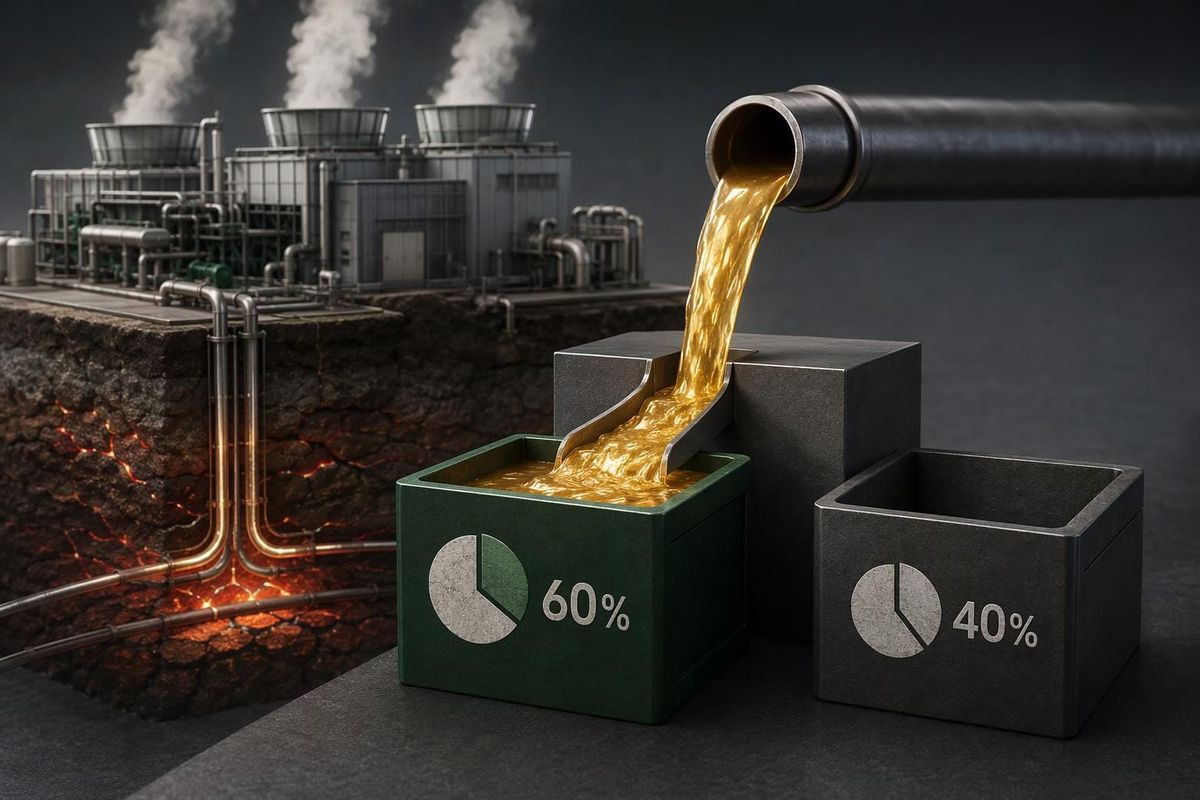
Fervo Energy, which builds and operates geothermal power plants, activated a 60% distribution entitlement for outside Cape Station investors when project assets entered service, according to its quarterly report filed Tuesday. The investors keep that share until their $75.0 million contribution is repaid—yet Fervo expects no preferred cash distributions during the rest of 2026.
Profit Before Cash Reaches Fervo
The immediate effect showed up in earnings rather than cash payments. Fervo assigned $31.2 million of third-quarter income to the Class A investors in Cape Phase I Intermediate HoldCo, applying their distribution rights to the subsidiary group's available net assets.
That allocation helps explain why consolidated profit and earnings belonging to Fervo diverged. Monday's earnings release reported $11.7 million of consolidated quarterly profit, supported by a $29.9 million tax benefit and an $11.8 million non-cash gain from interest-rate swaps. After the project investors' income allocation, the loss attributable to Fervo was $19.5 million, compared with $15.8 million a year earlier.
The consolidated accounts include project subsidiaries Fervo controls without owning all their equity. Income recorded across that group therefore does not all belong to the parent, and an accounting allocation to outside owners does not itself mean cash changed hands.
The intermediate investors' carrying balance stood at $113.0 million on September 30, 2026, against $81.9 million on June 30, 2026. That balance measures their interest for accounting purposes; it is distinct from the original capital contribution and the cash they are entitled to receive.
The Distribution Share Steps Down
Repaying the $75.0 million contribution does not end the intermediate investors' participation. Their share next falls to 53.6% until qualifying distributions deliver a 12.5% annualized return, accounting for the timing of payments.
A further stage reduces their share to 20.0%. Phase I investors remain entitled to distributions for at least 15 years, measured from the later contractual startup date, and longer if their return target remains unmet.
The broader financing arrangements involve Centaurus Capital and Granite Energy InvestCo, known as Catalyst. Fervo expects cumulative distributions of approximately $122.0 million to Centaurus, subject to return hurdles, and approximately $139.0 million to Catalyst through 2041. Centaurus retains a $5.00-per-megawatt-hour royalty after its second priority distribution period ends.
These priorities predate the plant's startup. The second-quarter report already described preferred payment obligations that must be met before cash can reach Fervo. Payments depend on the applicable contractual commercial-operation date and available cash, not simply on declaring an individual generating unit operational.
Cape Station Starts Earning Its Keep
Fervo uses horizontal wells and hydraulic fracturing to connect hot rock underground, allowing water to bring heat to the surface for electricity generation. Cape Station in Utah is its move from pilot-scale production toward a much larger operating business; its Nevada pilot, Project Red, has supplied 3 megawatts since 2023.
Cape Station first exported electricity on September 24, 2026. Fervo declared its first 33-megawatt generating unit commercially operational on September 30, bringing total operating capacity to 36 megawatts from 3 megawatts at the second quarter's end.
“In the third quarter, Cape Station achieved a major milestone, reaching first power and contractual commercial operation,” Tim Latimer, Fervo's CEO and co-founder, said in Monday's earnings release.
Commissioning also brought $514.3 million of assets into service. That amount includes shared Phase I wells and infrastructure, capitalized interest and financing costs; it is not the standalone cost of the first generating unit. Fervo expects the fourth quarter to be Cape Station's first full revenue quarter.
Construction Still Demands Cash
Project cash faces restrictions beyond preferred equity. The Project Granite financing directs revenue through a payment hierarchy and limits distributions to the parent until specified requirements are met. Reserve requirements, covenants and change-of-control provisions under the preferred financings can also restrict or accelerate payments.
Fervo ended September with $1.9 billion of unrestricted cash and $301.6 million of debt after issuance costs. Operating activities used $55.4 million during the first nine months of 2026, versus $12.4 million a year earlier, while capital spending reached $656.0 million.
Management expects another $450.0 million to $500.0 million of capital spending in the fourth quarter. Its second-half estimate is now $700.0 million to $750.0 million, down from $850.0 million to $900.0 million. Fervo attributed the change to construction and commissioning efficiencies that let some spending occur later, without changing expected commercial-operation dates or total expected investment.
GeoBlock 2 began exporting test electricity Wednesday, while GeoBlock 3 is undergoing system testing before hot geothermal fluid is introduced. Fervo expects both units to reach commercial operation by January 1, 2027, completing Cape Station Phase I.
Sources
- 10-Q Filing — Fervo Energy (FRVO) — SEC EDGAR
- 10-Q Filing — Fervo Energy (FRVO), Q2 FY2026 filed 2026-08-13 (comparison basis) — SEC EDGAR
- Earnings release (8-K Item 2.02, exhibit991earningsrelease1.htm) — Fervo Energy, filed 2026-11-09 — SEC EDGAR
- Fervo now has $12B in orders for its geothermal power tech | TechCrunch — TechCrunch
- Fervo Energy Company GAAP EPS of -$0.07 beats by $0.02, revenue of $0.12M misses by $0.03M (FRVO:NASDAQ) | Seeking Alpha — seekingalpha.com
- Fervo Energy soars as Cape Station's first GeoBlock enters commercial operation (FRVO:NASDAQ) | Seeking Alpha — seekingalpha.com
- Fervo Energy Co (FRVO) (Q3 2026) Earnings Call Highlights: First Geoblock Online, Google PPA ... — Yahoo Finance
- Fervo targets ~100 MW by 2027 and mid-2028 start for Google 396 MW deal as H2 2026 CapEx shifts to $700M-$750M (NASDAQ:FRVO) | Seeking Alpha — seekingalpha.com