AST SpaceMobile Plans Blacklift Rocket With Approximately $800 Million License For Firefly Engines
The reusable rocket would carry up to five BlueBird satellites per launch, with flights planned to start in late 2028.


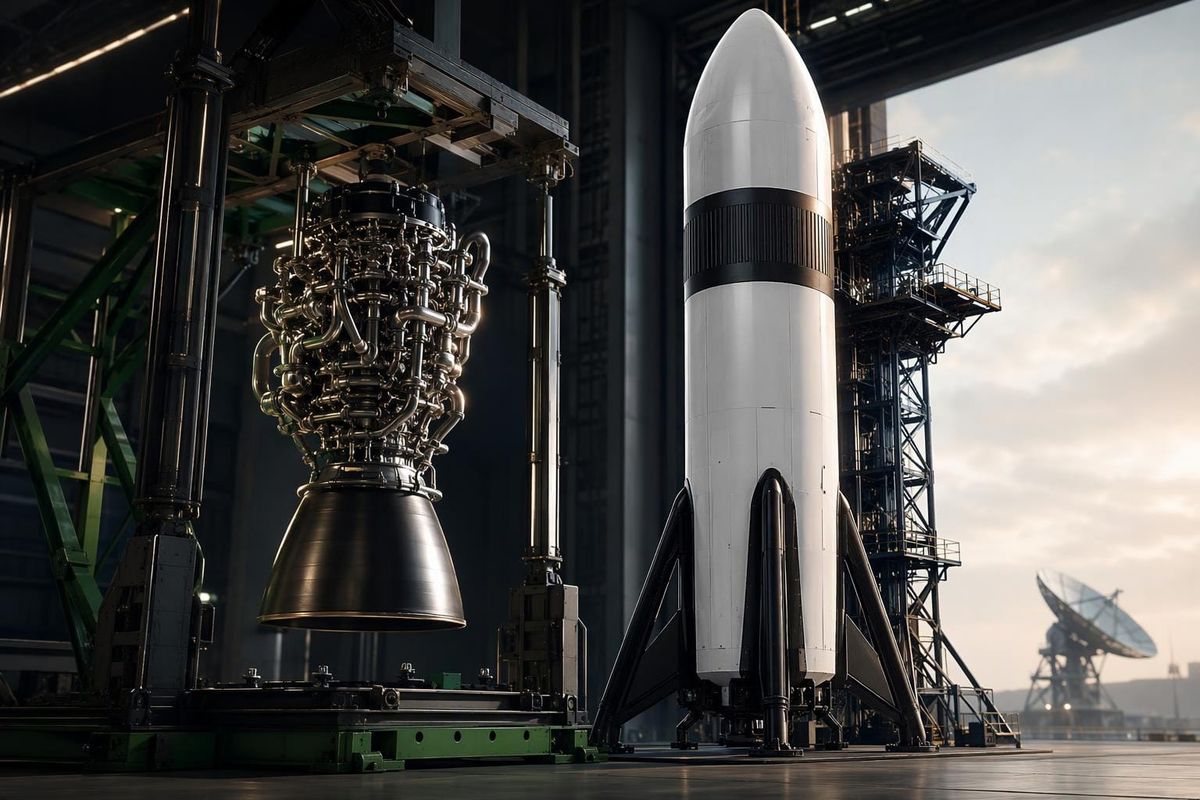
AST SpaceMobile, which is building satellite cellular broadband for everyday smartphones, plans to build its own Blacklift rocket and pay approximately $800 million upfront for rights to manufacture Firefly Aerospace engines. The company announced the 20-ton rocket Friday in an SEC filing, extending its in-house production plans from satellites to launch vehicles.
Cash, Shares And Engine Support
The engine license calls for $400 million cash and 10 to 14 million Class A shares, with the share count determined by a future average-price calculation. That makes new shares, as well as cash, part of the cost to existing holders.
Separate from the license, AST SpaceMobile will pay Firefly $250 million to supply engines for its first three launches. Engineering support will cost another $250 million over three years.
The perpetual manufacturing rights cover Miranda and its vacuum variant, Vira. AST SpaceMobile plans a new U.S. factory to make the engines rather than relying exclusively on purchased units.
Five BlueBirds Per Flight
Blacklift is designed for reuse and to carry up to five BlueBird satellites into low-Earth orbit on each launch, starting in late 2028. The company intends a mission-specific vehicle for repetitive satellite deployments.
AST SpaceMobile President Scott Wisniewski said, "The Miranda engine will allow us to leapfrog the traditional five-to-ten-year development cycle as we build Blacklift." He said the capability would help serve markets beyond phone connectivity, including government radar and secure communications, connected devices, federal emergencies and AI computing at the network's edge.
Firefly Aerospace CEO Jason Kim said Miranda had undergone more than 175 hot-fire tests totaling over 4,200 seconds, equivalent to approximately 20 full first-stage flights. Kim also cited a flight-like test at 110% performance for the 230,000-pound-thrust engine.
Outside launch companies remain part of AST SpaceMobile's plan. Its agreements cover over 100 BlueBird satellites expected to be deployed cumulatively between 2027 and 2028, and the company has access to additional launches for U.S. government missions.
A Launch Business For Its Network
BlueBird production already extends through satellite 51 at the company's Midland, Texas, facility. The rocket would add launch capability to the satellite manufacturing operations that AST SpaceMobile already runs.
The planned broadband service reaches ordinary phones beyond terrestrial cell coverage, with carriers generally sharing revenue with AST SpaceMobile. Its 2025 annual report says the service had not launched or generated revenue; revenue to that point came from U.S. government agreements and carrier purchases of gateway equipment, software and related services.
The company has partnerships with more than 50 carriers serving nearly 3 billion subscribers globally, including definitive agreements with AT&T, Verizon, Vodafone and Saudi Telecom Company. Government work is another intended application, through agreements directly with the U.S. government or through prime contractors.
AST SpaceMobile plans to unveil Blacklift in New York City on Thursday, November 12.
Sources
- 8-K Filing — AST SpaceMobile, Inc. (ASTS) — SEC EDGAR
- Exhibit ex99-1.htm — AST SpaceMobile, Inc. 8-K exhibit — SEC EDGAR
- AST SpaceMobile is so desperate for launch they're building their own rocket - Ars Technica — arstechnica.com
- AST SpaceMobile to develop own rocket using Firefly engines — spacenews.com
- Firefly Aerospace signs $1.3B engine deal with AST SpaceMobile (FLY:NASDAQ) | Seeking Alpha — seekingalpha.com
- AST SpaceMobile to Build Own 20-Ton Rocket to Deploy BlueBird Satellites in Low Earth Orbit Using Miranda Engines from Firefly Aerospace — businesswire.com
- AST SpaceMobile Awarded U.S. Space Force Contract Through STR to Advance Space-Based Sensing Capabilities — businesswire.com