White House Fact Sheet Lists $2.4 Billion In Industry AI Compute Credits Inside A $6 Billion Science Package
The administration's fact sheet names NVIDIA at $1 billion, AMD at $500 million and eleven partners in all for the Genesis Mission Consortium.


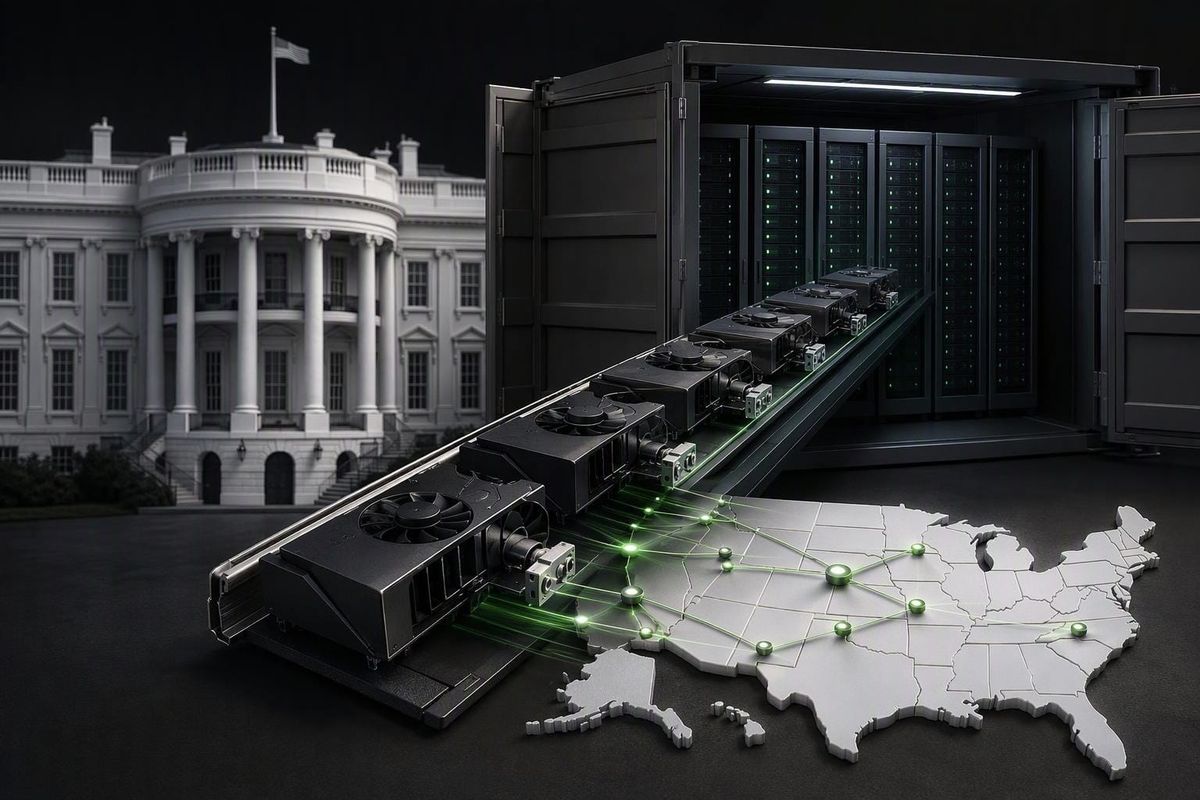
The White House said Thursday that its new science initiatives represent over $6 billion in investments across the federal government, industry, academia and philanthropy, according to a fact sheet tied to the Science: A New Golden Age Summit. The administration called it the most ambitious set of science initiatives in decades; the numbers below are its own account.
What the fact sheet says
The largest industry line is $2.4 billion in compute credits and science tools from eleven partners for the Genesis Mission Consortium. The fact sheet lists NVIDIA at $1 billion, AMD at $500 million, OpenAI at $200 million and Anthropic and Google at $150 million each. AMP and Emerald AI are listed at $100 million each, and AWS, Armada, Crusoe and Micron at $50 million each.
The credits are meant to support more than 15 federal agencies working on national science and technology challenges. The Genesis Mission grew to that number of agencies in July, with a $5 billion federal commitment, the document says.
Other items include a $1 billion Georgia computing and workforce-training investment announced by universities, industry and the state. More than 14 universities across 10 states launched the Southeast Regional computing consortium, and five universities in North and South Carolina launched a regional hub. The National Science Foundation and the Energy Department added over $100 million for instruments and autonomous labs.
On students, the Energy Department launched a $100 million Battelle-Genesis Mission High School Fellowship and a $100 million Genesis Mission Fellowship for accelerated PhDs. The administration also revived the NSF Young Scholars Program, which the document says was abandoned in 1996.
Missions, institutions and the quote
The Energy Department announced eight quantum challenges to guide a $215 million Quantum Genesis Q Competition. NSF launched two $33 million prize competitions, in Quantum+X applications and synthetic multicellularity.
The NIH, Energy Department and Biohub launched a $1.8 billion virtual biology initiative this week, aimed at data and modeling for virtual cells. A new X-Labs Consortium carries over $310 million in industry and philanthropic commitments, building on a $1.5 billion NSF X-Labs initiative announced in May.
Office of Science and Technology Policy Director Michael Kratsios, who wrote the report the summit builds on, said the day "marks the most transformative day for the American scientific enterprise since the reshaping of the Federal research ecosystem following World War II."
Axios reported that the administration is looking for industry to step in amid its cuts to government science funding.
What to watch
NASA and the Energy Department signed a partnership on space nuclear power. The fact sheet says NASA's Space Reactor-1, a nuclear-powered spacecraft to Mars, is expected to launch in 2028.
The quantum challenges will guide the $215 million competition, which the fact sheet says aims to demonstrate fault-tolerant quantum computers.
Sources
- Trump Administration Announces the Most Ambitious Set of Science Initiatives This Century — The White House
- Exclusive: Inside Trump's AI science summit — Axios
- Why Donald Trump chose these leaders to head his 'Super Intelligence Force' on AI — The Hill
- NVIDIA Commits $1 Billion to Advance US Science Over the — globenewswire.com
- Trump to announce $100 million STEM fellowship initiative for PhD students — qz.com
- International, cross-sector collaboration commits nearly $2 billion to build foundational data for AI models to predict and treat disease — prnewswire.com