Telefônica Brasil Profit Climbs 30% With Help From Lower Legacy-Network Depreciation
Free cash flow rose 37.7%, while a scheduled December distribution brings planned 2026 shareholder payments to R$7.3 billion.


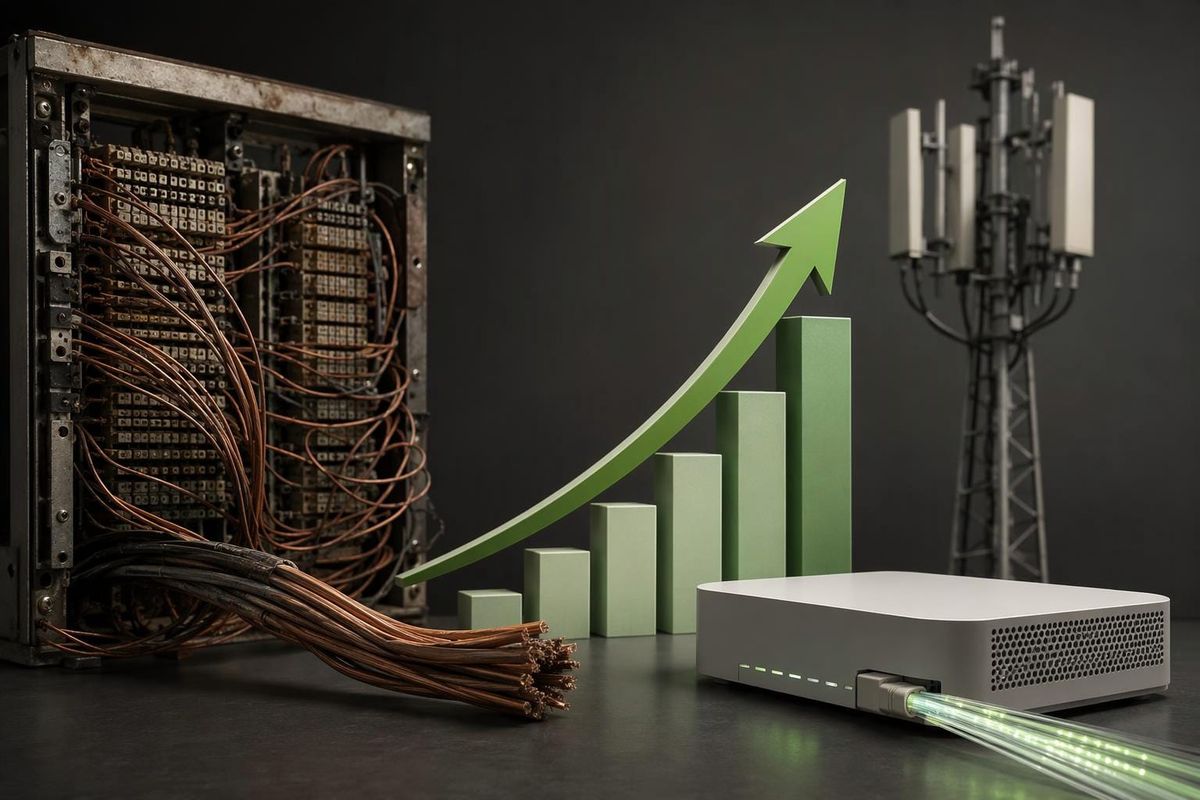
Telefônica Brasil, which sells mobile, broadband and digital services in Brazil, reported a 30.1% increase in third-quarter net income attributable to the company to R$2.5 billion in its Tuesday results announcement. The company attributed the gain to growing revenue, higher EBITDA and lower depreciation after accelerated charges on legacy networks, including copper assets, ended.
Copper's Smaller Charge, Larger Gains
Depreciation and amortization fell 2.9% from a year earlier to R$3.6 billion, and 9.4% from the second quarter. Network investment partly offset the reduction in legacy-asset charges.
EBITDA—earnings before interest, taxes, depreciation and amortization—rose 10.0% to R$7.1 billion. Its margin reached 44.5%, up 1.1 percentage points from a year earlier.
Copper also helped through asset sales. Gains of R$366 million, mainly from copper-related disposals and measured after costs, helped offset increases in operating expenses. Operating expenses were unchanged overall, even as personnel costs rose 7.8% and general and administrative costs increased 14.3%.
Net financial expenses increased 12.4% to R$748.9 million. The company attributed that increase mainly to lower interest income, monetary adjustments on its FISTEL TFF liability and larger network-related lease liabilities.
Mobile And Fiber Build Revenue
Net revenue increased 7.2% to R$16.0 billion. The company credited postpaid mobile, fiber broadband and corporate data and digital services, whose revenues grew 9.1%, 5.7% and 4.9%, respectively.
Telefônica Brasil serves consumers and businesses, combining connectivity with cloud computing, cybersecurity and other digital products. Business digital-service revenue reached R$5.6 billion over the latest twelve months, up 10.9% and accounting for 8.9% of total revenue.
The postpaid mobile base grew 7.1% to 74.7 million connections. Fiber reached 8.4 million connected homes, up 10.8%, across a footprint of 32.4 million homes. Its 5G network covered 1,012 municipalities and 73% of Brazil's population.
Vivo Total bundles mobile and fiber on one offering. A one-time reallocation of bundle revenue between those businesses affected their individual revenue figures but left total service revenue unchanged.
Cash Supports The Payout Commitment
Free cash flow rose 37.7% to R$2.4 billion. The company credited EBITDA growth, judicial-deposit reversals and tax payments that fell 23.6%; greater working-capital consumption partly offset those benefits.
Capital spending, excluding leases and licenses, fell 1.6% to R$2.6 billion. That reversed year-over-year increases of 9.6% in the first quarter and 6.1% in the second. About 75% went toward mobile and fixed-network infrastructure.
For 2024–2026, Telefônica Brasil has committed to distribute at least all annual net income through dividends, interest on capital, capital reductions and buybacks. It paid R$7.0 billion in the first nine months of 2026, 9.6% more than the full-year 2025 distribution, including R$3.0 billion of previously declared interest on capital and R$4.0 billion through a capital reduction.
The executive board approved a December 15, 2026 payment of R$325 million in interest on capital—a shareholder distribution—declared in February. That brings planned 2026 payments to R$7.3 billion. Up to R$1.0 billion remains available for buybacks.
Telefônica Brasil had a market value of $18.6 billion at Tuesday's close.
An additional R$3.2 billion in declared interest on capital is due to shareholders by April 30, 2027.