Polaris Raises 2026 Profit Outlook To $3.50-$3.60 A Share, Its Third Increase This Year
The powersports maker swung to a third-quarter profit on 11% higher sales, and about $1.09 of its new guidance comes from tariff refunds.


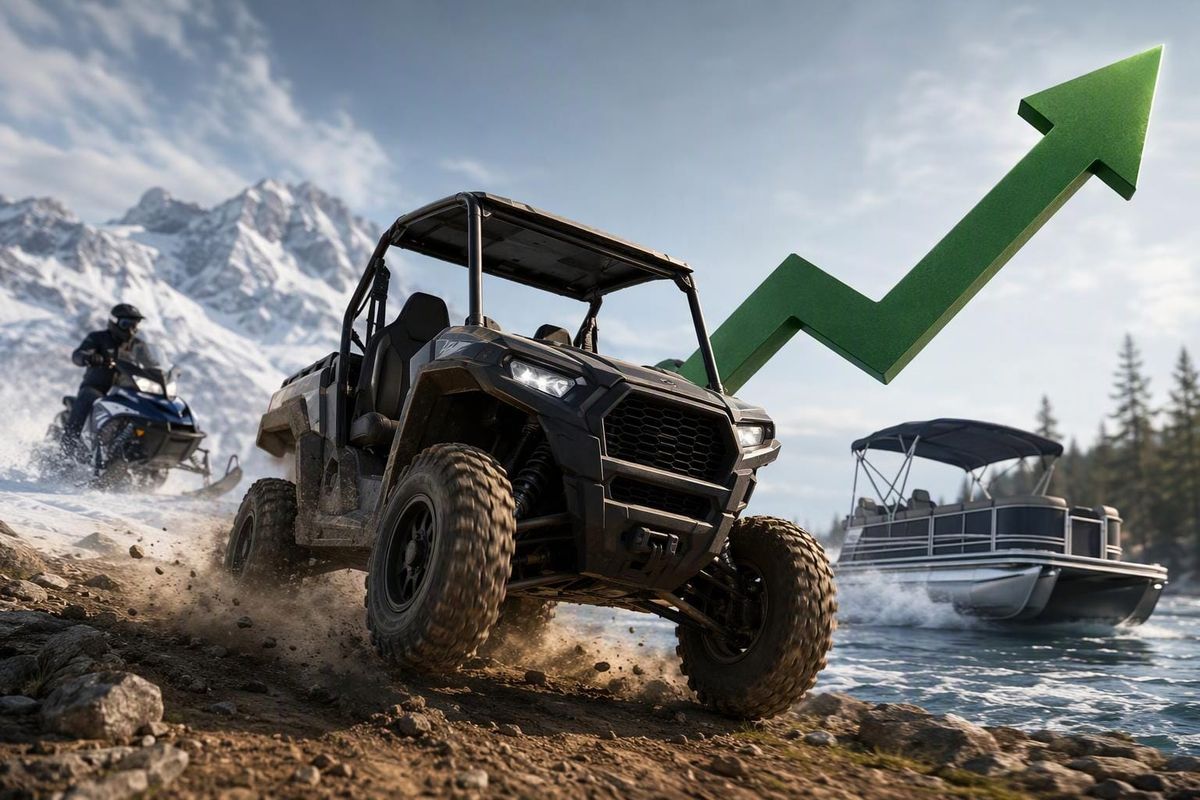
Polaris, the maker of off-road vehicles, snowmobiles and boats, raised its 2026 adjusted earnings guidance to $3.50 to $3.60 a share from $3.00 to $3.10, after third-quarter sales rose 11% to $2,043 million. The results, in an 8-K filed Monday evening and dated October 27, turned a year-earlier loss into a profit.
From a loss to $0.66 a share
Net income attributable to Polaris was $38.4 million, or $0.66 per diluted share, against a loss of $15.8 million, or $0.28 a share, in the third quarter of 2025. Adjusted earnings came to $1.08 a share, up from $0.41.
Gross margin rose to 21.2%, up 52 basis points (about half a percentage point). Operating expenses slipped to $376 million from $380 million. Adjusted EBITDA, a measure of operating earnings, was $180.0 million, an 8.8% margin versus 7.6% a year earlier.
The quarter included $10 million of tariff refunds, worth $0.13 to adjusted earnings per share. The year-earlier period carried a $42.3 million loss on disposal groups, tied to business sales.
Powersports and boats lead the gain
Polaris Powersports sales climbed 18% to $1,822.1 million, driven by higher off-road vehicle, commercial and snowmobile shipments and better net pricing. Marine sales rose 29% to $133.4 million on pontoon shipments and product mix. Aixam & Goupil, the quadricycle unit, fell 12% to $68.0 million on lower Aixam shipments.
North America sales rose 14% to $1,815 million, while international sales fell 11% to $228 million. The sale of Indian Motorcycle partly offset the growth. The company said it gained off-road vehicle market share for a sixth straight quarter.
Polaris designs and makes powersports vehicles and sells them through dealers, mainly in North America and Western Europe.
Guidance, and the tariff refund piece
Polaris now expects 2026 adjusted sales of $7.55 billion to $7.60 billion, up from $7.30 billion to $7.50 billion. About $1.09 of the new per-share range comes from tariff refunds recorded in the second and third quarters.
CEO Mike Speetzen credited a disciplined approach to dealer inventory, operational efficiency and the pace of innovation for share gains and better results, allowing the company to raise guidance "for the third time this year."
Operating cash flow for the first nine months fell to $291.8 million from $562.3 million a year earlier. Speetzen and CFO Bob Mack discussed the quarter on a call Tuesday at 8:00 a.m. Central.
Inventories ended September at $1,544.9 million, down from $1,697.3 million a year earlier.