POET Expects 30,000 Engines Targeted For 2026 To Ship By Second Quarter Of 2027
The optical-engine developer has $774.3 million in cash and short-term investments as it funds a manufacturing expansion.


POET Technologies, which develops optical engines for AI networks and data centers, expects to deliver 30,000 engines originally targeted for 2026 by the second quarter of 2027. Its Monday release, furnished to the U.S. Securities and Exchange Commission, tied the timetable to wafer and component shortages and difficulties improving production yields.
Capacity Must Catch Up With Orders
POET expects its existing backlog to ship by the second quarter of 2027 as funded capacity becomes available. Chairman and Chief Executive Officer Suresh Venkatesan said, "Until it is in place, we are sequencing wafer starts between production orders and new customer programs, so we ship to our customers' schedules and keep our new products on track."
The company ran approximately 120 wafers monthly for much of 2026, compared with approximately 50 in 2025. Committed equipment supports approximately 1,250 monthly, with planned productivity improvements taking that to approximately 1,500.
POET expects to invest more than $45 million in its high-volume line. Equipment installation extends through approximately April 2027, and management targets manufacturing readiness by mid-2027. Assembly expansion has two phases, with the second projected to finish by the end of 2027; assembly capacity is projected to grow approximately tenfold by then.
A 15,000-square-foot clean room is already built, with its size planned to double in 2027. POET said large data-center customers increasingly require the class 1K environment used for the new assembly space.
Customer Qualification Sets The Pace
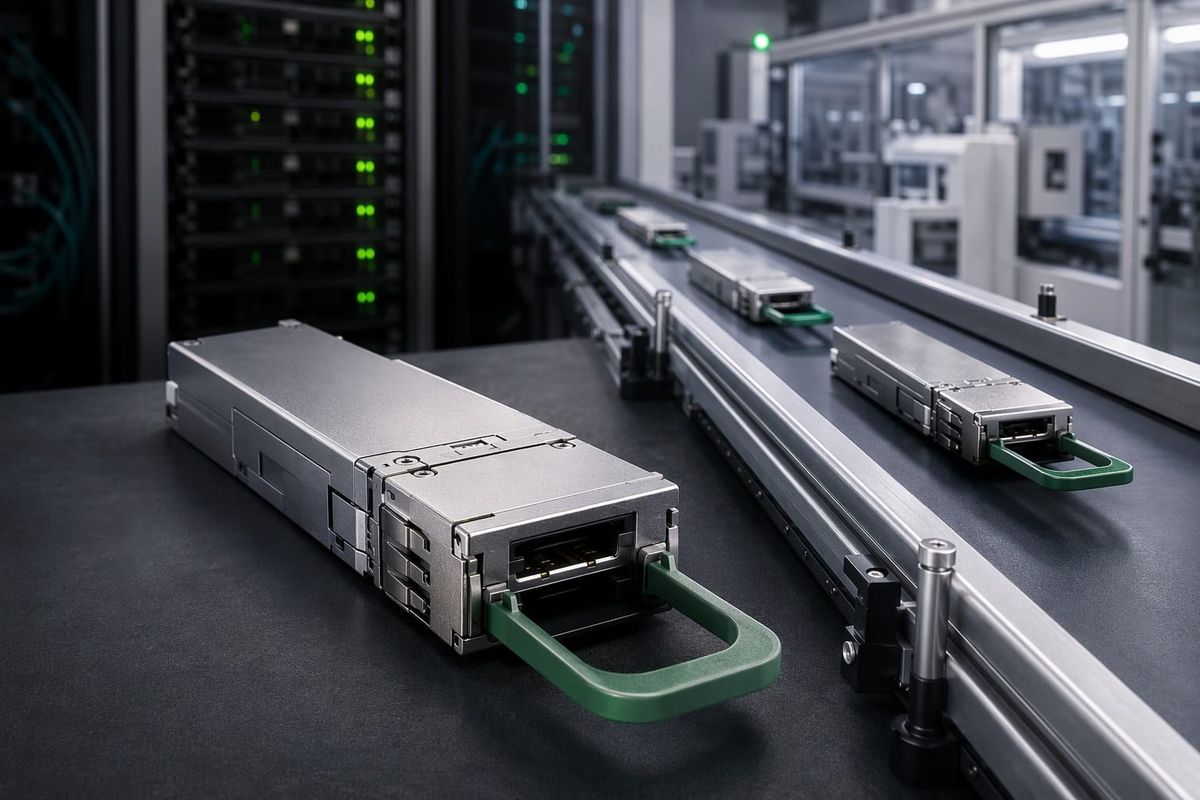
POET's optical engines handle light inside transceivers connected to data-center switches and servers. Its Optical Interposer combines electronic and photonic devices on one chip, and its light-source products include LightBar. Contract manufacturers in Penang, Malaysia, handle production.
The company has nine active customers across 16 projects and expects seven customers to start production using its engines in 2027. Four customers have each ordered more than $1 million; three prospective customers account for four additional projects.
Customer qualification can require modifications to a module or POET engine, and longer industry lead times can prolong those design cycles. Management expects fourth-quarter shipments to exceed shipments during the first nine months of 2026 combined, while production builds inventory for first-half 2027 deliveries.
Lumilens, a customer program spanning multiple products, has initial products undergoing assembly development, with verification scheduled for this year. POET expects Blazar hybrid-laser sampling in the first half of 2027 and targets production for early 2028. Its 1.6T optical engines are scheduled to reach production in 2027.
Cash Covers A Large Build-Out
Third-quarter revenue was $1 million, up 244% from a year earlier and 80% from the second quarter—the seventh consecutive quarterly increase. Venkatesan attributed the growth to customer programs reaching production after years of development.
Cash and short-term investments totaled $774.3 million, compared with $796.3 million at second-quarter end. Operating cash use was $12.7 million versus $12.2 million; research and development spending was $5.4 million versus $5.8 million.
Reported net loss narrowed to $7.6 million, or $0.04 per share, from $11.3 million, or $0.07, in the second quarter and $9.4 million, or $0.11, a year earlier. Chief Financial Officer Giovanni Pacelli said, "The reported net loss narrowed in part because of a $6.4 million non-cash gain on the revaluation of warrants."
Excluding warrant revaluation, the non-IFRS loss was $13.9 million versus $16.9 million in the second quarter and $7 million a year earlier. That measure still includes other non-cash costs, including stock-based pay of $5.7 million in the latest quarter.
U.S.-listed POET shares fell about 10% to $4.60 in Monday trading. Pacelli became finance chief Monday, November 2, succeeding Thomas Mika, who remains through December 2 to assist the transition.
POET plans to release fourth-quarter and full-year results on March 1, 2027, alongside its first quarterly earnings call. Those results will begin its transition to U.S. domestic-issuer reporting and financial statements prepared under U.S. standard accounting rules.
Sources
- Form 6-K — Seventh consecutive quarter of sequential growth; loss per share improves to $(0.04) from $(0.07); $774.3 million in cash and short-term investments — SEC EDGAR
- POET Technologies Reports Record Q3 2026 Revenue of $1.03M, Up 244% | Morningstar — morningstar.com
- POET Technologies Reports Record Q3 2026 Revenue of $1.03M, — globenewswire.com