
Nike CEO Says He Underappreciated Sportswear Segmentation As Full-Year Revenue Guidance Points To High Single-Digit Decline
Elliott Hill admitted a strategic miscalculation on sportswear while guiding fiscal 2027 adjusted earnings per share to $1.15–$1.35.


Nike President and CEO Elliott Hill told analysts on the company's first-quarter fiscal 2027 earnings call Thursday that he underestimated how much the sportswear business needed to be carved into distinct consumer segments — a public admission of strategic miscalculation that helps explain why three of the brand's largest businesses remain in retreat. CFO David Denton followed with full-year guidance that sent Nike shares down about 8% in Thursday after-hours trading, according to market data.
What Hill Said About Sportswear
Speaking on the earnings call, Hill was direct about where his thinking had fallen short. "I probably did underappreciate breaking it down into segments focused on a distinct consumer, which will allow us to have greater clarity around the products, the stories and the retail experiences for those consumers," he said.
Sportswear, which Hill said accounted for just under half of first-quarter revenue, fell by low double digits. The decline combined deliberate actions with genuine underperformance: Nike cut dock-channel revenue by nearly 50%, creating a roughly $200 million headwind, and higher-volume sportswear footwear sold through below expectations. That weaker sell-through has already rippled into future order books, with Nike working alongside wholesale partners to clear excess inventory.
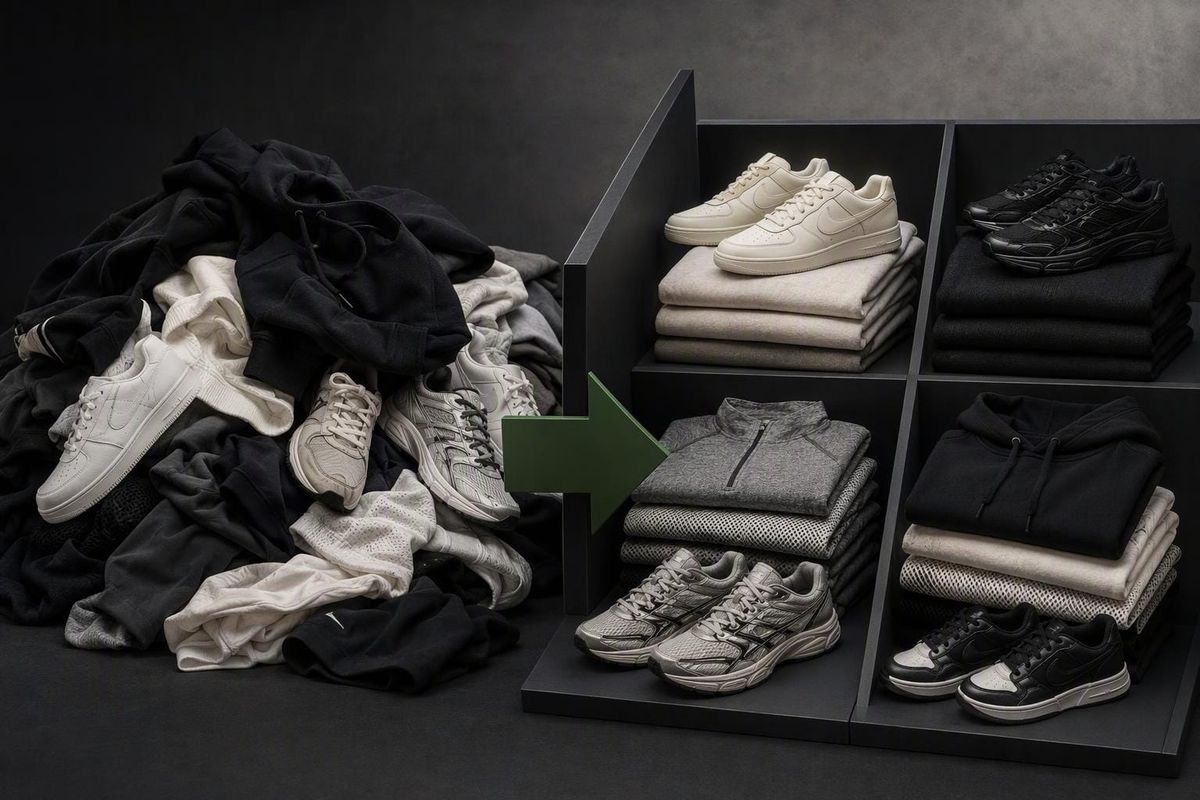
Hill's diagnosis was that the sportswear consumer is not a single audience but a collection of people with distinct needs, tastes, and motivations — and that Nike had been treating it as one. The fix, he said, is to organize sportswear assortments the same way the company has organized its performance business: around specific consumer insights and distinct style preferences. He pointed to early proof points — the Air Force 1 running a stable full-price business, running-inspired silhouettes like the P6000 and V5 Runner growing by strong double digits, and the Studio Fleece women's apparel collection becoming the best-performing apparel launch of the quarter across all of Nike.
When Morgan Stanley analyst Alexandra Straton pressed Hill on why the same pressure points — Jordan Brand, Greater China, and Sportswear — had persisted or worsened since he returned to lead the company, Hill acknowledged that the turnaround was proceeding one sport community, one city, and one country at a time, and that meaningful change at Nike's scale takes time.
Jordan Brand And Greater China: The Other Two Pressure Points
Jordan Brand represented 13% of Nike's global business in the first quarter, with revenue falling by mid-teens. Hill said the brand had been oversupplying its iconic retro product and asking those shoes to carry too much commercial weight. The stated remedy is a deliberate reduction in the volume and frequency of specific Jordan Retro launches — restoring the scarcity model that Hill said Jordan created — with North America expected to feel the biggest near-term impact. Together, Sportswear and Jordan Brand represented a high single-digit drag on consolidated revenue in the first quarter, management said.
Greater China compounded the pressure, with revenue declining 26% in the quarter. Denton told analysts that the guidance range for fiscal 2027 assumes China gets worse for the remainder of the year as Nike eliminates unprofitable digital distribution and resets the marketplace. The plan is to anchor Nike's and Jordan's digital presence in China around fewer, higher-quality flagship storefronts — on Tmall, JD, and Douyin, alongside Nike.com and the Nike app — while pushing top partners to invest in refreshed physical retail. Hill noted that the majority of partners' physical doors in Greater China have not been updated in the past seven years, and that Nike's House of Innovation in Shanghai has delivered 10 consecutive months of growth since shifting to a sport-led approach.
Where The Sport Offense Is Working
The picture is not uniformly dark. Hill said the performance portfolio — which Nike grew to $16 billion last fiscal year — expanded by another high single digits in the first quarter. Running was up double digits again, with Nike nearly tripling its share of the max-cushioning category over the past year. Global football drove strong double-digit growth across all four geographies, aided by World Cup energy; club football kit sales were up high teens. Basketball was up double digits in North America, and both tennis and golf grew double digits.
Hill also used Thursday's call to announce the Caitlin 1 — which he described as the largest women's signature shoe launch in Nike's history — rolling out to 5,000 doors, twice the average for a Nike Basketball signature shoe, backed by the company's largest Nike product campaign for the holiday season.
Fiscal 2027 Guidance And The Pace Program
Denton guided full-year fiscal 2027 adjusted earnings per share to a range of $1.15 to $1.35, with revenue expected to decline in the high single-digit range and adjusted earnings before interest and taxes to fall by a greater percentage than revenue, management said on the call. The guidance outlook overshadowed a first-quarter earnings-per-share beat.
Alongside the financial outlook, Hill detailed a new operating-model program called Pace, designed to scale the Sport Offense across the company. Pace is expected to generate cumulative savings of $2.5 billion but will cost approximately $1 billion to implement; management said the majority of those savings are not expected to arrive until fiscal years 2029 and 2030. The program includes a more flexible supply chain, a new campus in Bengaluru, India, and a reorganization into three geographies — the Americas (combining North America and Latin America), AP/GC (Asia Pacific and Greater China), and EMEA — with teams expected to move into the new structure in fiscal year 2028. Nike also said Pace will change the shape and size of its workforce, reducing overall headcount over time while adding capabilities in targeted areas.
What To Watch Next
Nike's Investor Day in November is the next major catalyst. Management has committed to presenting a long-term financial algorithm, deeper detail on Pace investment priorities, and a clearer view of the growth outlook for Sportswear, Jordan Brand, and Greater China beyond fiscal 2027.
At Thursday's close, Nike shares were priced at $35.15, down 0.71%, giving the company a market capitalization of about $52.5 billion, according to market data. The after-hours drop of about 8% came after the guidance range landed below what the first-quarter earnings beat alone might have implied.
The Investor Day in November is when management has promised to put numbers around what a healthy Sportswear, Jordan Brand, and Greater China business looks like — and how long it takes to get there.
Sources
- Full Transcript: Nike Q1 2027 Earnings Call — benzinga.com
- Nike NKE Q1 2027 Earnings: Aims to Improve Jordan Brand, China + More — wwd.com
- Nike: Fiscal Q1 Earnings Snapshot | The Seattle Times — apnews.com
- Running was a bright spot for Nike in an otherwise gloomy quarter — modernretail.co
- Nike (NKE) Reports Q1 Earnings: What Key Metrics Have to Say — finance.yahoo.com