Neuronetics Posts Operating Profit, Yet Projects It Will Miss A Revenue Test On Its $65.0 Million Loan
Third-quarter revenue rose to $42.0 million, but the company says a lender could call its debt and raises "substantial doubt."


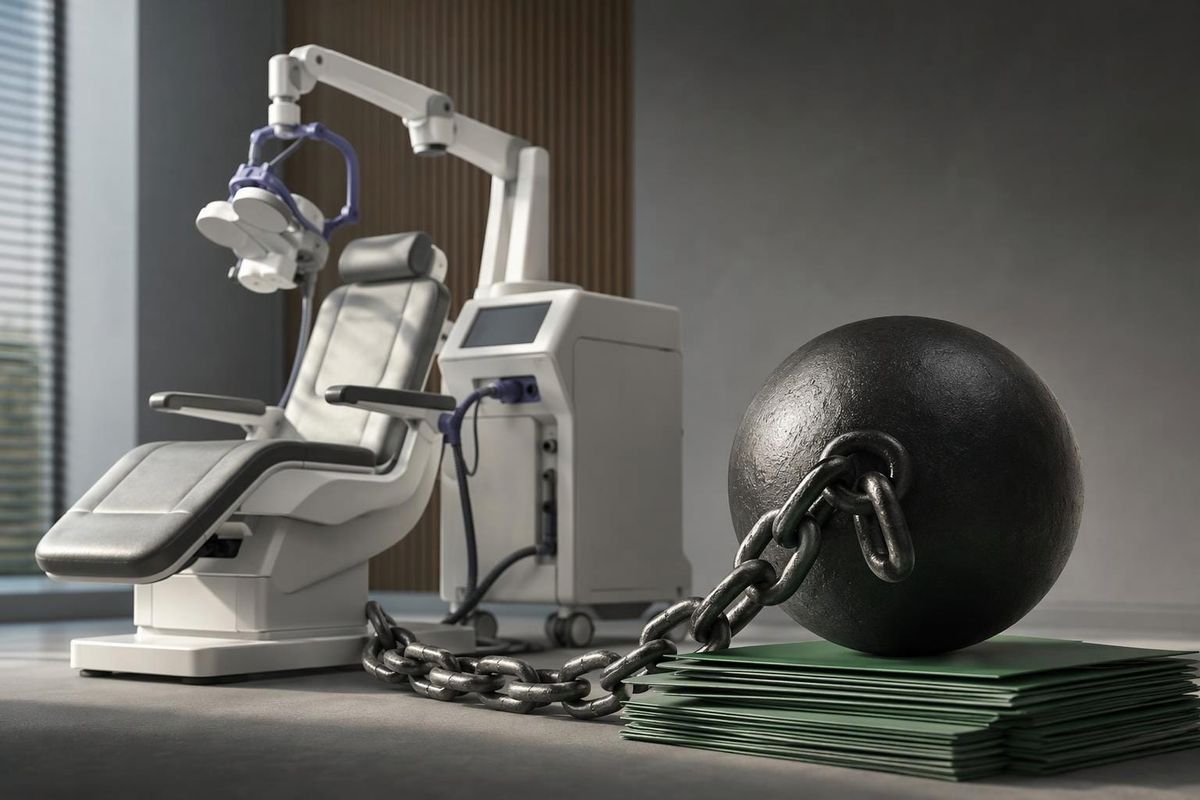
Neuronetics, which makes the NeuroStar transcranial magnetic stimulation system for depression and runs Greenbrook treatment centers, says it expects to fall short of a minimum-revenue test on its $65.0 million loan for the period ended March 31, 2027. The warning sits in a quarterly report filed Wednesday alongside the company's first operating profit in the periods compared, a quarter in which revenue grew 13%.
A covenant the company expects to miss
The company projects trailing twelve-month revenue for the period ended March 31, 2027 will come in below the minimum in its credit agreement. If it misses, the lender may at that time and at its discretion call the facility.
In that case, the filing says, the company is not projected to have the liquidity to pay off the loan, so "substantial doubt exists" about its ability to continue as a going concern. That is the auditor-style warning that a company may not survive another year. Borrowings outstanding were $65.0 million at September 30, 2026, on a facility that matures in July 2029.
Compared with the prior quarter's filing, the paragraph is almost unchanged. It adds one sentence, "The Company remains engaged in discussions with its lender," and "Actions within the Company's control" now reads "Additional actions within the Company's control." Those steps include better revenue cycle management, new treatment options at clinics and new NeuroStar sales strategies. The company says they "do not fully mitigate the risk" for the March 31, 2027 test.
Growth and a first operating profit
Total revenue rose to $42.0 million from $37.3 million a year earlier, with Greenbrook clinic revenue of $26.2 million doing most of the lifting, according to the company's earnings release. Income from operations was $0.5 million, against a $7.3 million loss a year ago. The net loss narrowed to $1.6 million from $9.4 million.
For the first nine months, revenue was $118.0 million, up 10%, and the net loss was $15.8 million versus $31.9 million. The accumulated deficit stands at $474.8 million.
Neuronetics sells the NeuroStar system and recurring treatment sessions, and runs Greenbrook clinics that offer TMS and SPRAVATO therapy. Greenbrook made up 62% of third-quarter revenue and NeuroStar 38%.
Cash, share sales and the covenant calendar
Cash and equivalents ended September at $22.1 million, with another $5.8 million restricted. Operating activities used $9.2 million of cash in the nine months.
The company sold 6,247,772 shares through its at-the-market program at an average $1.37, for gross proceeds of $8.6 million, and has about $33.1 million of capacity left. Shares outstanding rose to 77,728 thousand from 68,994 thousand at the end of 2025.
A March 12, 2026 amendment loosened the revenue covenants only through December 31, 2026 and the liquidity covenants through September 30, 2027. The company was in compliance at September 30, 2026.
Management guides to full-year 2026 revenue of $160 million to $164 million, unchanged, and the March 31, 2027 test is the date the lender's option arises.
Sources
- 10-Q Filing — Neuronetics (STIM) — SEC EDGAR
- 10-Q Filing — Neuronetics (STIM), Q2 FY2026 filed 2026-08-11 (comparison basis) — SEC EDGAR
- Earnings release (8-K Item 2.02, d144740dex991.htm) — Neuronetics, filed 2026-11-04 — SEC EDGAR