Mettler-Toledo Sees AI Lab Upgrades As Upside, Not A Driver Of Its 2027 Forecast
Customers are already running automated experiments, but management says adoption is early and its outlook rests on existing momentum.


Mettler-Toledo, which makes precision instruments and their supporting software, is treating AI-driven equipment upgrades as potential upside rather than a meaningful ingredient in its 2027 forecast, Chief Financial Officer Shawn Vadala said on the company's earnings call Friday. Chief Executive Officer Patrick Kaltenbach described customer laboratories already using its instruments for automated experiments, but the growing interest has yet to become a substantial forecast assumption.
The Forecast Doesn't Depend On AI
“I view it more as upsides,” Vadala said when a Barclays analyst asked whether customers adopting AI could trigger an instrument upgrade cycle.
The initial 2027 outlook puts local-currency sales growth at approximately 5% and adjusted earnings at $52.50 to $53.50 per share, representing earnings growth of 10% to 12%. Management also excludes a meaningful contribution from investments to bring production closer to home.
The sales assumptions are more concrete: Vadala expects pricing to contribute just over 2% next year, with volume growth around 3%. Activity in analytical instruments and laboratory balances has improved, but the forecast assumes that activity continues rather than accelerates.
For 2026, management narrowed its local-currency sales growth outlook to approximately 5%, from approximately 4% to 5%, including organic growth of 4%. Adjusted earnings are forecast at $47.70 to $47.90 per share, up 12%; the sales and cost-of-sales forecasts exclude tariff refunds.
Connecting The Laboratory Bench
Mettler-Toledo's AI strategy centers on supplying measurements and connecting equipment to customers' own software. Kaltenbach said investments in digital interfaces over recent years let newer instruments feed customers' systems without requiring them to adopt a common AI platform.
LabX, the company's laboratory software, connects almost its entire laboratory instrument fleet, Kaltenbach said. He put the company's typical equipment footprint at 40% of the bench in quality-control laboratories—a base of instruments that can supply data for automated workflows.
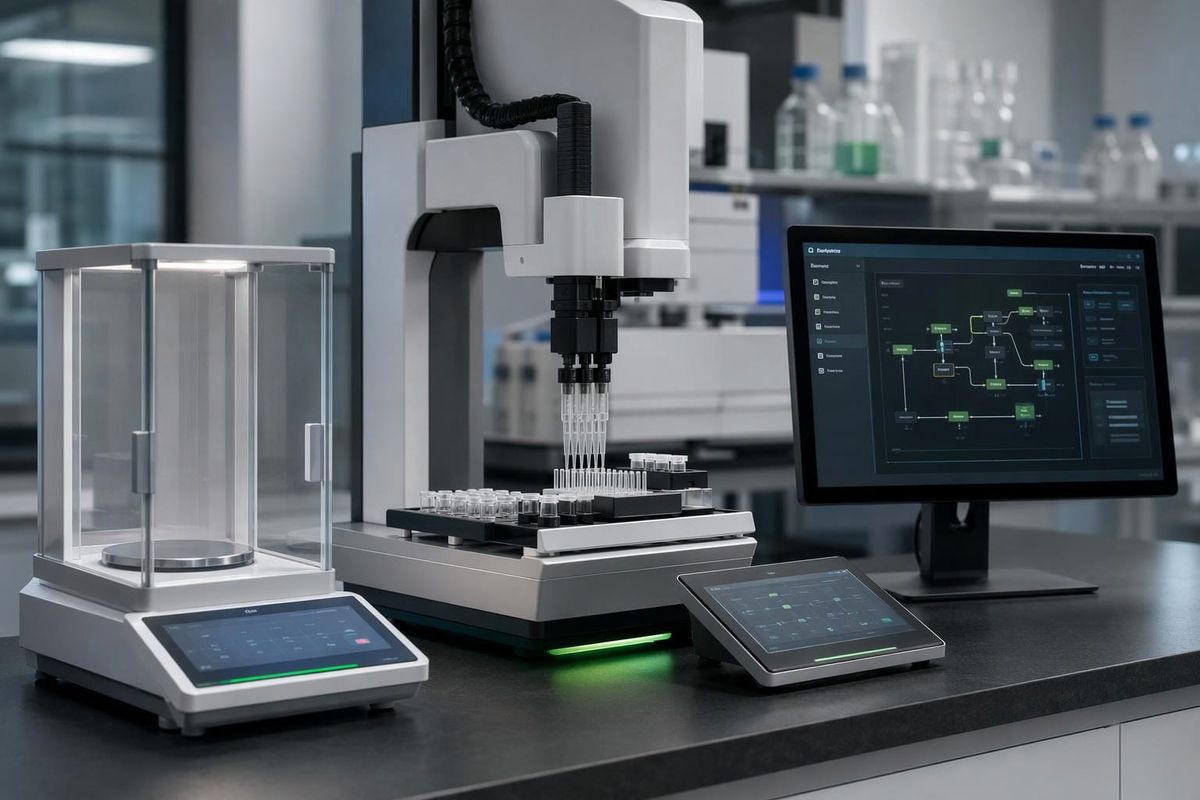
Customers at several accounts already combine robots, instruments and LabX to run experiments that optimize themselves, according to Kaltenbach. Applications include pharmaceutical research and battery development, where laboratories can operate around the clock to refine electrolyte chemistry.
A Stifel analyst asked whether automation would produce a larger earnings contribution next year. Kaltenbach pointed to customer engagement rather than a quantified earnings benefit: “This is still a bit early innings,” he said.
The laboratory opportunity sits inside Mettler-Toledo's largest business. Laboratory instruments and related service represented about 56% of 2025 net sales, compared with about 39% for industrial equipment and related service and about 5% for retail. Its products range from balances and pipettes to industrial scales and inspection systems, serving pharmaceutical companies, research laboratories and manufacturers, among other customers.
Existing Growth Sets The Baseline
The third-quarter results, reported Thursday, give management a source of growth beyond prospective AI upgrades. Sales totaled $1.1 billion, up 6% both in dollars and local currencies; organic local-currency growth was also 6%. Adjusted earnings reached $12.57 per share, up 13% from a year earlier.
Laboratory and industrial organic sales each grew 6%, while service revenue rose 7%. Kaltenbach described improving biopharma and biotech research activity, including strong liquid-handling growth, alongside demand for instruments used in quality laboratories and bioprocessing.
Geography remains a larger explicit forecast consideration. China grew 13% in the quarter, while Europe grew 2%. Management expects continued strength in China and emerging markets next year but remains cautious about Europe. Vadala said the company typically has only about one and a half months of backlog, limiting its visibility.
Management plans to show an automated laboratory workflow at Monday's investor meeting—the practical example behind an AI opportunity it is keeping outside the forecast's meaningful assumptions.
Sources
- Mettler-Toledo Stock Up on Q3 Earnings & Revenue Beat, '26 View Up — Yahoo Finance
- Mettler-Toledo Profit Rises on Asia Gains — MarketWatch
- Mettler-Toledo: Q3 Earnings Snapshot – WTOP News — wtop.com
- Mettler-Toledo (MTD) Surpasses Q3 Earnings and Revenue Estimates — Yahoo Finance
- Here’s What Lifted Mettler-Toledo (MTD) in Q3 — Yahoo Finance