Kopin CEO Puts Government AI Prospects At Hundreds Of Millions — Commercial Sales Remain A 2028 Goal
Fabric AI is funding up to $15 million of development, while projected training-time savings remain simulations.


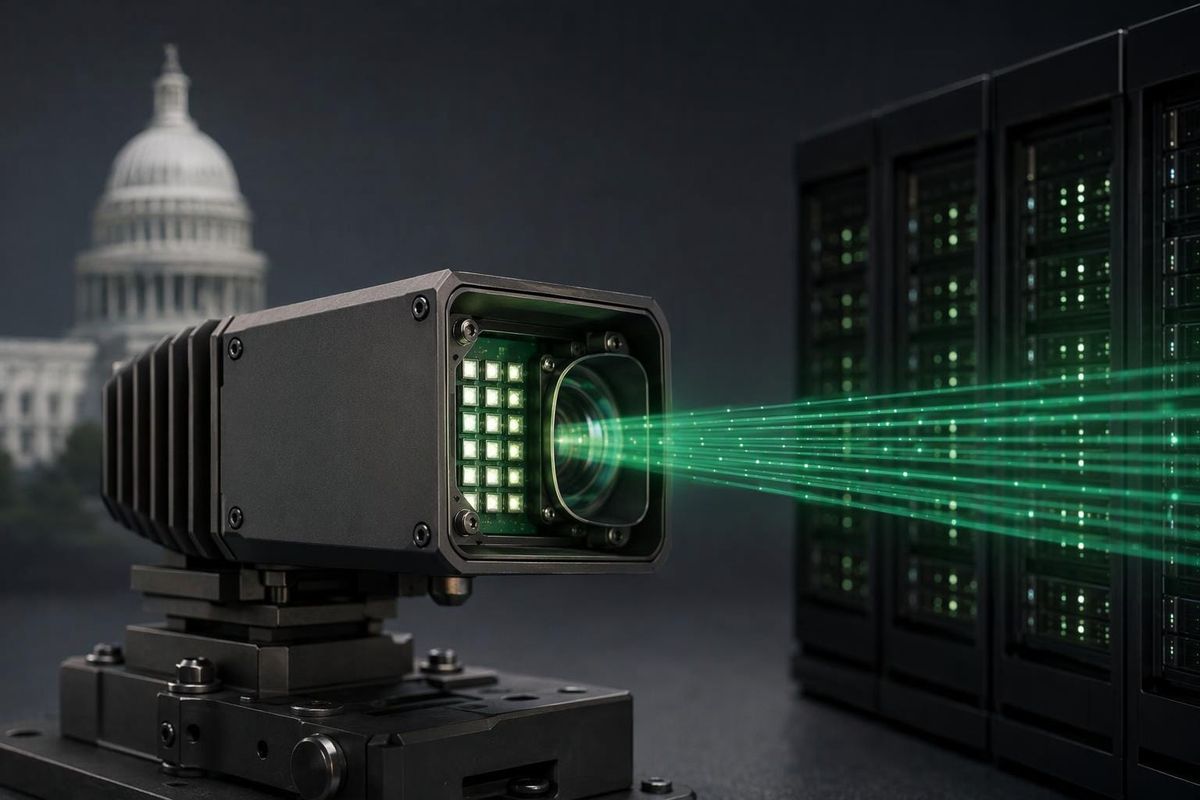
Kopin, which makes miniature displays and optical systems, has prospective government AI-connectivity business worth “well over several hundred million dollars,” Chief Executive Officer Michael Murray said on Tuesday's earnings call—but commercial revenue remains a 2028 goal. Its Neural IO technology is heading toward a public demonstration at CES in January 2027, according to the company's results release.
Government Prospects, Not Product Sales
Murray's estimate covers potential Neural IO projects with the Department of War and U.S. government agencies, rather than contracted revenue. He said Kopin has met with government agencies about the technology and its ability to manufacture it in the United States.
The commercial timetable is also a target. Responding to an analyst from Craig-Hallum, Murray said, "Our goal is 2028 for commercial revenue." Kopin and Fabric AI want to accelerate development of a monolithic chip—an integrated design that brings the technology together on one chip—with first-generation production silicon targeted for 2028.
Fabric AI's customer relationships remain its own to discuss. Asked about the partner's plans to reach large data-center operators, Murray said, "I think that's a question for them actually." He said Kopin supports Fabric AI's customer efforts while pursuing its own, and that Fabric AI has hired consulting firm Kearney to help develop its commercialization strategy.
Kopin is already bidding on potential projects. Murray said additional AI-infrastructure companies and semiconductor firms have signed confidentiality agreements to examine Neural IO. Potential competitors have also approached Kopin about making micro-LEDs for them, he told an analyst from Jones Trading.
The Training Gains Are Modeled
Neural IO uses micro-LEDs to send data through optical connections. Kopin's pitch draws on its experience making tiny, closely packed display pixels, rather than the telecommunications background Murray said characterizes many competing optical companies.
An October white paper with Fabric AI examined the potential impact across an entire AI system. For a system containing 10,000 graphics processors, it modeled useful training throughput per processor of 1.3 to 1.6 times the baseline, translating into 23% to 38% less time for the same training workload.
Murray explicitly cautioned that "these are all modeled results." The figures describe simulated improvements, not measured performance from production hardware. The architecture aims to extend high-bandwidth connections from approximately one meter to tens of meters, potentially allowing hundreds or thousands of processors to work in a tightly connected group instead of roughly 72.
Murray said customer discussions increasingly concern utilization across the data center and the costs of power, water and commissioning, rather than the price of an individual connection. For government applications, he described lower power consumption and more reliable connections as priorities, including for bringing AI closer to the battlefield.
At CES and SPIE Photonics West, Murray expects to demonstrate data transmission and reception using micro-LEDs, plus a pathway to at least 1.6 terabits. The demonstration design will precede the fully integrated chip Kopin wants to commercialize.
Funded Engineering Carries The Quarter
Chief Financial Officer Erich Manz said on the call that Fabric AI is funding up to $15 million of development through a successful demonstration. Kopin had received $9 million through the third quarter, including $4 million during the quarter.
The funding is already affecting results. Kopin's preliminary unaudited third-quarter revenue rose 52% from a year earlier to $18.2 million, and 43% from the second quarter. Management attributed the annual increase primarily to Fabric AI development revenue and government color micro-LED grants. Product revenue was $8.8 million, down from $10.7 million a year earlier, though up 15% from the second quarter.
The operating loss narrowed to $0.5 million from $3.5 million in the second quarter. Operations generated approximately $2.4 million of cash, supported partly by Fabric AI funding. Kopin reported a $3.4 million net loss, including approximately $2.7 million of investment losses largely tied to non-cash valuation changes.
Defense remains the business foundation: defense product sales, excluding development contracts, represented 74% of fiscal 2025 revenue. Kopin supplies displays and optical equipment for weapon sights, pilot helmets, industrial inspection and surgical headsets, earning money from products, funded development, licensing and royalties.
An additional $18.6 million U.S. Army IBAS award brought color micro-LED funding to $34 million. Murray expects micro-LED product manufacturing in mid-2027. The planned U.S. production line will serve both defense displays and Neural IO transmitters; an $800,000 Massachusetts manufacturing grant supports equipment for those activities.
The next public test is the planned CES demonstration in January 2027. Murray's commercial-sales goal remains 2028.
Sources
- Kopin results release (Form 8-K, EX-99.1) — SEC EDGAR
- Kopin: Q3 Earnings Snapshot – WTOP News — wtop.com
- Kopin: Q3 Earnings Snapshot | 9news.com — Associated Press
- Kopin: Q3 Earnings Snapshot | wfaa.com — Associated Press
- Kopin: Q3 Earnings Snapshot | wusa9.com — Associated Press
- Kopin: Q3 Earnings Snapshot | 11alive.com — Associated Press