IDEX CEO Calls Its 'Tunability' A 'Distinct Competitive Advantage' That Raises Its Potential Market
Eric Ashleman says shifting existing technology into faster-growing markets lifts growth and gives IDEX more acquisition targets to weigh.


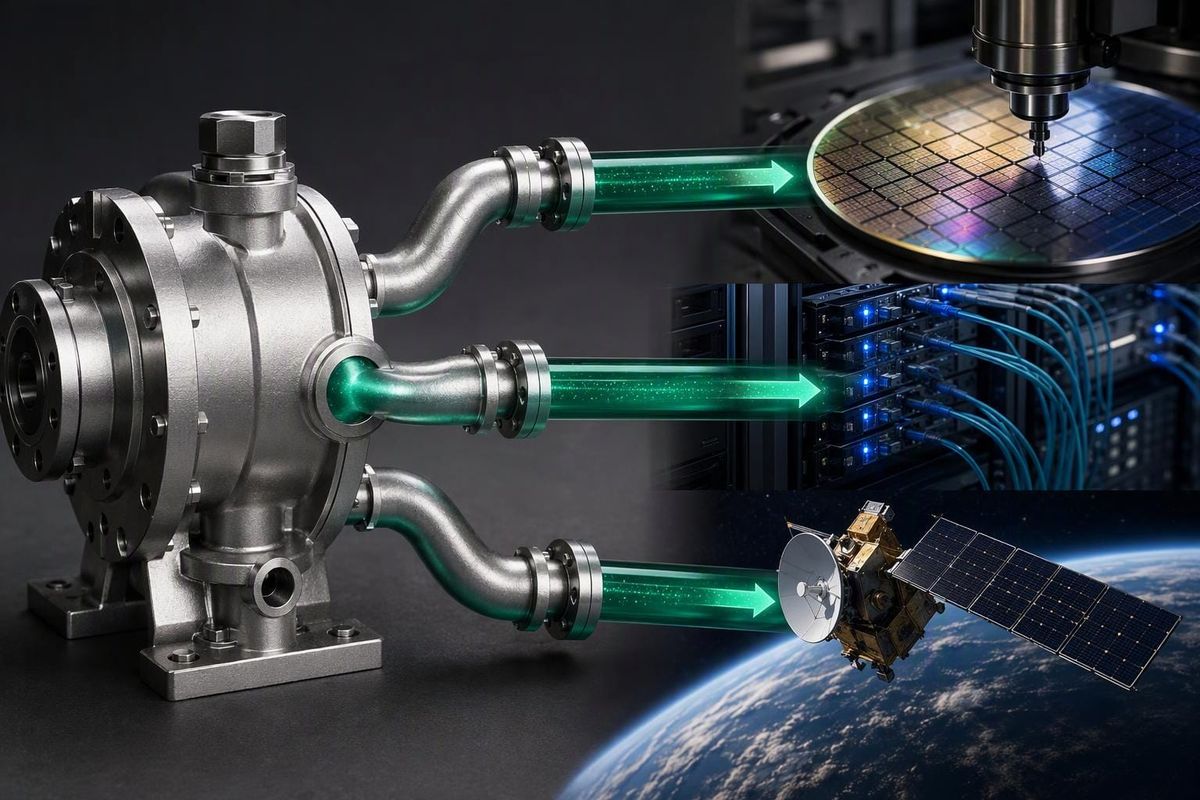
IDEX President and Chief Executive Officer Eric Ashleman used the company's third-quarter earnings call on Wednesday to single out an "underappreciated driver" of growth: the ability to tune existing technology "laterally and quickly" toward faster-growing markets. IDEX, which makes specialized pumps, valves, flow meters, seals, fire and rescue gear, and precision optical and fluidic components, reported organic sales up 8% in the quarter.
Three businesses, three pivots
Ashleman called the ability a "distinct competitive advantage that's unique to IDEX." He gave three examples.
At Mott, porous metal filtration long used in energy now solves purity problems in semiconductor manufacturing. Teams moved resources and modest incremental capital quickly, he said, "all within the same four walls in Connecticut."
At Muon, electroforming know-how from critical-care respiratory products now aligns fibers for optical circuit switching in data centers. At Miwan, laser etching of glass and ceramics was re-engineered into precision radio-frequency antennas for space, after a customer introduction elsewhere in the platform. Ashleman said that would not have happened without the cross-business communication IDEX formalized in its material science platform.
Muon has grown 20% organically so far this year, he said, and its margins have risen further after the company lifted it to the Health & Science Technologies segment's average margin level in the third quarter of last year. At Mott, he said, growth in semiconductor and space and defense is above the segment average, with meaningful margin improvement. He added that "a few larger calls" remain to be executed on some legacy Mott business.
More room to grow, more to buy
Asked by an analyst whether this widens the addressable market, Ashleman said tuning "does absolutely elevate the potential TAM." Three to five years ago, he said, the examples "really weren't things we were thinking about."
He tied it to deal-making: it gives IDEX "a lot more things to consider in terms of assets we might want to acquire." He said the company's activity level is "really, really high," built on proprietary conversations with owners who may not think it is time to sell. For larger deals, though, he said pricing and valuation levels are "still pretty robust."
CFO Sean Gillen said the M&A pipeline is focused on bolt-ons that attach to existing growth platforms.
The quarter behind the claim
Gillen said orders rose 13% organically to nearly $1 billion, and adjusted earnings per share grew 15% to $2.33. IDEX raised its 2026 outlook, now expecting organic growth of 6.5% to 6.8%, up from 5% to 6%, and adjusted EPS of $8.91 to $8.96, from $8.70 to $8.85.
Data center, semiconductor, and space and defense together are now over a third of the portfolio, Gillen said, with year-to-date growth of around 50%. The company's market value was $17.2 billion in Wednesday morning trading.
Gillen said IDEX will lay out its 2027 outlook on the fourth-quarter call.
Sources
- Idex (IEX) Q3 Earnings and Revenues Beat Estimates — Yahoo Finance
- IDEX Corp. (NYSE:IEX) : Cases :: Law360 — law360.com
- IDEX Gears Up to Report Q3 Earnings: What's in the Cards? — Yahoo Finance