Dell Says Sub-$3,000 Servers Have Disappeared As Customers Buy Fewer, Bigger Machines
Traditional servers and networking revenue rose 235% even as shipments fell, while customers delayed some PC replacements.


Dell Technologies, which sells PCs, servers and storage equipment, has lost the market for servers costing less than $3,000 to inflation, Vice Chairman and Chief Operating Officer Jeff Clarke said on Tuesday's earnings call. Yet its traditional servers and networking business generated $15 billion in third-quarter revenue, up 235% from a year earlier, according to the company's results release. Clarke's explanation: customers are buying fewer machines, but each does substantially more work.
The Missing Entry-Level Machines
“That market under $3,000 servers is gone,” Clarke said. He described the entry-level tower and rack machines as historically accounting for about 20% of industry units but just 2% of revenue.
Dell's server shipments fell during the quarter, as management expected. Clarke argued that counting boxes now gives an incomplete picture of what customers are buying: inflation has squeezed out cheaper systems, while newer configurations pack more computing capacity into each machine.
Dell shipped more processor cores than in the previous quarter and a year earlier, he said. Memory and storage content per server also increased against both periods. Those are increases in hardware capacity, not simply higher prices for the same equipment.
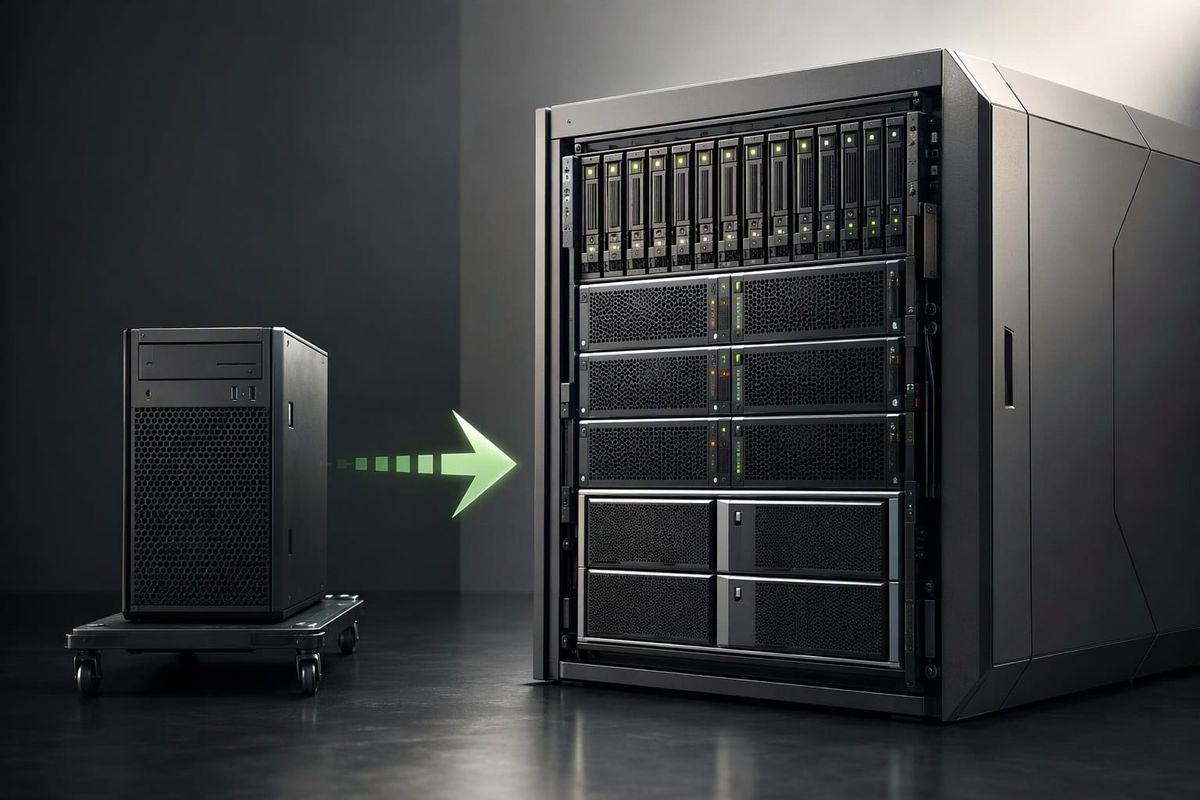
Clarke said Dell's newer 18G machines can replace 12 to 14 older 14G servers. The preceding 17G generation offered consolidation of roughly seven older machines into one. Customers can therefore buy fewer servers while adding the capacity needed to run larger workloads.
Memory Inflation Still Shapes The Budget
An analyst at UBS asked how easing memory inflation might change customer demand and server configurations. Clarke said Dell's outlook does not anticipate falling prices for enterprise server memory or storage chips.
“we still believe the market is inflationary,” he said. He expects the rate of price increases to slow, but said higher prices will continue to affect customer budgets into 2027.
Clarke attributed the squeeze partly to memory manufacturing capacity being directed toward high-bandwidth memory for graphics processors, at the expense of other memory types. In his assessment, demand for server memory remains well ahead of supply.
Customers are still spending their server budgets, Clarke said. He contrasted those purchases with PCs, where companies are delaying some replacements to fund infrastructure. The distinction matters for Dell because it sells both: its infrastructure unit supplies servers, networking and storage, while its client unit sells notebooks, desktops, workstations and peripherals.
Client-unit revenue rose 3% to $12.9 billion in the quarter, but operating income fell 6% to $704 million. Infrastructure revenue rose 198% to $42 billion, and its operating income increased 308% to $7.1 billion.
AI Reaches Beyond Graphics Processors
Clarke said AI inference and agentic computing—the systems that perform and coordinate tasks—are the fastest-growing portion of Dell's traditional-server business. They remain smaller than the business serving conventional enterprise applications.
These workloads require processors to coordinate containers, manage input and output, and organize the work around AI systems. Buyers include specialized cloud providers and enterprises in financial services, semiconductor design, high-frequency trading and pharmaceuticals, he said.
Servers configured for inference and agentic workloads sell for roughly twice the price of traditional servers, Clarke said. That adds another reason revenue can grow faster than unit shipments.
Storage is part of the same purchasing pattern. Clarke said customers are attaching more Dell-owned storage products to AI deployments, including systems for unstructured data. Agents generate records, logs and other material that must be retained, creating additional storage needs in his view. Storage revenue rose 24% to $4.9 billion.
Dell began selling AI servers in fiscal 2024, when infrastructure supplied 38% of revenue, Clarke said. Over the latest four quarters, that share reached 68%; infrastructure's contribution to operating income increased to 83% from 54% over the same comparison.
Servers Get Supply And Cash Priority
Dell raised its full-year revenue forecast to $202 billion from $192 billion. The updated outlook includes $78 billion of AI-server revenue, compared with $74 billion previously, and adjusted earnings of $29.68 per share, up from $25.50.
Chief Financial Officer David Kennedy said Dell plans to prioritize servers and storage while supply remains constrained. The company arranged to redirect some semiconductor wafers designated for PCs toward server supply in the year's second half. Some supply planned for November arrived across October and November, he said.
Management expects traditional-server growth to continue into the fourth quarter, although Kennedy's 137% year-over-year growth outlook is below the third quarter's 235%. He said the underlying demand drivers have not changed.
The board also expanded Dell's share-buyback authorization by $25 billion. Dell returned $4.9 billion through repurchases and dividends during the quarter, and Kennedy reaffirmed its commitment to return at least 80% of adjusted free cash flow to shareholders.
The customer trade-off Clarke described is already visible in Dell's business: companies are postponing some PC replacements while paying for more capable servers and storage.
Sources
- Dell Technologies results release (Form 8-K, EX-99.1) — SEC EDGAR
- Dell earnings report Q3 2027 — CNBC
- Dell Stock Falls Despite Fiscal Q3 Beat And Raise | Investor's Business Daily — investors.com
- Dell’s stock rises as the AI boom helps sales more than double - MarketWatch — MarketWatch
- Dell lifts annual forecasts after record quarter on surging AI server demand - CNA — channelnewsasia.com
- Round Rock-based Dell posts $54.9B revenue as AI demand grows — Yahoo Finance