Vuzix Bets On Customer-Funded AI Development To Put Its Factory To Work
Causeway samples used existing equipment as Vuzix pursues paid development and expects its consulting costs to ease next quarter.


Vuzix, which makes smart glasses and optical components, expects customers to help pay for its move into AI data-center connectivity, President and CEO Paul Travers said on the company's earnings call Thursday. The bet is to turn existing manufacturing capacity into paid development and repeat orders while its established glasses business shrinks.
Paid Projects Are The Test
Causeway, Vuzix's platform for routing optical signals inside AI computing systems, has reached hardware evaluations and discussions with more than 10 companies within three months of its announcement. Vuzix has signed a co-development letter of intent and started integrating optical hardware supplied by a partner.
Asked by a Craig-Hallum analyst how shareholders should assess progress, Travers pointed to projects moving through joint development, customer-paid engineering, qualification and production.
“Customer funding is an especially important signal,” Travers said. He expects those payments to cover development work and help put the company's manufacturing overhead to productive use. Some relationships could become strategic partnerships, potentially involving investments in Vuzix, he said.
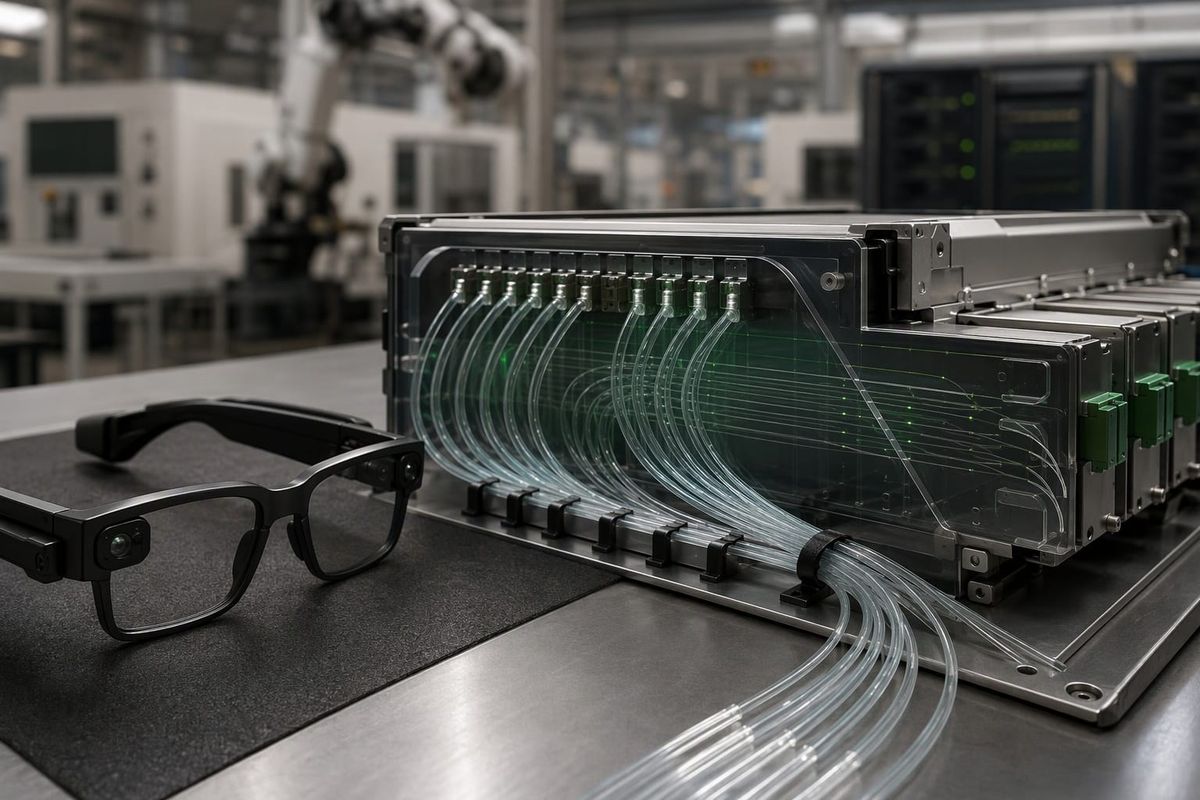
The initial platform supports evaluation of up to 19,200 parallel optical pathways. Causeway uses a passive glass bridge to route dense arrays of light between emitters and detectors; the active components determine each pathway's data rate.
Prospective customers and partners include light-source suppliers, optical-engine developers, packaging companies, server-rack manufacturers and research teams at large data-center operators. Vuzix's contribution is the optical routing; customer-specific integration and qualification remain steps toward production.
A Factory Built Before The Orders
“We built this company ahead of the business that we're now pursuing,” Travers said when asked whether Vuzix can handle parallel customer programs.
Chief Financial Officer Grant Russell said the Causeway evaluation samples were produced with equipment already in place, requiring no additional capital spending. Vuzix invested approximately $2.7 million in equipment and tooling during the first nine months of 2026, mainly for waveguide manufacturing and research. Its Rochester manufacturing upgrades are installed, and customers have received functional single-plate color waveguides for evaluation.
Vuzix assembles products and manufactures waveguide optics in West Henrietta, New York. It sells branded glasses, components for other device makers, engineering services and software. Its glasses support hands-free work in manufacturing, logistics, field service and healthcare, alongside defense and other applications.
The company is shifting toward customized products whose customers pay for development and may become repeat buyers. Blade 2 and Shield were discontinued at the end of 2025 when essential components became unavailable. Z100 now serves as a customer platform supplied against volume commitments.
Lower Spending, Still Burning Cash
Third-quarter revenue fell 33% to $714,000. Russell attributed the decline primarily to weaker smart-glasses sales, including fewer M400 units and the absence of sales from the older product lines. Engineering services and products supplied to other manufacturers generated $220,000, down 17% from $265,000 a year earlier.
Operating expenses rose to $7.6 million from $7.1 million, including $1 million of Causeway consulting costs. Management does not expect that bill to recur in the fourth quarter and forecasts operating expenses around the mid-$6 million range.
The quarterly net loss widened to $8.4 million, or $0.10 a share, from $7.4 million, or $0.09 a share. Operations used $6.7 million of cash, compared with $5 million a year earlier.
Vuzix ended September with $9.2 million in cash and no outstanding debt. Russell said customer-funded engineering shifts development costs toward committed customers; management also plans to raise capital as needed and adjust discretionary spending.
For Causeway, management's next commercial step is securing funded engineering programs with defined milestones. Repeat component orders depend on successful integration and customer qualification.
Sources
- Could this breakthrough make smart glasses mainstream? — The Edge Malaysia
- Vuzix: Q3 Earnings Snapshot | 9news.com — Associated Press
- Vuzix: Q3 Earnings Snapshot | king5.com — Associated Press
- Vuzix: Q3 Earnings Snapshot | 11alive.com — Associated Press
- Vuzix: Q3 Earnings Snapshot – WTOP News — wtop.com