Vertex Assigns $5.1 Billion Of Its Crinetics Price To One Unapproved Drug
Vertex's preliminary accounting puts $5,116.0 million on atumelnant, a Phase 3 drug, against $1,335.4 million of goodwill.


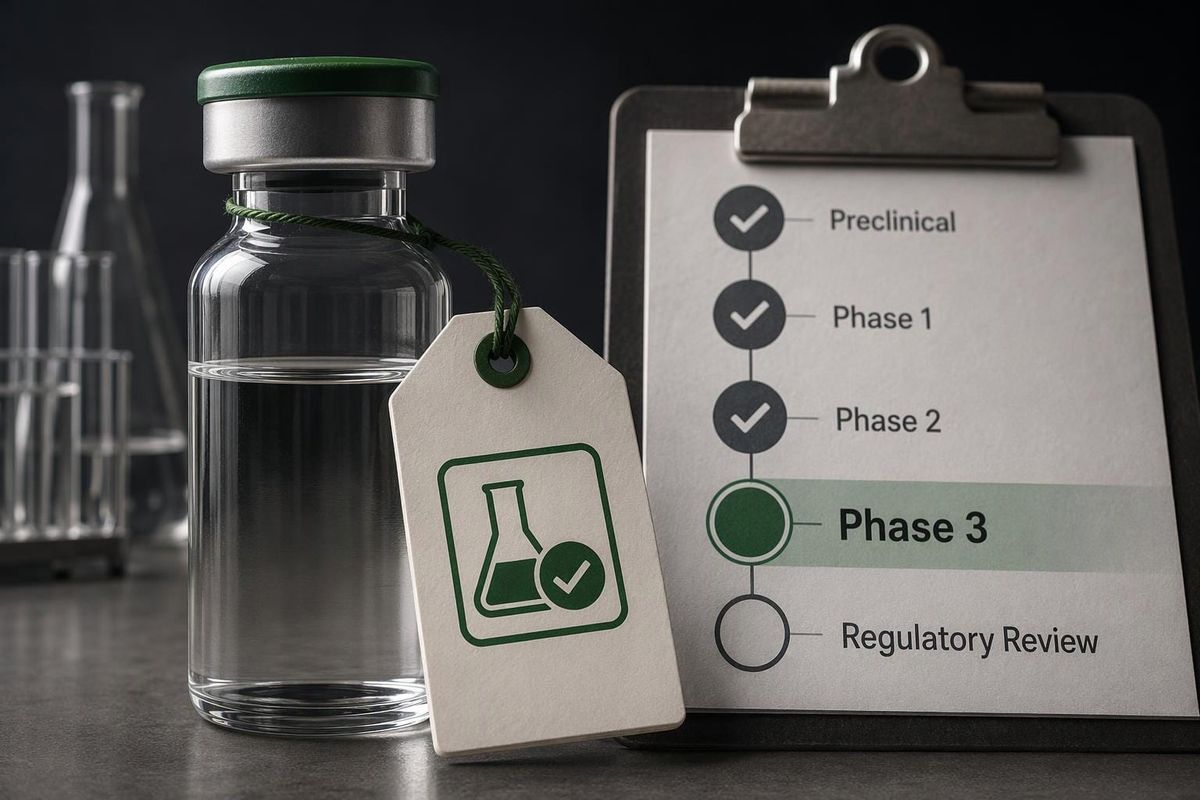
Vertex Pharmaceuticals, the biotech behind cystic fibrosis medicines and the gene-editing therapy Casgevy, assigned $5,116.0 million of its $9,619.1 million Crinetics purchase price to atumelnant, a drug still in Phase 3 development, according to its quarterly report filed Tuesday. The company calls the allocation preliminary, and it can change for up to a year.
Where the $9.6 billion went
Vertex paid $85.00 per share in cash and closed the Crinetics deal on September 1, for a total equity value of $10.0 billion. Of the cash paid, $409.6 million went to accelerate and settle unvested Crinetics equity awards. The company booked that as post-acquisition expense, $265.5 million in research and development and $144.1 million in selling, general and administrative costs, leaving $9,619.1 million to allocate.
Atumelnant takes $5,116.0 million. PALSONIFY, Crinetics' marketed acromegaly drug, takes $3,010.0 million. Goodwill is $1,335.4 million, which the filing says arises primarily from establishing the $1,315.2 million net deferred tax liability on intangible assets that have no tax basis.
The prior quarter's filing carried only $224.6 million of indefinite-lived in-process research and development, all tied to type 1 diabetes. Vertex's balance sheet now shows $5,340.6 million of such assets.
A valuation built on odds of success
Vertex valued the intangibles with a discounted cash flow analysis. Its stated assumptions include the probability of technical and regulatory success for atumelnant, estimated future cash flows from potential sales, and the costs of developing and selling the medicines.
Atumelnant is in Phase 3 for congenital adrenal hyperplasia, which Vertex says affects about 17,000 people in the U.S. The trial is a 32-week, placebo-controlled study of 150 people, and Vertex expects to finish enrollment in the first quarter of 2027. The drug is also in a Phase 2/3 trial for ACTH-dependent Cushing's syndrome.
The filing's risk factors say the deal's benefits depend on PALSONIFY revenue and atumelnant's commercial potential. If development is delayed or ends, or approval fails, Vertex says it may not realize the expected revenue growth.
Amortization and the open window
The purchase allocation, including certain intangibles and tax analyses, will be finalized within one year of the acquisition. PALSONIFY's asset is amortized straight-line over about sixteen years. Vertex expensed $15.3 million in September, and expects $51.8 million in the fourth quarter and $205.5 million in 2027. Cost of sales as a share of net product revenue rose to 15.3% from 13.5% a year earlier.
Vertex booked $10.1 million of PALSONIFY revenue in September. The deal was funded with cash and a $4.5 billion term loan, due $1.0 billion in August 2027, $1.0 billion in September 2028 and $2.5 billion in August 2029. Transaction costs of $58.9 million sit in SG&A.
Third-quarter revenue rose 12% to $3,440.8 million, the company said in its earnings release, but net income fell to $653.6 million from $1,082.9 million, which Vertex ties mainly to Crinetics-related expenses. Its market value was $140.2 billion in Tuesday's session.
The next dated test is November 30, the FDA's target action date for povetacicept in IgA nephropathy, with atumelnant's Phase 3 enrollment due to finish in the first quarter of 2027.
Sources
- 10-Q Filing — Vertex Pharmaceuticals (VRTX) — SEC EDGAR
- 10-Q Filing — Vertex Pharmaceuticals (VRTX), Q2 FY2026 filed 2026-08-04 (comparison basis) — SEC EDGAR
- Earnings release (8-K Item 2.02, ex-991_q32026.htm) — Vertex Pharmaceuticals, filed 2026-11-02 — SEC EDGAR