Two Buyers Took 99% Of Revolution Medicines' First Drug Sales, And Stocking Inflated The Quarter
Two customers held all the receivables, and the company says initial stocking means the quarter is a poor guide to demand.


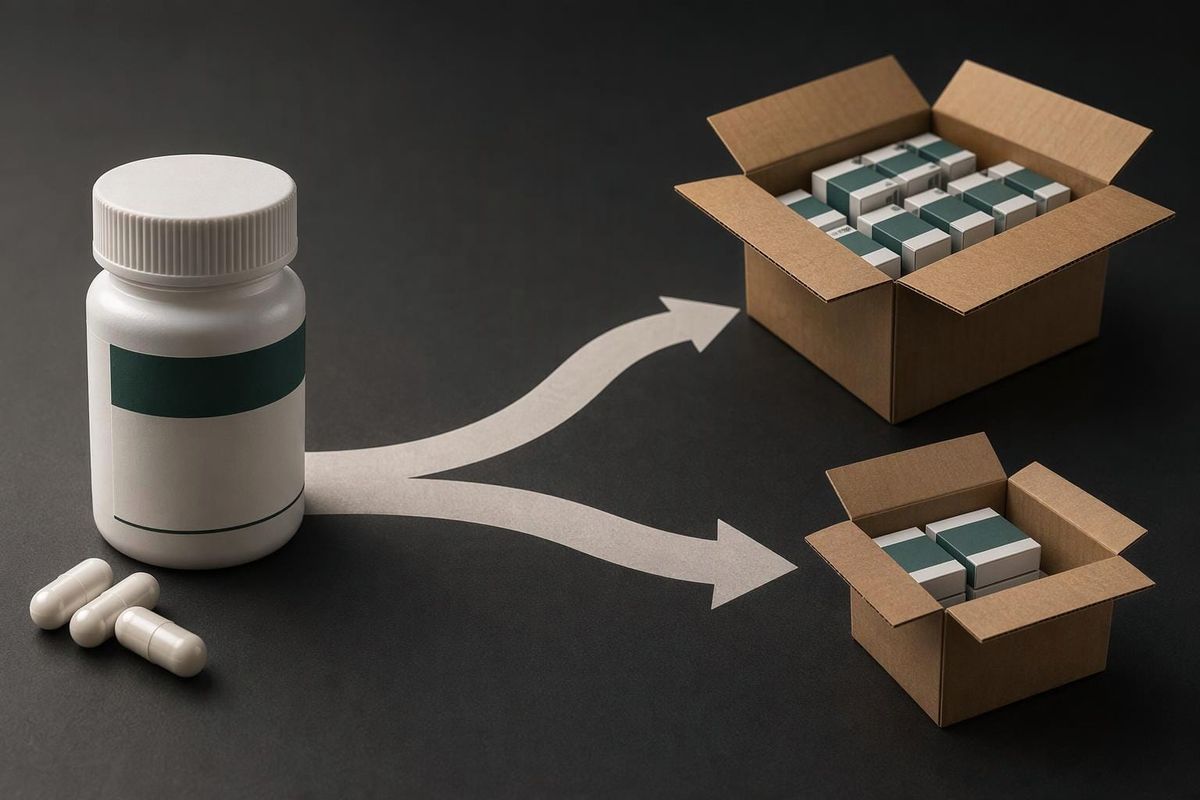
Two customers accounted for 71% and 28% of net product revenue in Revolution Medicines' first quarter selling its pancreatic cancer drug RASONQUE, the company said in its quarterly report on Wednesday. Part of that revenue came from filling pharmacy shelves, so it overstates what patients actually used.
Concentrated buyers, large receivables
Revolution Medicines, a precision oncology company built around drugs that target RAS-driven cancers, began selling RASONQUE (daraxonrasib) in August after FDA approval. Net product revenue was $197.6 million for the quarter, which the company's earnings release ties to about five weeks of commercial availability.
The same two customers made up 72% and 28% of accounts receivable at September 30. No other customer exceeded 10% of revenue or receivables. Receivables stood at $230.7 million against $197.6 million of revenue, and the company says its allowance for credit losses was not material. The company's prior quarterly report carried no product revenue.
The drug moves through a limited network of specialty pharmacies. Accrued rebates, a liability that did not exist at the end of 2025, were $44.7 million, reflecting reserves for government and other discounts.
Launch-quarter caveat
Management says revenue reflects both patient demand and initial stocking, and expects product revenue to rise because the quarter was only partial. In the release, the company called the transition of patients from its expanded access program and the first cohort of waiting patients "finite early-launch dynamics." It said more than 5,000 unique patients received commercial drug from approval through September 30.
Cost of sales was just $0.3 million because the company sold inventory made before approval, whose costs were already booked as research and development. Capitalizing those costs would have added $1.8 million. The company expects zero-cost sales to continue through the rest of 2026 and into 2027, with cost of sales rising as a share of revenue afterward.
Costs and financing behind the launch
The quarter's net loss was $407.5 million, against $305.2 million a year earlier, including $40.7 million of non-cash charges from a change in the value of warrants. Research and development expense was $417.1 million and selling, general and administrative expense $153.3 million. Cash and securities were $3.7 billion.
Royalty Pharma now takes a cut of sales, and weak sales would raise its share from 2030 through 2041. In October the company drew a $250.0 million first tranche of a term loan secured by substantially all its assets, and elected not to take an optional third royalty tranche.
The European Commission's decision on the CHMP's positive opinion for daraxonrasib is pending, and full-year 2026 operating expense guidance of $2.1 billion to $2.2 billion was reiterated.
Sources
- 10-Q Filing — Revolution Medicines (RVMD) — SEC EDGAR
- 10-Q Filing — Revolution Medicines (RVMD), Q2 FY2026 filed 2026-08-05 (comparison basis) — SEC EDGAR
- Earnings release (8-K Item 2.02, rvmd-ex99_1.htm) — Revolution Medicines, filed 2026-11-04 — SEC EDGAR
- Revolution Medicines GAAP EPS of -$1.90 beats by $0.50, revenue of $197.5M beats by $170.15M (RVMD:NASDAQ) | Seeking Alpha — seekingalpha.com
- Genmab Stock Price Shock Puts 3 Oncology Biotech Names In Focus — Yahoo Finance
- Revolution Medicines Reports Third Quarter 2026 Financial — globenewswire.com
- Medicilon представляет революционные лекарства с наградой Excellence in Client Partnership Award — prnewswire.com
- Medicilon udeľuje spoločnosti Revolution Medicines „Cenu za vynikajúce partnerstvo s klientom" — prnewswire.com