TransDigm’s Inventory Reserve Rises To $357 Million While It Stocks Up For Future Sales
The aircraft-parts supplier bought raw materials for fiscal 2027 demand, but its estimate for aging or obsolete inventory also grew.


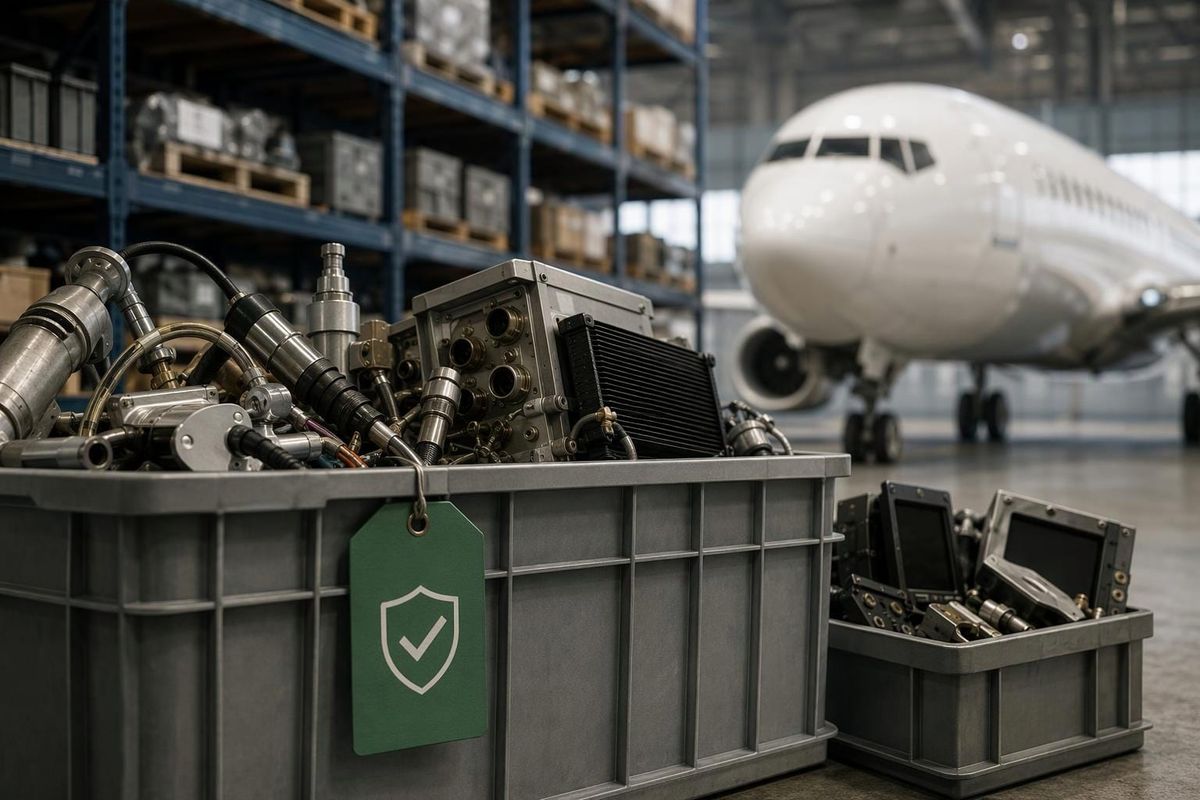
TransDigm, which makes components for commercial and military aircraft, increased its inventory reserve to $357 million from $270 million a year earlier, according to its annual report filed Tuesday. The larger allowance for parts that could become obsolete or sell slowly accompanied raw-material purchases that management said support expected fiscal 2027 sales.
More Parts, More Valuation Risk
TransDigm ended September 30, 2026, with $2.7 billion in inventory after provisions, compared with $2.1 billion at September 30, 2025. The increase extended beyond materials waiting to enter production: finished goods rose to $343 million from $257 million, while work in progress reached $746 million from $543 million.
Raw materials and purchased components accounted for $1.6 billion, against $1.3 billion a year earlier. That gives holders two distinct measures to consider: the amount of stock the company carries and the adjustment it makes for stock whose value may not be recovered.
The reserve depends on management's assessment of quantities on hand, previous consumption and expected sales. TransDigm records inventory at cost or its expected recoverable value, whichever is lower. A larger provision therefore introduces a qualification to the buildup without establishing that the company's demand expectations have failed.
The Reserve Was Already Growing
The increase began before fiscal 2026's acquisitions. TransDigm's previous annual report showed the reserve rising from $236 million in September 2024 to $270 million in September 2025.
That earlier year's accounting also helps explain what the latest balance means. In fiscal 2025, TransDigm recorded $51 million in reserve charges through costs and expenses, separately from $2 million related to acquisitions and purchase-price adjustments.
The $357 million balance is consequently not a measure of fiscal 2026's inventory expense. Treating the entire reserve as a charge for the year would confuse an accumulated balance with an annual cost. The earlier acquisition-related entry also shows why reserve movements and operating expenses need to be kept separate.
Replacement Parts Support The Sales Bet
TransDigm supplies equipment such as pumps, valves, cockpit displays and safety restraints, selling both to aircraft builders and to customers replacing parts during an aircraft's working life. Replacement-parts sales represented approximately 55% of fiscal 2025 net sales. Airlines, maintenance businesses and military agencies are among its customers.
The operating results give the inventory purchases a concrete business backdrop. Fiscal 2026 revenue rose 19.5% to $10.6 billion from $8.8 billion. Sales from existing businesses, excluding acquisitions, grew 11.3%. TransDigm attributed that increase to gains of approximately $400 million in defense, $350 million in commercial aftermarket and $250 million in sales to aircraft manufacturers.
Management said overdue repairs helped lift replacement-parts sales. It reported no material shift in commercial aftermarket orders since the Middle East conflict began. Those are management's assessments of demand, rather than evidence that every part held in inventory will sell.
In Tuesday's earnings release, TransDigm forecast fiscal 2027 revenue of $12.0 billion to $12.2 billion, representing 14% growth at the midpoint. The assumptions include commercial aftermarket and defense revenue growth under 10%, with aircraft-manufacturer revenue growth ranging from under 10% to a little over 10%.
Mike Lisman, chief executive officer of TransDigm Group, said, "We are well-positioned for continued growth as we head into our fiscal 2027 across all three of our primary end markets."
Inventory Absorbed More Cash
Changes in inventory used $272 million of cash in fiscal 2026, compared with $146 million in fiscal 2025 on the current annual report's presentation. Those cash-flow figures exclude the effects of buying and selling businesses; management attributed the increased use to raw materials purchased for fiscal 2027 demand.
Operating cash flow nevertheless rose to $2.2 billion from $2.0 billion. Inventory purchases and the reserve address different questions for holders: purchases consume cash to prepare for customer needs, while the provision reduces the value assigned to potentially aging stock.
TransDigm had a market value of $67.4 billion as of 5:05 p.m. ET Tuesday. For that business, the relevant comparison is now between the sales growth management expects and the larger inventory balance already carried—not an assumption that the reserve establishes a demand shortfall.
Fiscal 2027's sales forecast supplies the benchmark for the raw-material purchases. The $357 million reserve captures management's separate estimate of inventory that could sell slowly or become obsolete.
Sources
- 10-K Filing — TransDigm (TDG) — SEC EDGAR
- 10-K Filing — TransDigm (TDG), FY2025 filed 2025-11-12 (comparison basis) — SEC EDGAR
- 10-Q Filing — TransDigm (TDG), filed 2026-02-03 (earlier disclosure) — SEC EDGAR
- 10-Q Filing — TransDigm (TDG), filed 2026-05-05 (earlier disclosure) — SEC EDGAR
- 10-Q Filing — TransDigm (TDG), filed 2026-08-04 (earlier disclosure) — SEC EDGAR
- Earnings release (8-K Item 2.02, exhibit991tdg2026q4earning.htm) — TransDigm, filed 2026-11-10 — SEC EDGAR
- TransDigm Group Reports Fiscal 2026 Fourth Quarter and Year-End Results – Company Announcement - FT.com — Financial Times