Stereotaxis Sales Rise 20% With New Robot Revenue, But Catheter Shortages Limit Procedures
The company closed $12 million in financing as Robocath costs widened its adjusted loss.


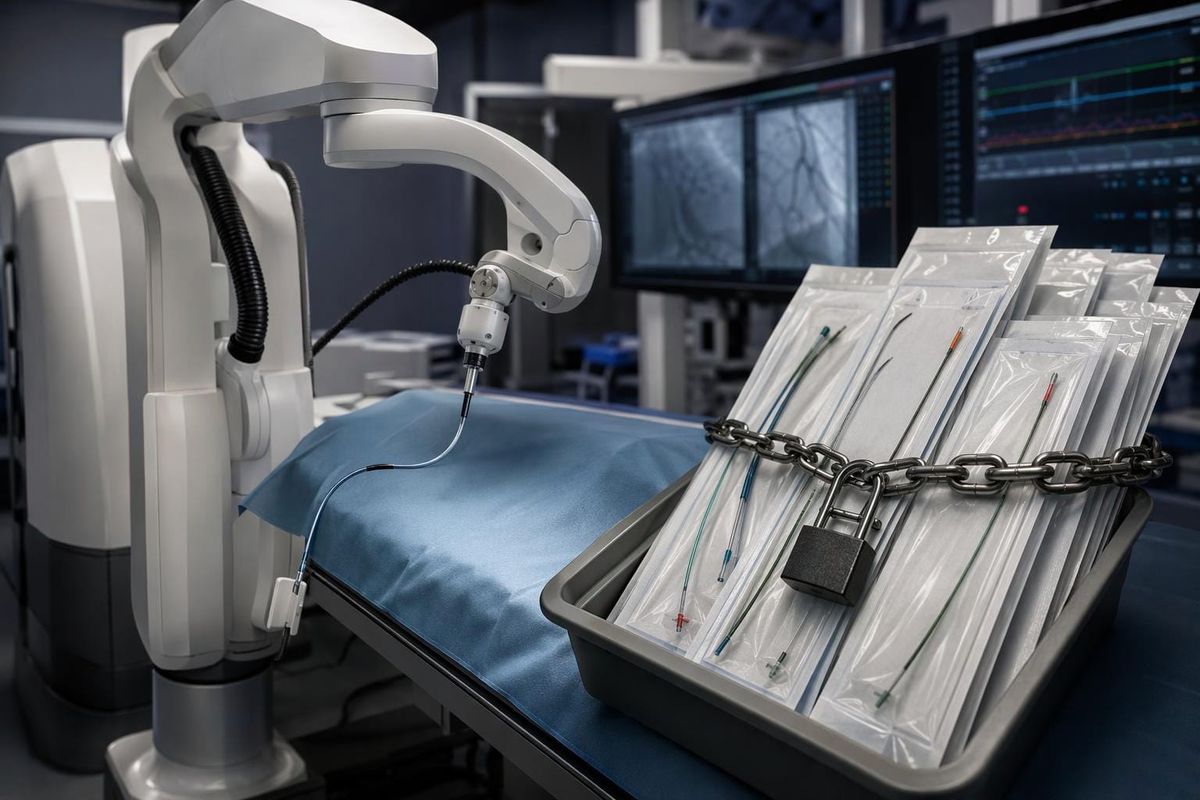
Stereotaxis, which sells surgical robots and disposable catheters, grew third-quarter sales 20% to $8.9 million, with new robot-system revenue helping offset catheter shortages that limited procedures. Its Tuesday SEC filing also detailed $12 million in financing that closed Monday, replenishing a quarter-end cash balance of $4.0 million.
New Systems, Unfilled Catheter Orders
Sales were $7.5 million a year earlier and $7.7 million in the second quarter; the latest result was up 16% from that second-quarter level. System revenue rose 60% to $3.0 million from $1.9 million, according to the company's earnings release.
Stereotaxis attributed the system increase to recognizing part of the revenue from its first U.S. GenesisX shipment and first Genesis shipment in China, plus a full quarter of Synchrony operating-room system sales. Disposables, service and accessories brought in $5.9 million, up 6% year over year but down 4% from the second quarter.
The company said catheter supply shortages constrained procedures and left approximately $1.9 million of disposable orders unfilled entering the fourth quarter. Gross margin—the share of sales left after direct costs—was 45%, with recurring products and services at 59% and systems at 15%. Stereotaxis attributed margin pressure to spreading fixed overhead over low production volumes.
For the first nine months, sales were $22.9 million, below $23.7 million a year earlier.
Robocath Adds Costs And Capabilities
Stereotaxis completed its Robocath purchase during the quarter and announced a collaboration with Canon. On November 1, it presented initial human results from coronary procedures using Robocath's next-generation robotic system at TCT.
The company attributed its wider adjusted net loss—$5.2 million versus $2.4 million a year earlier—mainly to Robocath transaction and operating costs. Reported net loss was $6.5 million in both periods. Adjusted operating expenses rose to $9.1 million from $6.6 million; total operating expenses were $10.4 million, including $1.3 million in non-cash charges.
Cash outflow totaled $6.5 million: $3.9 million involved Robocath acquisition payments and $2.6 million the core Stereotaxis business.
Chairman and CEO David Fischel described a strategy of moving beyond systems with lengthy sales and construction cycles while building disposable products that "enhance the value of our robots and provide a robust recurring revenue opportunity."
Cash Today, Potential Shares Later
The financing provided $12 million in gross proceeds, with another $12 million available at the company's option subject to conditions and regulatory milestones. Investors included entities affiliated with board members.
The initial debt can convert into common shares at $1.21 each, a 30% premium to the stock's preceding 10-day volume-weighted average price. The notes charge 10% annual interest and mature in three years; interest generally accumulates into principal until maturity. Conversion would increase the share count.
The company's financing announcement put pro forma cash at $16 million and total availability, including the conditional draw, at $28 million. Stereotaxis intends to fund working capital, product commercialization and research and development.
Management expects adjusted quarterly operating expenses, excluding non-cash and one-time items, of about $8 million. It sees revenue growth and stable expenses providing a route to positive cash flow within the next year.
Stereotaxis identified initial commercial GenesisX installations and resolving MAGiC catheter supply constraints as the near-term milestones behind its expectations for growth.
Sources
- 8-K Filing — Stereotaxis, Inc. (STXS) — SEC EDGAR
- Exhibit ex99-1.htm — Stereotaxis, Inc. 8-K exhibit — SEC EDGAR
- Exhibit ex99-2.htm — Stereotaxis, Inc. 8-K exhibit — SEC EDGAR
- Top Robotics Stocks With Strong Potential for Long-Term Growth — Yahoo Finance
- Stereotaxis Reports 2026 Third Quarter Financial Results & — globenewswire.com
- Stereotaxis Announces Convertible Note Financing of Up To — globenewswire.com