Starbucks’ Store Write-Down Risks Take Audit Focus As Lease Restructuring Costs Rise To $309 Million
Overall restructuring charges fell, but lease costs rose and Starbucks still owed $336.2 million under its restructuring plans.


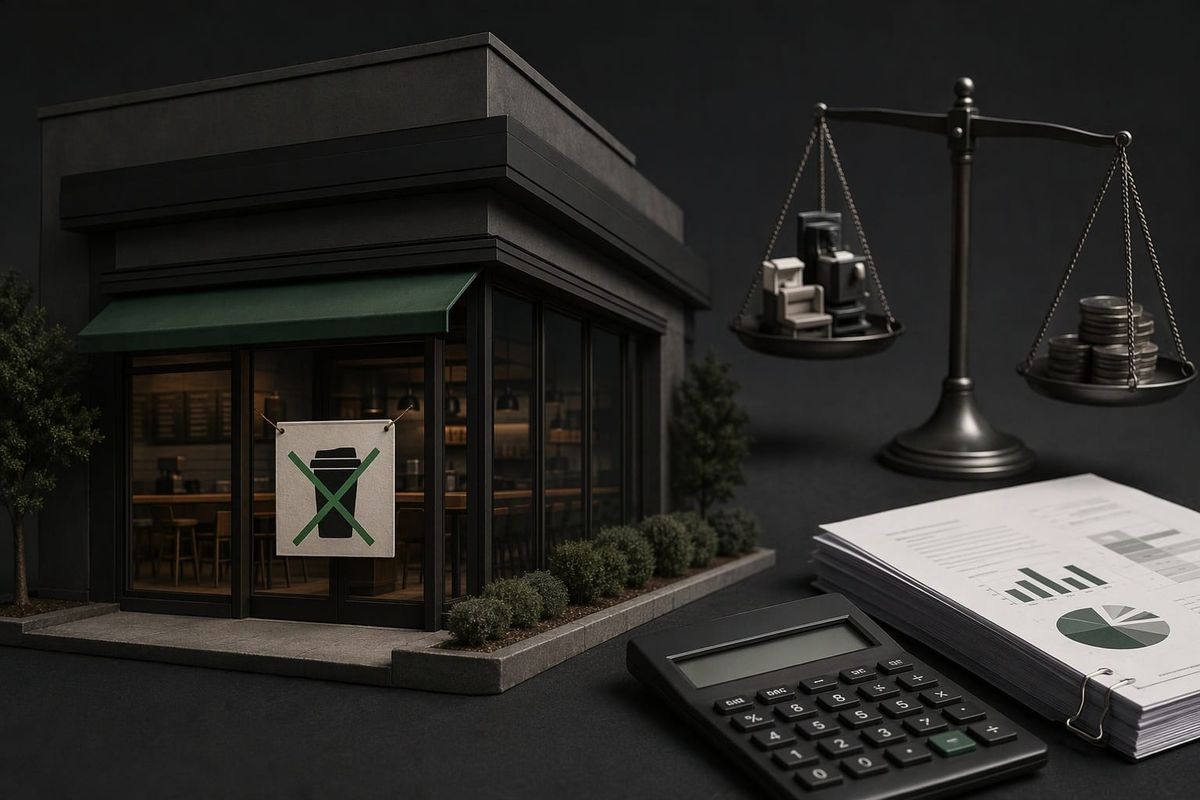
Starbucks’ individual coffeehouse write-down risks became its auditor’s central judgment call in Thursday’s annual report, while lease restructuring costs rose to $309 million from $239.3 million in fiscal 2025. The coffee chain’s closures leave a financial bill extending into fiscal 2027, even as management describes its turnaround as a growth plan.
The Store-Level Judgment
Deloitte identified the circumstances that trigger coffeehouse asset write-downs as its critical audit matter—a judgment demanding especially difficult audit work. The auditor also gave Starbucks’ financial statements an unqualified opinion, meaning it accepted their presentation under standard accounting rules.
The focus differs from the China goodwill assessment in the fiscal 2025 audit. Goodwill represents value recorded in a business purchase beyond its identifiable net assets; the current issue concerns when assets at individual coffeehouses need to be reduced on the books.
Starbucks tests each company-operated coffeehouse as an asset group, combining its equipment and improvements with the asset representing its right to occupy leased space. When expected future cash flows fall below that group’s recorded value, Starbucks assesses whether its estimated fair value requires a write-down.
The calculation depends on projections for revenue and operating expenses, local market conditions and the discount rate used to value future cash flows. Those estimates connect the accounting directly to whether a location can earn enough to support the value Starbucks has recorded.
Lease Costs Buck The Decline
Total restructuring and impairment charges fell to $688.6 million in fiscal 2026 from $892.0 million a year earlier. Starbucks attributed the decline to lower costs from support-organization changes and closures, partly offset by higher impairment costs at Starbucks Reserve and Roastery locations.
Lease costs moved in the opposite direction. The $309 million included $113.0 million in write-downs of lease assets, primarily at Reserve and Roastery locations, and $196.0 million largely tied to accelerated lease-asset expense and other costs of leaving coffeehouses and offices before their contracts ended.
Starbucks separately recorded $259.5 million in restructuring-related asset disposal and impairment charges excluding lease-asset write-downs, compared with $352.8 million in fiscal 2025. That distinction matters: reducing the recorded value of an asset and settling a lease obligation are different parts of the closure bill.
At fiscal year-end, Starbucks had $336.2 million in outstanding restructuring liabilities. Lease exits and related costs accounted for $279.1 million of that balance.
Growth Includes More Closures
Starbucks’ October 29 earnings release reported 250 North American closures under its fourth-quarter restructuring plan. The company has closed, or plans to close, locations that fail its expectations for the customer experience and financial performance.
Brian Niccol, Starbucks’ chairman and chief executive officer, said in that release: “Back to Starbucks started as our turnaround plan. Now, it's our growth plan.”
The business combines coffee roasting and sales through its own coffeehouses with licensing, product sales and royalties from other operators. Its Nestlé alliance extends packaged coffee and tea into grocery and foodservice channels. Owning a coffeehouse puts its operating assets and lease commitments directly on Starbucks’ books.
China now follows a different model. Boyu Capital, the investment firm that bought control of Starbucks’ China retail business, took a 60% interest in a transaction completed in the third quarter and already described in Starbucks’ quarterly report. Starbucks retained 40% and continues licensing its brand and intellectual property.
The transaction converted 7,991 company-operated coffeehouses into licensed locations. Starbucks now records its share of the venture’s income alongside product sales and royalties, rather than consolidating that business’s full revenues and expenses.
The Fiscal 2027 Closure Bill
Starbucks expects to complete both restructuring plans and the remaining coffeehouse closures in the first half of fiscal 2027. It expects approximately $74 million in lease-related charges and $70 million in asset disposal and impairment charges during that fiscal year.
The company also expects fewer North American company-operated openings in fiscal 2027 while it rebuilds its development capabilities and invests in existing locations. Management expects international operations, supported by licensing, to lead global coffeehouse growth.
Starbucks expects revenue growth to moderate in fiscal 2027, primarily because of the China divestiture comparison and recent North American closures. It cautioned that restructuring and shifts between operating models can affect both one-time charges and recurring revenue, expenses and margins, complicating comparisons across periods.
For holders, the remaining $279.1 million in lease-related restructuring obligations is the concrete cost still attached to the closure program.
Sources
- 10-K Filing — Starbucks (SBUX) — SEC EDGAR
- 10-K Filing — Starbucks (SBUX), FY2025 filed 2025-11-14 — SEC EDGAR
- 10-Q Filing — Starbucks (SBUX), filed 2026-01-28 (earlier disclosure) — SEC EDGAR
- 10-Q Filing — Starbucks (SBUX), filed 2026-04-28 (earlier disclosure) — SEC EDGAR
- 10-Q Filing — Starbucks (SBUX), filed 2026-07-29 (earlier disclosure) — SEC EDGAR
- Earnings release (8-K Item 2.02, sbux-09272026xearningsrele.htm) — Starbucks, filed 2026-10-29 — SEC EDGAR
- Starbucks baristas start receiving bonus payments — nrn.com
- Off the Charts: Investing opportunities in restaurant stocks — CNBC
- Stocks extend recovery from Thursday's sell-off. Plus, new trial data from Lilly, J&J — CNBC
- Starbucks plans to hire 7,500 staff in major UK expansion plan | Starbucks | The Guardian — The Guardian