Spire Global Cuts Operating Cash Use 59% As Weather And Space Services Sales Expand
Revenue rose 42%, while the satellite-data company offered a preliminary 2027 sales forecast of $96 million to $106 million.


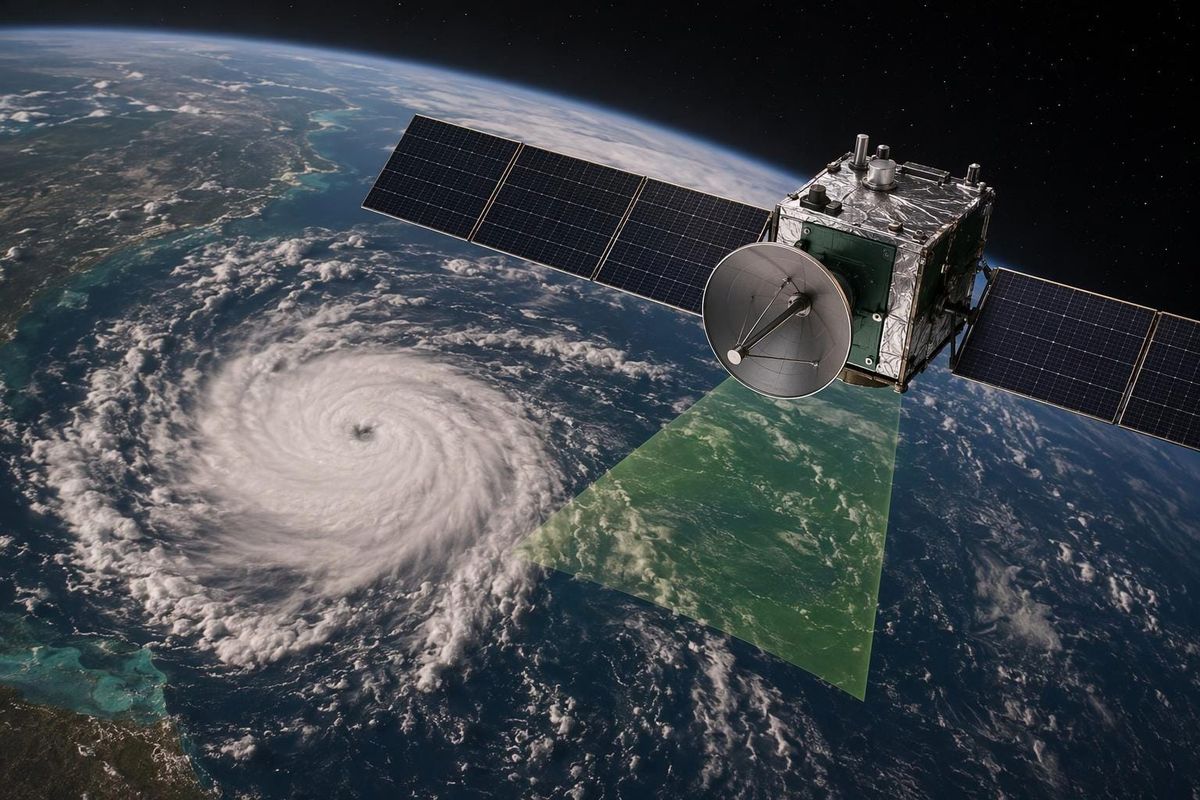
Spire Global, which sells satellite data for weather forecasting, aircraft tracking and defense operations, reduced third-quarter operating cash use by 59% to $5.0 million. Its earnings release Tuesday put revenue at $18.0 million, up 42% from a year earlier, with the company crediting more Space Services deliveries and weather-data sales.
Less Cash Used, Still Losing Money
Operations used $12.0 million a year earlier and $23.4 million in the second quarter; the latest quarter's cash use was 79% below that second-quarter figure. Spire attributed the improvement to its management of cash and working capital and expects another improvement in the fourth quarter.
Capital spending adds another claim on cash. Spire spent $8.9 million on property and equipment during the quarter, leaving negative free cash flow of $13.9 million, compared with negative $20.4 million a year earlier. It ended September with $78.0 million in cash, cash equivalents and marketable securities, and no debt.
Spire kept 46% of sales after direct costs, a nine-percentage-point improvement. Adjusted gross margin reached 49%, up eight percentage points. Adjusted EBITDA—a measure excluding interest, taxes, depreciation and selected other costs—improved 27% to negative $8.6 million from negative $11.8 million, which Spire attributed mainly to higher sales.
The net loss nevertheless widened to $20.3 million from $19.7 million. Operating expenses reached $28.5 million, compared with $25.7 million a year earlier.
Weather Orders Support The Sales Pipeline
The revenue comparison excluding maritime was stronger: sales rose 77%. Spire identified weather observations from its hyperspectral microwave sensors as the main source of additional weather-data sales.
Spire builds and operates small satellites and ground stations. Alongside data subscriptions and analytics, its Space Services business lets customers use its satellite infrastructure to deploy and operate their own sensors.
The National Oceanic and Atmospheric Administration awarded Spire a $33.2 million weather-data task order during the third quarter. A separate two-year, $28 million NOAA contract covers work to make satellite-based microwave weather sensing ready for operational use. That work includes preparing a satellite and sensor payload for flight, with operational capability targeted no later than 2030.
Spire also signed two U.S. and three international awards for radio-frequency geolocation, including business from repeat customers. At September 30, it had $175.4 million in contracted obligations awaiting recognition as revenue.
“These multi-year awards give us greater revenue visibility into 2027 and beyond,” Spire CEO Theresa Condor said in the earnings release.
A Preliminary View Of 2027
Spire expects 2026 revenue of $75 million to $80 million and adjusted EBITDA of negative $32.4 million to negative $27.4 million. It said the midpoint implies a 71% improvement in fourth-quarter adjusted EBITDA from the third quarter. Its preliminary 2027 revenue forecast is $96 million to $106 million.
Starting with these results, Spire is focusing its outlook on revenue and adjusted EBITDA, ending guidance for adjusted operating loss and adjusted net loss per share.
In October, Spire launched the first three satellites produced at its Boulder, Colorado, facility. The company described its U.S. manufacturing expansion as a way to serve growing national-security demand and build mission-specific capabilities for domestic defense partners.
The NOAA weather-data task order starts December 1, 2026, and runs to December 1, 2028. Unfunded purchase options could take its potential value to approximately $66 million if fully exercised.