Senseonics CFO Promises $100 Million In Revenue Next Year As Europe Takes Longer
Management raised its 2026 sales outlook for the third time, while an analyst pressed executives on Europe's slower transition.


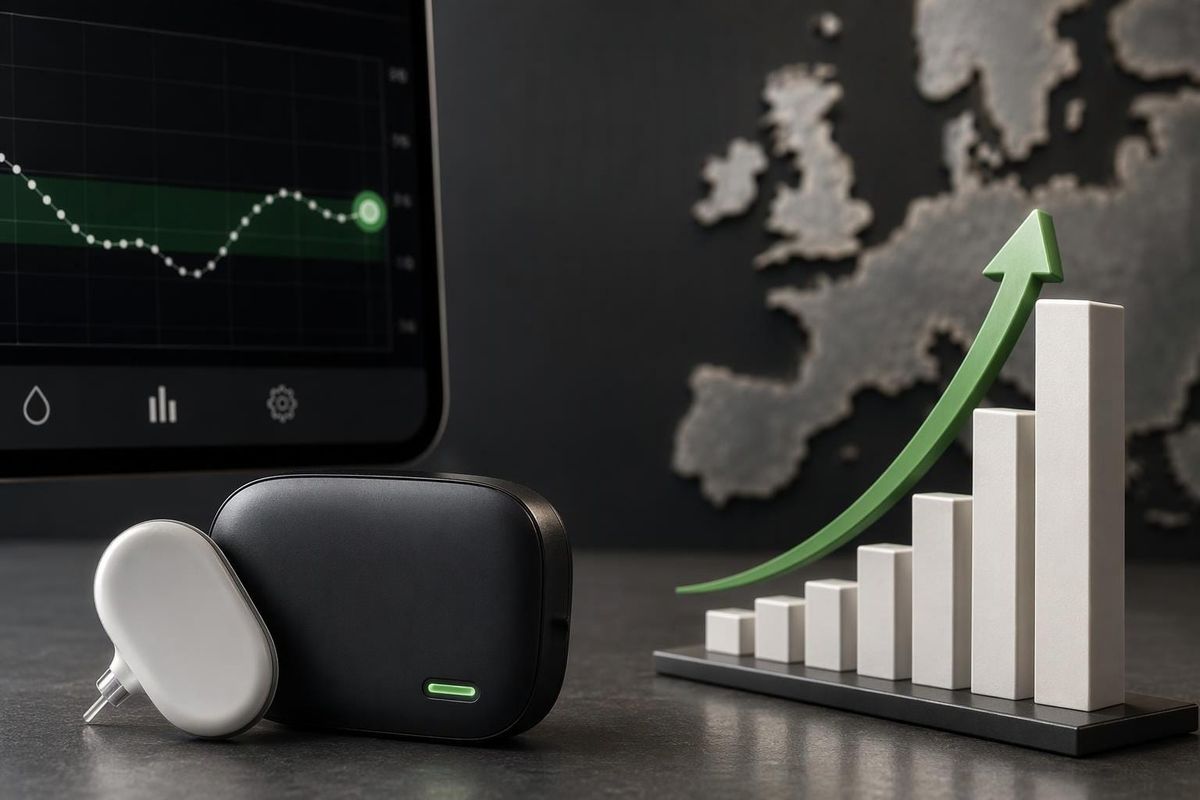
Senseonics, which develops and sells implantable glucose monitors for people with diabetes, expects to become a $100 million revenue business next year, Chief Financial Officer Rick Sullivan said on the company's earnings call Monday. The commitment came before formal 2027 guidance and alongside another increase in this year's sales forecast, despite a slower-than-expected European transition.
A Higher Forecast, A European Question
“we'll certainly be a $100 million company next year,” Sullivan said in response to a Stifel analyst asking about revenue expectations just below that level. He said the company would provide formal guidance at the beginning of 2027.
Senseonics raised its 2026 revenue outlook to $68 million–$70 million from $62 million–$66 million. President and Chief Executive Officer Tim Goodnow called it the third increase this year.
Third-quarter revenue was $19.6 million, approximately 140% above the $8.1 million reported a year earlier. U.S. sales reached $16.8 million, up approximately 160% from $6.4 million; international revenue was $2.8 million, up approximately 65% from $1.7 million. Revenue for the first nine months rose approximately 118% to $45.8 million from $21 million.
Management now expects Europe to supply approximately 15% of annual revenue rather than 20%, attributing the shift to faster U.S. growth. The Stifel analyst challenged that explanation, arguing the revised outlook also implied lower international sales in dollars.
Chief Commercial Officer Brian Hansen acknowledged the timing problem: “It just took a little longer than we expected,” he said. Bringing the European commercial teams in-house delayed the year-long sensor's launch. Dedicated teams now lead launches in Germany, Italy, Spain and Sweden.
Switchers, Inserters And Pump Choices
Eversense combines a sensor beneath the skin with a removable, rechargeable transmitter and an app for glucose readings and alerts. Eversense 365 lasts up to twelve months; Eversense E3 lasts up to six months. Senseonics earns revenue from sensors, transmitters and, in some cases, insertion and removal procedures.
Approximately nine out of ten new insertions involve patients switching from competing sensors, Hansen said. Annual reorders are ahead of management's expectations. Goodnow separately said about 94% of users finish a sensor's full term; approximately 75% move from their first sensor to a second, and about 85% from their second to a third.
Direct-to-consumer advertising remains the largest source of new patient starts, while active prescribers increased more than 90% from a year earlier. Eon Care surpassed its year-end goal of 100 insertion providers during the quarter and now targets approximately 120 by year-end. The network performed more than 40% of U.S. Eversense insertions, allowing doctors to prescribe without doing the procedure themselves.
Hansen said limited pump compatibility had caused patients to discontinue the sensors. Senseonics already works with Sequel's Twist pump and announced its Beta Bionics partnership in September. Management expects that integration to launch this quarter, with first patients possible before year-end, and expects broader pump choice to support 2027 growth.
Higher Margins, Continued Cash Spending
Gross profit reached $12.1 million versus $3.5 million a year earlier, with gross margin approximately 62% versus 43%. Bundled payments, which carry higher selling prices than distributor sales, represented approximately 65% of volume rather than the usual roughly 60%. Management expects full-year gross margin above 60%.
The net loss widened to $32.7 million, or $0.50 per share, from $19.5 million, or $0.43 per share. Research spending rose to $11.7 million from $7.8 million; selling and administrative expenses reached $32.3 million versus $15.3 million.
Management expects annual operating expenses slightly above its previous $150 million–$160 million range and cash use of approximately $120 million. At September 30, cash, restricted cash and short-term investments totaled $126.6 million; Hercules Capital borrowings had $55 million in principal outstanding and a carrying value of approximately $56.2 million.
Senseonics began human testing of Freedom on October 26. The planned monitor would eliminate the external transmitter, using an integrated battery and Bluetooth instead. Management expects a pivotal study in 2027, targets a potential launch in 2028 and expects cash-flow breakeven shortly after launch under its current plan.
Formal guidance at the beginning of 2027 will put a detailed forecast alongside Sullivan's $100 million commitment.
Sources
- Senseonics: Q3 Earnings Snapshot – WTOP News — wtop.com
- Senseonics GAAP EPS of -$0.50 beats by $0.02, revenue of $19.6M beats by $3.4M (SENS:NASDAQ) | Seeking Alpha — seekingalpha.com
- Senseonics: Q3 Earnings Snapshot | wusa9.com — Associated Press
- Senseonics Holdings, Inc. (SENS) latest stock news and headlines – Yahoo Finance — Yahoo Finance
- Senseonics Holdings, Inc. Reports Third Quarter 2026 — globenewswire.com