Schrodinger's AI Co-Scientist Bunsen Now Handles About 80% Of Its Internal Heavy Calculations
The software maker also raised 2026 guidance, with drug discovery revenue now seen at $75 million to $85 million.


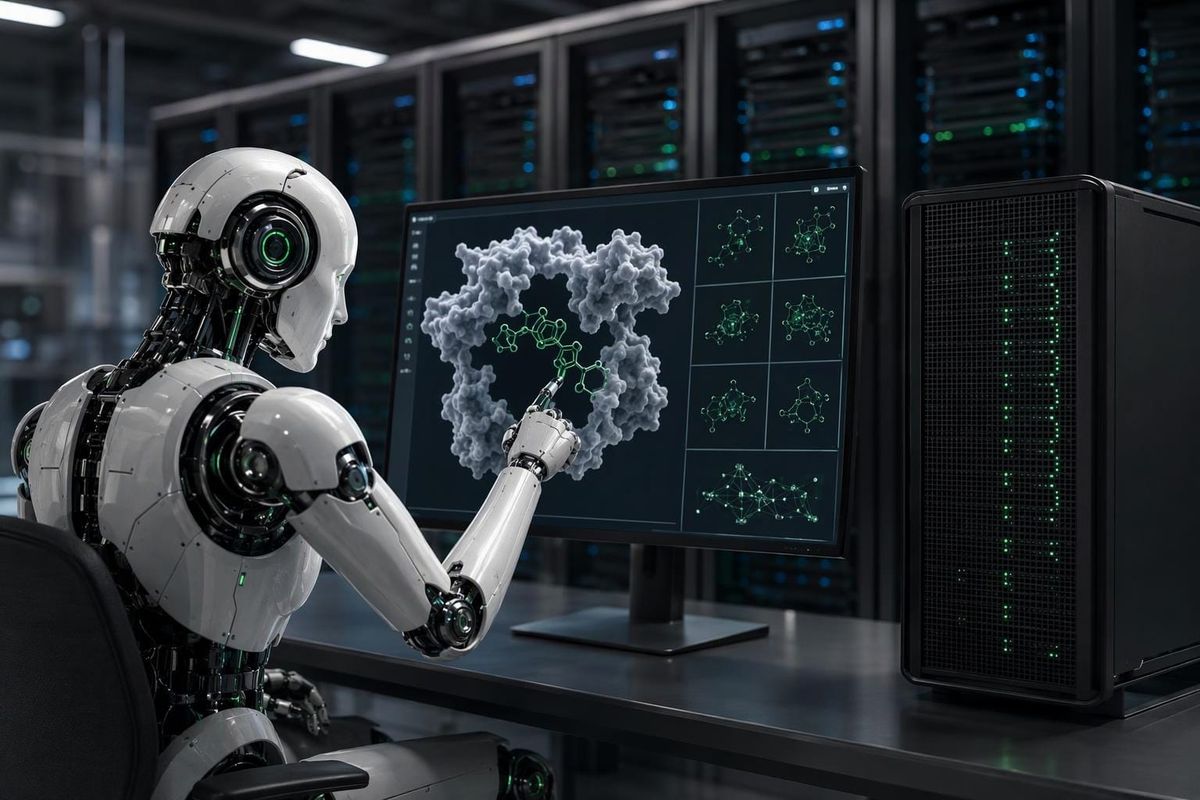
Schrodinger, which makes physics-based modeling software for drug and materials discovery, said its agentic AI co-scientist Bunsen now handles approximately 80% of the high-throughput calculations on its internal compute cluster, CEO Ramy Farid said on Wednesday's third-quarter earnings call. Pressed by an analyst, management would not share how customers are using tokens or whether they will pay more.
Bunsen moves in-house first
Farid said Bunsen has "rapidly become the primary interface for discovery workflows" inside Schrodinger. Customer feedback from the Early Access program has been "enthusiastically positive," he said, with multiple customers evaluating it.
Asked by an analyst from BMO Capital Markets about token consumption and willingness to pay, CTO and COO Pat Lorton said engagement is going great but there was nothing the company was comfortable disclosing on higher token use or customers paying more. CFO Richie said Bunsen should give customers more throughput, and since pricing is throughput-based, that should mean more use of the platform and licenses.
An analyst from KeyBank Capital Markets asked about user counts. Farid said exact numbers can't be disclosed, that Bunsen is still in early access with an open beta expected this year, and that there is "maybe more enthusiasm than we've seen for a really long time" for a new technology.
Guidance raised on a milestone
Third-quarter total revenue was $64.5 million, up 19%, Richie said. Annual contract value (ACV) was $44.7 million, up 17%, or 24% excluding contribution ACV. Software revenue was $38.2 million, of which hosted revenue was $17.2 million, up 49%.
The company now expects full-year ACV of $222 million to $232 million, or 12% to 17% growth over 2025. It lifted drug discovery revenue guidance to $75 million to $85 million from $65 million to $75 million, citing a milestone payment from Structure Therapeutics. Operating expenses are still expected to be below 2025's.
The quarter's net loss was $38 million, against $33 million a year earlier. The company ended with $373 million in cash and marketable securities.
The hosted-license drag
Hosted licenses, recognized over the life of a contract, were 45% of software revenue, up from 32% a year earlier. Richie said each 1% increase in hosted revenue cuts reported revenue by roughly $2 million to $3 million, depending on contract length and renewal timing. Software gross margin was 75%, from 77%.
That is why a product that lifts usage matters to the software story. Schrodinger also earns drug discovery revenue from collaborations and runs its own programs; in September it co-founded Tektora with NEA and RA Capital, funded with $55 million.
Bunsen's open beta is expected this year, Farid said, and Schrodinger is to present data on its MALT1 inhibitor at the American Society of Hematology meeting in December.
Sources
- Schrodinger Q3 2026 Earnings Call Transcript — benzinga.com
- Schrödinger GAAP EPS of -$0.50 beats by $0.17, revenue of $64.49M beats by $16.86M (SDGR:NASDAQ) | Seeking Alpha — seekingalpha.com
- SOPHiA GENETICS SA (SOPH) Reports Q3 Loss, Beats Revenue Estimates — Yahoo Finance
- Schrödinger Reports Third Quarter 2026 Financial Results — businesswire.com