SanDisk Splits Stock 8-For-1 As CEO Calls NAND-For-DRAM Talks 'Something To Keep An Eye On'
SanDisk's board approved an 8-for-1 split, and its CEO said customers are weighing NAND in place of DRAM in parts of AI systems.


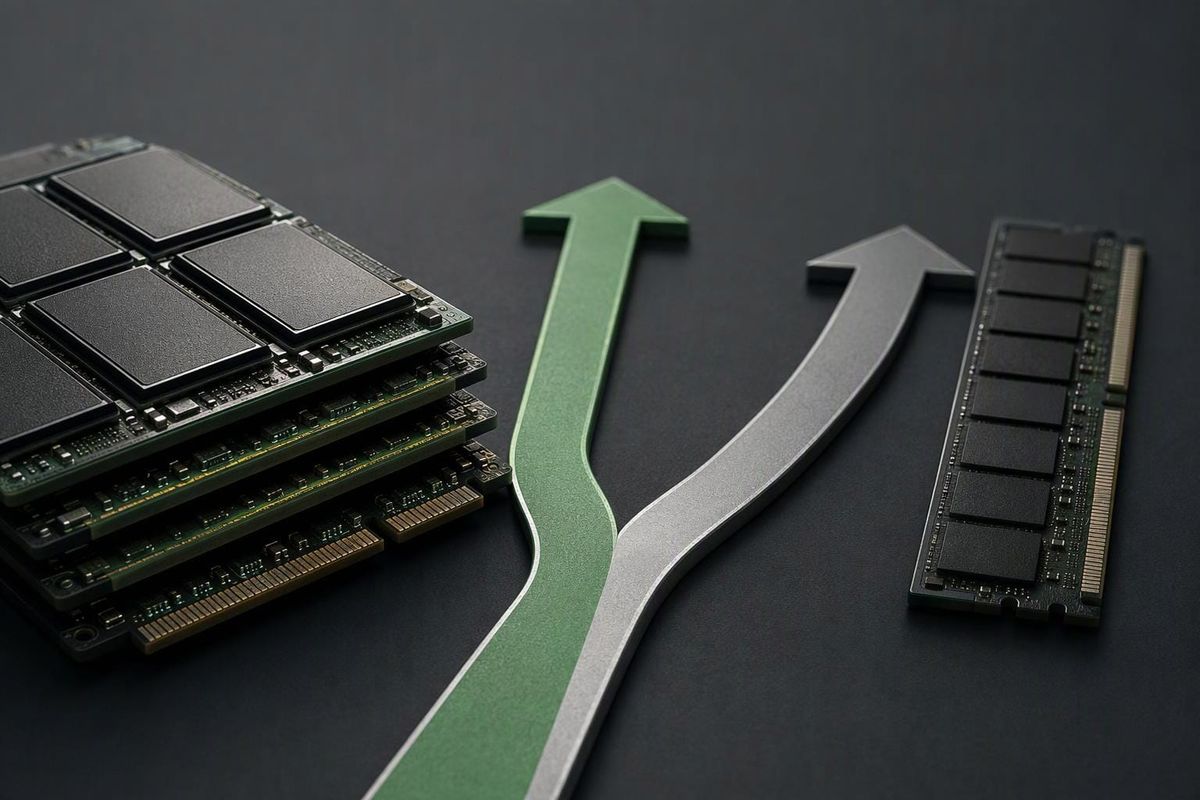
SanDisk, which makes flash memory storage, said its board approved an 8-for-1 stock split, announced by CFO Luis Visoso on the company's fiscal first-quarter 2027 earnings call on Thursday. On the same call, CEO David Goeckeler said customers are discussing running NAND flash in a high-endurance mode where DRAM sits today, and called it "definitely something to keep an eye on."
Split dates and second-quarter guide
Visoso said the additional shares are expected to be distributed on November 19, with trading on a split-adjusted basis expected to begin on November 20.
For the second quarter of fiscal 2027, SanDisk expects revenue of $12.2 billion to $12.6 billion and adjusted gross margin of 84.5% to 85.5%. Adjusted earnings per share are guided at $55 to $57 before the split, assuming 151 million diluted shares, or $6.88 to $7.13 after it, assuming about 1,208 million shares.
The quarter behind the split
First-quarter revenue was $11 billion, which Visoso said was up 23% from the prior quarter and 378% from a year earlier, above the company's guidance of $10.3 billion to $10.8 billion. About 60% of the increase came from volume and 40% from higher prices. Adjusted earnings per share were $49.51, against $39.25 in the prior quarter.
Datacenter revenue was $4.8 billion, up 61% sequentially. Edge was $5.8 billion, up 7%, and consumer was $397 million, down 29%. SanDisk generated $5.7 billion of adjusted free cash flow, spent $5 billion repurchasing about 3.2 million shares, and ended the quarter with $5.1 billion in cash and no debt. Its market value was $203.0 billion at Thursday's close.
SLC mode as a DRAM substitute
Answering a question on endurance, Goeckeler said SanDisk is seeing single-level-cell (SLC) designs pulled into AI architectures. He said it is "not really in sales yet" and is more of an architectural conversation than a performance one.
Pressed by an analyst from Mizuho on how it plays out next year, he said it is "a little early to have a very strong view." He noted a trade ratio of three to one or four to one against TLC or QLC flash, so "it will impact the overall supply in the market," depending on how much is deployed. The analyst, not Goeckeler, raised the idea that it could tighten the market.
Another analyst asked whether it cannibalizes other NAND products. Goeckeler said he does not see that, calling it an expansion of the addressable market. He said the question is whether NAND in SLC mode is good enough to replace DRAM in places, given a cost differential of "huge, 20 to 40x."
Asked about adding capacity, he said SanDisk's cells can run in SLC, MLC or TLC mode, so it can "supply the market with the wafers we have." He said it is "super early" for the supply question.
Demand per CPU and the NBM pipeline
Goeckeler said SanDisk sees 60 to 90 gigabytes of NAND demand per CPU in inference and agent-orchestration uses. Visoso said about 50% of bits are under long-term customer agreements called NBMs for fiscal 2027 and about two-thirds for fiscal 2028, and he expects that to rise a little. SanDisk's NBM pipeline exceeds its supply through the end of the decade, he said.
Goeckeler said management will update investors on how the SLC discussions develop over the next couple of quarters.
Sources
- Sandisk Reports Fiscal First Quarter 2027 Financial Results – Company Announcement - FT.com — Financial Times
- Sandisk perks up as storage strength boosts Q1 results, guidance; unveils 8-1 stock split (SNDK:NASDAQ) | Seeking Alpha — seekingalpha.com
- SanDisk Posts Q1 Double Beat, Announces Stock Split — benzinga.com
- Citi Says the NAND Shortage Will Last Until 2028. Here’s Why Sandisk Stock Is Still So Cheap. — Yahoo Finance
- Sandisk sees revenue nearly quintuple — and its stock is heading higher — MarketWatch