Rivian CFO Claire McDonough Steps Down As Management Flags Rising R2 Component Costs
Derek Mulvey will be named interim CFO, and Rivian expects only a positive automotive gross profit exit rate, not a full quarter.


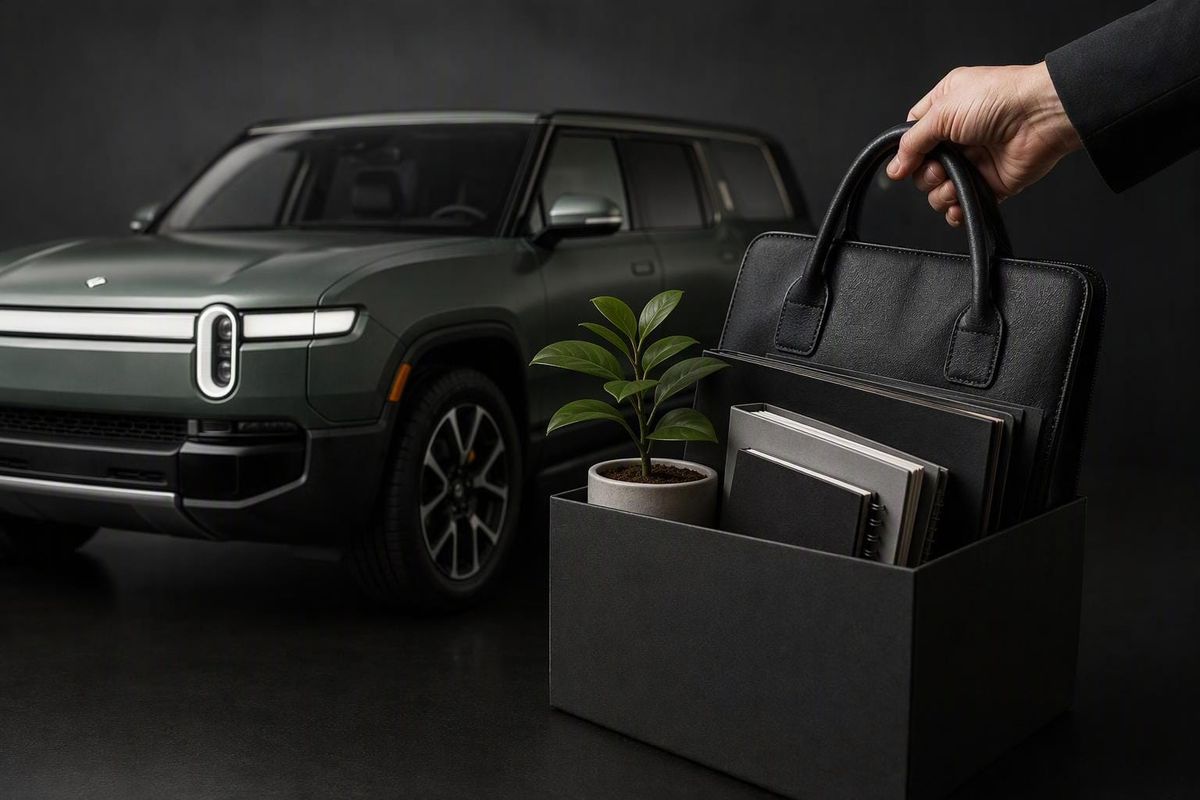
Rivian CFO Claire McDonough said on the company's third-quarter earnings call Thursday that she is stepping down, while management warned that rising commodity and memory costs are weighing on profit at its R2 SUV. Derek Mulvey, vice president of finance, will be named interim CFO effective tomorrow, investor relations head Chip McClure told the call.
A Departure And A Margin Caveat
McDonough, who has been at Rivian six years according to CEO RJ Scaringe, said she is leaving to move back to the East Coast, be closer to family and pursue a new opportunity. She said she is departing "with complete confidence in this company's trajectory."
Mulvey said Rivian intends to "exit the quarter at an automotive gross profit," adding: "I wouldn't expect the full quarter." Rivian, which designs and builds electric vehicles including the R1T, R1S and R2, expects R2 to deliver a positive automotive gross margin exit rate for the year.
Scaringe said commodity pricing is "a lot higher than what we expected," and called memory "a really important call out." He said the company is looking for offsets so it can still deliver the base R2 trim at $45,000 and the top trim at about $57,000, through packaging changes, part consolidation and supplier work.
Third-Quarter Numbers
Revenue was $2.155 billion, up 38% from a year earlier, McDonough said. Consolidated gross profit was $176 million, an 8% margin. Adjusted EBITDA losses were $435 million.
Automotive gross loss was $80 million, against a $130 million loss a year earlier. Rivian produced 19,751 vehicles and delivered 19,248. It recognized about $120 million of incremental cost of revenue from the R2 ramp compared with more normalized production, a figure Mulvey said includes expedited freight and under-absorbed plant costs.
The software and services segment brought in $605 million, up 45%, with $354 million of it from the Volkswagen joint venture. Its gross profit was $256 million, a 42% margin.
Scaringe said R2, launched in June, is already the best-selling vehicle by volume, outselling R1 and the commercial van.
Guidance, Cash And Capital Spending
Rivian raised the low end of its 2026 delivery guidance to 67,000 to 70,000 units from 65,000 to 70,000. Adjusted EBITDA losses are now expected between $1.75 billion and $1.85 billion, a $100 million improvement at the midpoint.
Capital spending guidance fell by $300 million at the midpoint to $1.4 billion to $1.5 billion. Mulvey called the cut "strictly from a timing perspective," tied to lumpy spending on the Georgia plant, and said a meaningful step-up is coming in 2027.
The company ended the quarter with about $5.5 billion in cash and short-term investments. Counting expected Uber, Volkswagen and Department of Energy capital, available liquidity and targeted funding would be about $13 billion, Mulvey said. A further $250 million from Uber is tied to a milestone expected by year-end.
Rivian holds its Autonomy and AI Day on December 9, the same month Mulvey's exit-rate target for automotive gross profit comes due.
Sources
- Rivian (RIVN) earnings Q3 2026 — CNBC
- Rivian reports upbeat Q3 results, boosts full-year guidance as R2 sales ramp up — Yahoo Finance
- The R2 SUV is already Rivian's best-selling vehicle | TechCrunch — TechCrunch
- Rivian’s R2 is officially its best-selling vehicle | The Verge — The Verge
- Rivian (RIVN) Q3 2026 earnings: revenue up 38%, R2 now its best-seller | Electrek — electrek.co