Rigetti CEO Sees Commercial Adoption Roughly Three Years Away And Puts Technology Before Sales
Research orders support today's revenue, but management wants proof its quantum computers can deliver value to data-center customers.


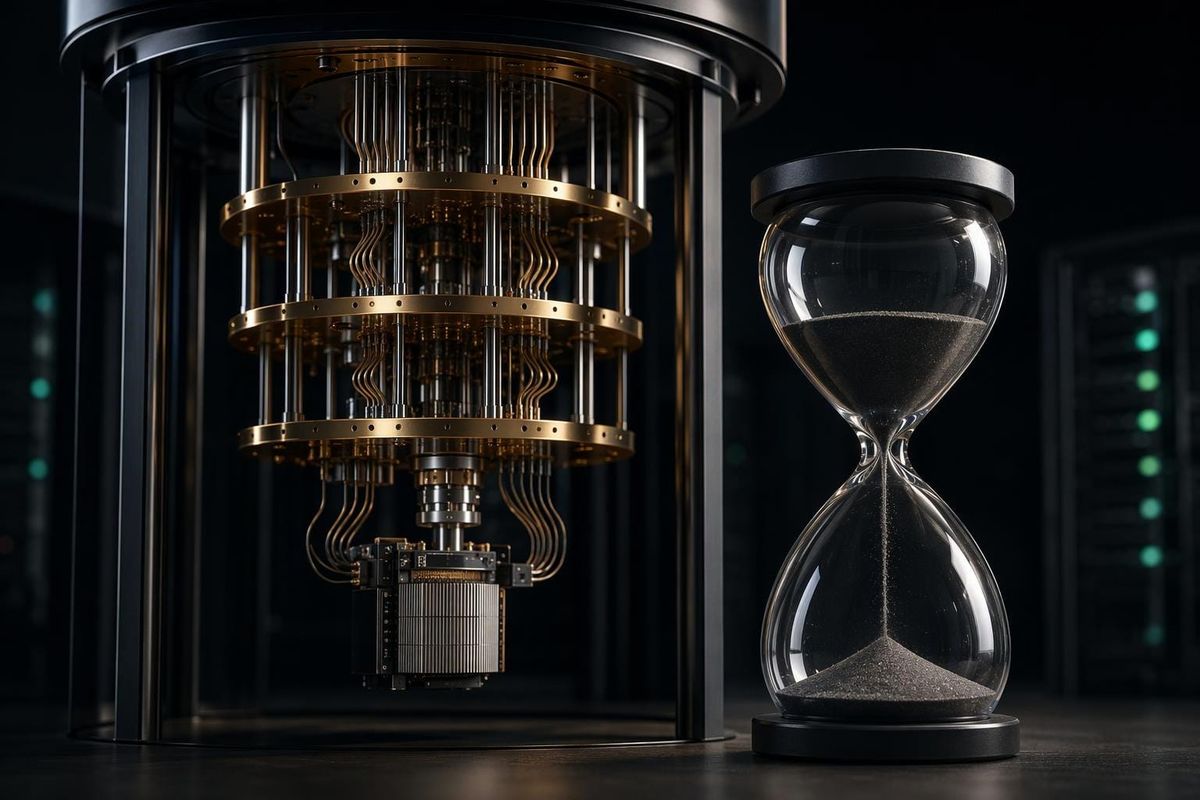
Rigetti Computing, which builds quantum computers and their processors, remains roughly three years from commercial adoption, President and Chief Executive Officer Subodh Kulkarni said on the company's earnings call Tuesday. Research sales are already growing: its accompanying results release put revenue for the first nine months at $10.9 million, approximately 110% above the same period of 2025.
Research Orders Versus Commercial Value
Kulkarni drew a distinction between researchers buying access to quantum machines and data-center managers investing because those machines deliver a return. He wants Rigetti judged primarily on technical progress until it can demonstrate quantum advantage — outperforming classical computers.
“We need to perfect the technology before we can really expect commercial sales to take off,” Kulkarni said. He described research-oriented sales as “not the right metric” during that development period, even as he said customer interest and cloud usage continue to grow.
A TD Cowen analyst asked for current and year-over-year order or backlog trends. Chief Financial Officer Jeff Bertelsen answered in terms of increasing interest from governments, laboratories and commercial researchers, and said he expects growth opportunities as systems become more capable.
Rigetti's existing business serves those research customers. Most revenue comes from technology-development contracts; it also sells processors, complete computers, engineering services and cloud access. Its customers include businesses, government organizations, universities and laboratories. Rigetti manufactures processors at its U.S. Fab-1 facility and offers access through its own platform, Amazon Braket and Microsoft Azure Quantum.
Kulkarni applied the same technology-first test to acquisitions. Responding to a Cantor Fitzgerald analyst, he rejected buying another company simply to add sales. A purchase would need strategic value or help Rigetti accelerate its development timetable.
A Recovery With Installation Risk
The improvement follows a smaller existing business: annual revenue fell to $7.1 million in 2025 from $12 million in 2023. Revenue for the first nine months of 2026 exceeded the full-year 2025 total, but third-quarter sales were $1.4 million, versus $1.9 million a year earlier.
Bertelsen attributed the quarterly decline to delivery timing, customer acceptance and government-development programs. Because a relatively small number of installations and contracts determine when sales can be recorded, he argued that year-to-date revenue offers a better measure at this stage.
India's C-DAC placed an $8.4 million order scheduled for fourth-quarter acceptance testing. Rigetti expects approximately $20 million in revenue for 2026, contingent on C-DAC accepting the system and the company recording the associated sales in the fourth quarter.
Third-quarter gross margin was approximately 61%, versus approximately 21% a year earlier. Bertelsen cautioned that contract mix, pricing, system configurations and hardware-revenue timing can move that measure substantially between quarters.
Spending rose as well. Operating expenses reached $34 million, from approximately $21 million a year earlier, including $25.5 million for research and development and $8.5 million for selling, general and administrative costs. Bertelsen attributed the increase to employee costs and additional development work. Stock-based pay was approximately $8 million, versus approximately $4.3 million.
The operating loss widened to $33.2 million from $20.5 million. The standard-accounting net loss was $3.1 million, or $0.08 per diluted share, versus $201 million, or $0.60; both periods included non-cash changes in warrant and earn-out liability values. Excluding those adjustments and stock-based pay, the loss was $20.5 million, or $0.06 per diluted share, versus $10.7 million, or $0.03.
300 Qubits Is An Intermediate Test
Rigetti's latest machine, Cepheus-1-108Q, achieved 99.5% median fidelity for two-qubit operations — a measure of their accuracy. Smaller portions of the machine achieved 99.6% across 80 qubits and 99.7% across 50. The full system combines 12 interconnected nine-qubit chips.
The company targets more than 300 qubits, approximately 99.7% median two-qubit fidelity and operation speeds below 60 nanoseconds by mid-2028. Kulkarni described that system as an intermediate demonstration of the scaling strategy, rather than enough to establish quantum advantage.
For roughly three years out, Rigetti aims for approximately 1,000 qubits, approximately 99.9% two-qubit fidelity and speeds below 50 nanoseconds, alongside error mitigation and correction. Management believes that combination could support a demonstration of quantum advantage; it is a development target, not a commercial result.
Kulkarni identified accuracy as the biggest challenge for the mid-2028 milestone. Rigetti is experimenting with larger, 36-qubit chips and plans to fit more qubits into a single refrigeration system rather than connect several refrigerators. He believes that approach can improve performance and reduce costs.
Wiring is another obstacle: a 1,000-qubit machine would require a few thousand coaxial cables. Rigetti is developing superconducting flexible cables with partners and internally, and exploring fiber optics for larger systems. Its work with Riverlane addresses real-time error correction, while cloud access lets researchers develop algorithms and applications before the hardware reaches management's performance goals.
Cash Funds The Technical Bet
Rigetti ended September with $497.1 million in cash, cash equivalents and investments, down from $541.3 million at June's end and $589.8 million at the end of 2025. It had no debt. Operating cash use was $49.1 million for the first nine months, versus $43.6 million a year earlier; capital spending was $42.6 million.
Bertelsen said spending on larger refrigeration capacity, fabrication equipment and supporting infrastructure explains the elevated capital investment. He expects 2027 capital spending to be relatively consistent with 2026 rather than return to earlier levels.
In September, Rigetti signed an agreement for up to $100 million from the U.S. Department of Commerce under the CHIPS Act. The department received approximately 7.7 million shares, a minority, non-controlling stake. Funding supports smaller readout electronics, expanded cooling capacity and fabrication for more highly connected chip designs.
Bertelsen said Rigetti had drawn none of that funding as of September. It can draw funds monthly as costs are incurred; the receipts flow through equity rather than sales, while project spending remains research expense or capital investment. The award therefore finances development without constituting customer revenue.
The near-term revenue test is C-DAC's fourth-quarter acceptance. The longer technical test is the mid-2028 system — a milestone Kulkarni still places short of quantum advantage.
Sources
- Rigetti Computing results release (Form 8-K, EX-99.1) — SEC EDGAR
- Rigetti Computing Reports Third Quarter 2026 Financial Results — Yahoo Finance
- Rigetti Q3 Earnings Preview: What To Expect From Upcoming Report — Yahoo Finance
- Rigetti Stock Jumped 17% on IonQ’s Guidance Raise. Here’s What Its November 10 Report Has to Show — Yahoo Finance
- Rigetti Computing Reports Third Quarter 2026 Financial — globenewswire.com