Recursion Says Oral FAP Drug Shrank Upper-Gut Polyps In 92% Of Patients
CEO Najat Khan put the market for REC-4881 at roughly $15 billion and said a pivotal study is targeted for the second half of 2027.


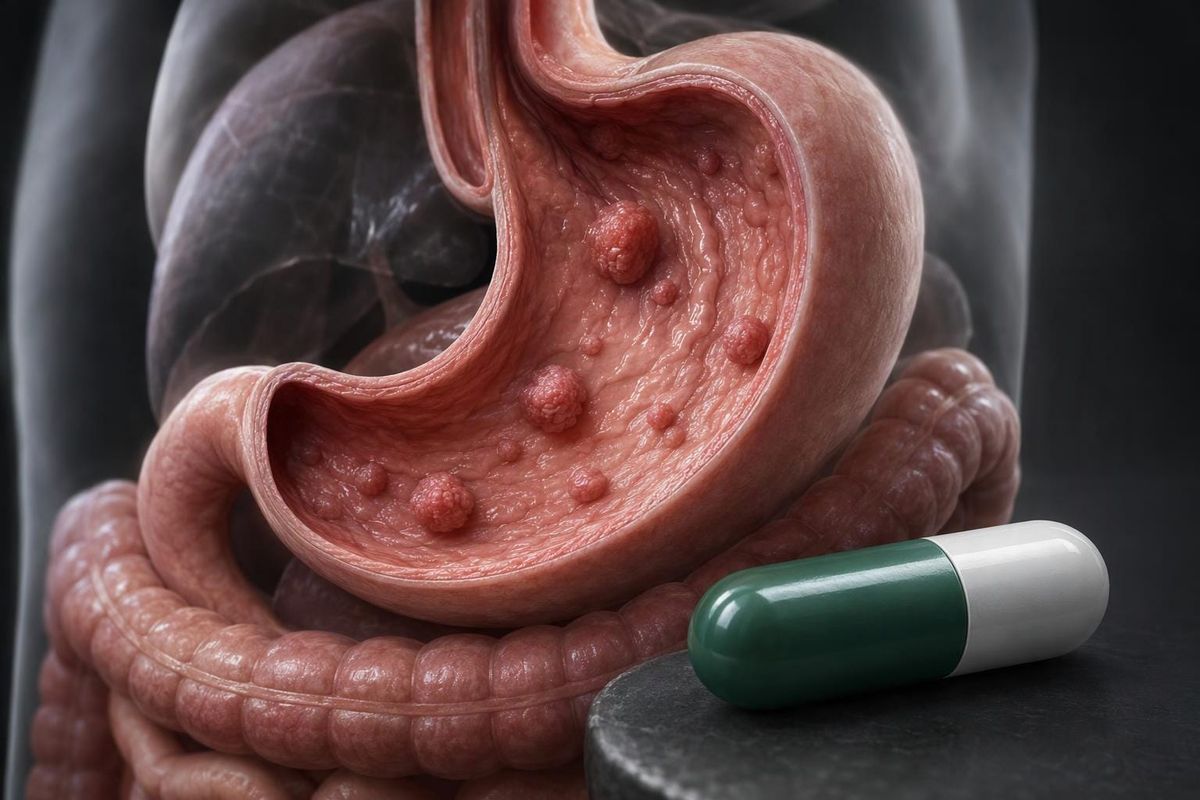
Recursion's experimental pill REC-4881 reduced polyp burden in the upper digestive tract of 92% of patients with familial adenomatous polyposis after 13 weeks, CEO Dr. Najat Khan said on the company's third-quarter earnings call, held live at a medical meeting in Denver. Recursion, a clinical-stage drug developer that uses AI and automated labs, says the hereditary disease has no approved drug treatment.
Deep cuts, and they lasted off drug
Khan said median reductions were about 55% in the upper GI tract and about 50% in the lower. Of eight patients with polyps larger than 5 millimeters at baseline, six had fewer by week 13 and four saw counts fall by at least 80%.
The effect persisted after dosing stopped. Eleven of 12 evaluable patients still had upper GI burden below baseline after 12 weeks off treatment, Khan said, adding that spontaneous regression was not seen in natural history.
On safety, Khan said 21 of 26 evaluable patients on the 4 mg daily dose had grade 1 or 2 treatment-related side effects, most commonly an acne-like rash. Four had grade 3 events, and four patients discontinued, with no additional discontinuations in this update.
A $15 billion market estimate
Khan said more than 50,000 patients across the US and EU5 have been diagnosed with FAP. Recursion's immediate focus is an estimated 37,000 who have had their colon removed, and she said those populations underpin a total addressable market of roughly $15 billion.
The drug is an oral MEK1/2 inhibitor Recursion licensed from Takeda after its platform flagged MEK inhibition as a way to reverse disease-linked cell changes.
Pivotal study timing
Asked by an analyst from Bank of America whether larger-polyp activity could change standard of care, Chief Medical Officer Dr. Vicki Seyfert-Margolis said REC-4881 could potentially be an adjunct to routine surveillance. A phase three trial, she said, must show benefit on cancer, high-grade dysplasia and the need for surgery.
Khan said talks with the FDA on the registrational study design continue, with a start targeted in the second half of 2027, depending on regulatory alignment. Preliminary expansion data for REC-1245, an oral cancer drug, in endometrial cancer are also expected in the second half of 2027.
CFO Ben Taylor said a $200 million follow-on offering extends cash runway into 2029, and 2027 cash operating expenses are expected under $360 million.
Khan said Recursion expects to update its FDA discussions on REC-4881 and generate more phase two data before any registrational study begins.
Sources
- Recursion Pharmaceuticals: Q3 Earnings Snapshot | wusa9.com — Associated Press
- Document — sec.gov
- Recursion Pharmaceuticals (RXRX) Stock May Be Fully Priced As REC 4881 Data Nears — Yahoo Finance
- Recursion Pharmaceuticals GAAP EPS of -$0.22 misses by $0.01, revenue of $18.55M beats by $3.74M (NASDAQ:RXRX) | Seeking Alpha — seekingalpha.com
- Recursion Pharmaceuticals (RXRX) Declines More Than Market: Some Information for Investors — Yahoo Finance