Palladyne AI's Army Tests Advance, But Its CEO Can't Forecast Material Software Sales
Ben Wolff favored FANUC's 2027 commercial prospects while government purchasing timelines remained uncertain.


Palladyne AI, which supplies autonomy software and components for defense and manufacturing, is getting paid to deploy its drone software in the field—but President and Chief Executive Officer Ben Wolff said on Tuesday's earnings call he cannot forecast when substantial government software sales will follow. The uncertainty sits alongside third-quarter revenue that rose 895% from a year earlier to $8.6 million, according to the company's results release.
Army Marks Aren't Purchase Commitments
Asked by a Lake Street analyst to rank the company's partnerships, Wolff separated the commercial opportunity from the government buying process. Drone partnerships require software integration and demonstrations, then a federal customer that wants both the software and the aircraft—and has funding for them.
"My crystal ball at this point is so broken, I can't predict when that's going to actually generate material revenues," Wolff said.
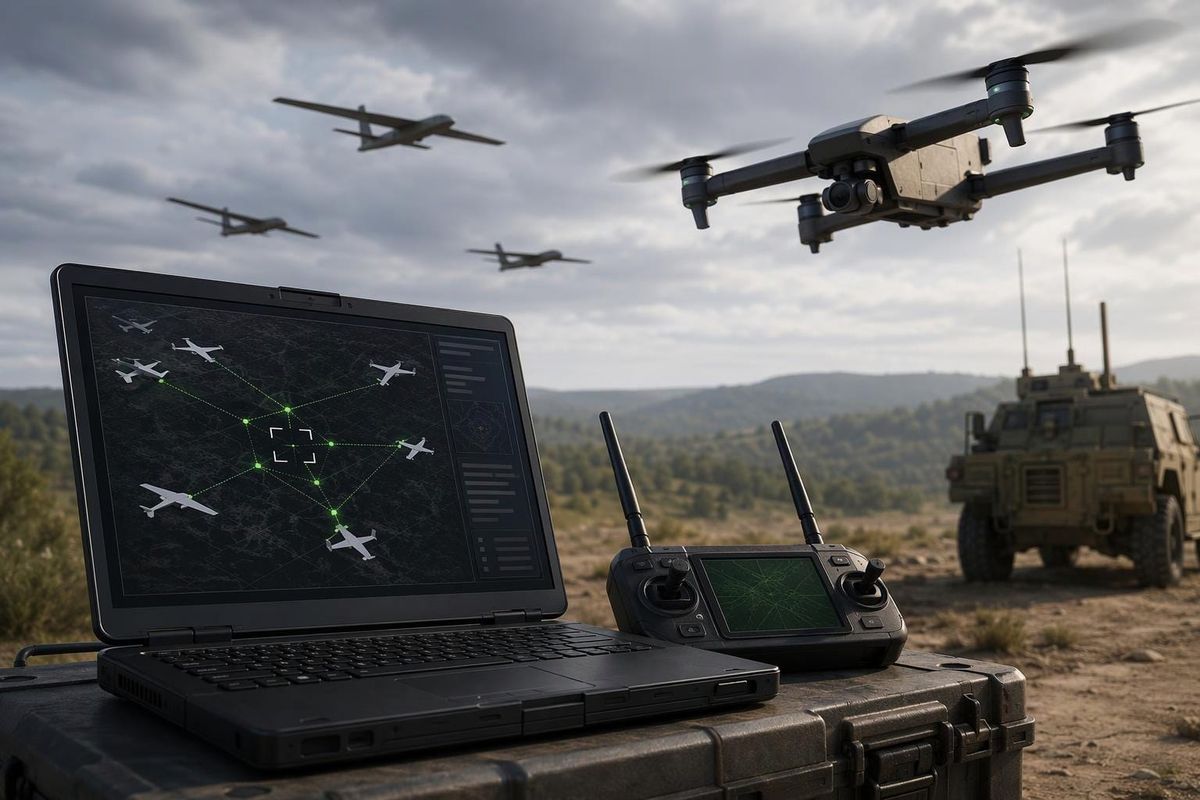
Palladyne reported that SwarmOS earned the Army's highest possible score on all nine criteria at Project Convergence Capstone 6. Integrated with Anduril's Lattice, the software coordinated drones from multiple manufacturers. The company also participated in Northern Strike 2026 at Camp Grayling, Michigan.
Wolff told a Northland Capital Markets analyst that defense funding a year earlier paid for laboratory development; customers now pay for field deployment. He described that as progress toward procurement, rather than completed large-scale purchases.
SwarmOS pricing targets 10% of the drone's cost, Wolff said. He said direct users had not objected to the structure, but added: "we don't have any large contracts buying it yet either."
The June agreement with Israel Aerospace Industries gives Palladyne exclusive U.S. rights to adapt, manufacture, integrate and market Harpy, Harop and Mini Harpy loitering munitions. Wolff said larger drone-platform purchases historically involve contracting cycles of two to four years.
FANUC Offers A Different Buying Path
Wolff favored FANUC's commercial prospects for 2027 because industrial customers can make decisions without waiting for a federal budget. The collaboration pairs FANUC robots with Palladyne's manufacturing software and brings the company into conversations with businesses ranging from small manufacturers to Fortune 500 companies.
The software recognizes parts and their orientation, then creates a robot's working path. Prospective applications include grinding tack welds, sealing seams and programming welding robots offline in a digital replica of the factory environment.
Wolff cautioned that the manufacturing opportunities he described had not generated revenue yet and that large-company sales cycles can be lengthy. His preference for FANUC was a judgment about the buying path, not a forecast of signed sales.
Defense expansion continues through Orkid Tech's fixed-wing aircraft and NORDA Dynamics' Underdog module. SwarmOS coordinates targets and drones; Underdog handles the final approach, with a human authorizing engagement. Joint development of SwarmShot with Federal Ammunition and Mossberg began after quarter-end, targeting incoming drones.
Revenue Rises, Cash Spending Stays Elevated
Palladyne raised its 2026 revenue floor to $25 million while keeping the ceiling at $27 million. Third-quarter sales increased 48% from the second quarter, with components revenue up 26% and government-contract revenue up 135% over that same period.
Backlog fell 24% during the quarter to $18.7 million, including $15.3 million funded. Revenue recognition reduced the balance, partly offset by $2.7 million in net new awards. Wolff's earlier warning concerned backlog not necessarily increasing every quarter—not orders consistently falling.
Chief Financial Officer Trevor Thatcher said on the call that full-year cash consumption, including capital spending, is expected at or slightly above the $36 million upper end of guidance. He attributed the outlook to working-capital timing and investments supporting growth. Third-quarter cash consumption was $8.7 million, including $0.9 million of capital spending.
Cash, equivalents and marketable securities totaled $47 million at quarter-end, up from $43.7 million at the second-quarter close. The company received approximately $11.7 million in net proceeds during the third quarter from its program selling shares into the market.
Separately, 20.5 million warrants covering approximately 3.4 million shares and 2.3 million contingent merger shares expired on September 24, reducing potential dilution. PDYN's market value was $175 million as of 9:02 a.m. ET Tuesday.
Management expects to finalize its 2027 budget with the board early next year—the next named step for turning its growth expectations into a spending plan.
Sources
- Palladyne AI results release (Form 8-K, EX-99.1) — SEC EDGAR
- Earnings To Watch: Palladyne AI Corp (PDYN) Q3 2026 -- GF Value Sees 43% Upside — Yahoo Finance
- Palladyne AI Reports Record Third Quarter 2026 Results — businesswire.com