Secondary Offering Vs Follow-On Offering: How The Terms Differ In Real Filings
A follow-on is any stock sale after the IPO; a secondary is one where holders sell existing shares. Here is how to tell them apart in real filings.


Is a follow-on offering the same as a secondary offering?
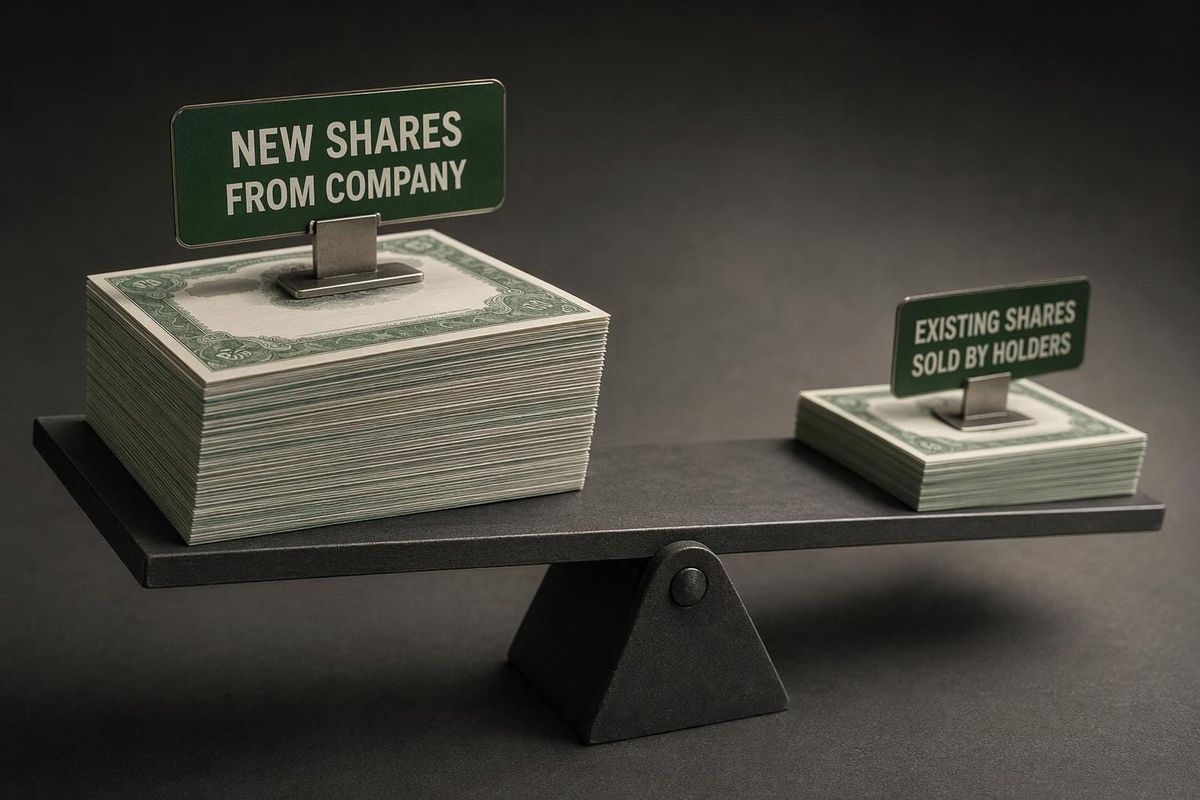
Not exactly. "Follow-on" describes timing: the sale comes after a company's initial public offering. "Secondary" describes who is selling: existing holders rather than the company. A follow-on can be primary (new shares) or secondary (existing shares), and news headlines often use the words loosely. The only reliable way to tell is the filing, which says whose shares are being sold and who receives the money.
Primary offering: the company sells new shares
In a primary offering the company creates and sells new shares. The company receives the proceeds, after the underwriters' fee, and uses them for whatever the filing states. Because there are more shares afterward, each existing share represents a smaller slice of the company. That is dilution.
Arcus Biosciences shows the pattern. It priced a $250.0 million stock offering of 14,285,715 new shares at $17.50 each, with the company receiving the proceeds. Those new shares equal 10.1% of the 141,304,346 shares outstanding after the deal. The underwriters also hold a 30-day option on 2,142,857 more shares, which would lift the share count to 143,447,203 if used.
Secondary offering: holders sell existing shares
In a secondary offering, a founder, early investor or other large holder sells shares it already owns. The company issues nothing new, so the share count stays put and the company gets no cash. The filing normally lists "selling stockholders" and says the company receives none of the proceeds.
A secondary can still move a stock, because a large block of shares reaches the market and holders are signaling they want to sell. But it does not dilute in the strict sense of increasing shares outstanding. Many deals combine both: some new shares from the company and some from holders.
Follow-on offerings and how they are priced
Follow-on deals are usually sold through underwriters, banks that buy the shares and resell them. The price is set at the time of the sale, typically below the most recent trading price, because buyers need a reason to take a large block quickly. Two other terms recur in the filings:
- The underwriting discount is the fee per share the banks keep, so the company's net proceeds are lower than the headline amount.
- The overallotment option, or "greenshoe", lets the banks buy extra shares from the company, usually within a set window, which enlarges the deal.
You may also see "APO" in a headline. It stands for a follow-on public offering of shares by a listed company, so APO is another label for the same family of deals.
Real example: a biotech priced below the prior close
Rapport Therapeutics priced a $200.0 million stock offering at $21.00 a share. That was a 23.7% discount to the $27.54 last reported price. The public offering covers 8,333,334 common shares, plus an option for up to 1,190,476 more that would bring the total to 9,761,905 shares and the offering to about $230.0 million.
The cost is in the fine print: the underwriting discount is $1.26 a share, about $12.0 million in all. The company also sold $150 million of convertible notes alongside the stock, a separate financing that matters for how you read the total raise.
Arcus gives a milder comparison: its $17.50 price was 8.4% below the $19.10 last reported. After discounts, Arcus gets $235.0 million before expenses.
| Offering | Price per share | Discount to last reported price |
|---|---|---|
| Rapport Therapeutics | $21.00 | 23.7% |
| Arcus Biosciences | $17.50 | 8.4% |
| Meta Platforms | $625.00 | 0.9% |
Real example: a mega-cap sale and the stock reaction
Size does not decide the discount. Meta priced a $25.0 billion offering of 40,000,000 Class A shares at $625.00 each, a 0.9% discount to Monday's $630.56 last reported price. Proceeds were about $24.9 billion before expenses, or about $28.7 billion if the underwriters' option is used. The deal was upsized from the $22.5 billion first announced, and a $12.5 billion preferred deal priced the same day.
Oracle shows what a falling price looks like. Oracle's shares fell 6.97% to $121.56 in Monday trading as of 1:56 p.m. ET, erasing about $28 billion in market value, as it launched a $10 billion common stock sale. It was part of a $20 billion raise that included notes. Friday's close was $130.67. The filing shows the share count at 3,100,255,354, from 3,023,726,695 on August.
Does a secondary offering dilute shareholders, and why do stocks drop on announcement?
A primary sale dilutes because the share count rises, as in the Arcus and Oracle figures above. A pure secondary does not raise the count. Prices often fall on either kind for reasons you can check: the sale price is set below the market, a large block of new supply arrives, and in a primary deal each existing share owns less of the company. The filings state the discount and share counts; they do not say why a given stock moved, so treat any single-day drop as a reading, not proof of cause.
Where to find the offering terms in the filing
Start with EDGAR full-text search and search the company name. Offering documents are usually a prospectus supplement, often labeled 424B5, and the company often also files an 8-K, the report of important events. Check these items:
- Who is selling: the company, selling stockholders, or both.
- Use of proceeds: whether the company or the holders receive the money.
- Price per share, the underwriting discount and the option for extra shares.
- Shares outstanding before and after the sale.
For general background on how offerings work, see Investor.gov and FINRA's investor pages.
Frequently asked questions
Is a follow-on offering the same as a secondary offering?
No. A follow-on is any public sale after the IPO. A secondary is one kind of follow-on, where existing holders sell their shares; the other kind is primary, where the company sells new ones.
Does a secondary offering dilute shareholders?
A pure secondary does not, because no new shares are issued and the count stays the same. A primary offering does, because the share count rises.
Why does a stock drop when an offering is announced?
The sale price is usually set below the recent price, and new supply arrives. Oracle's shares fell 6.97% in Monday trading as its sale launched, though the filing does not state a cause for the move.
What is an APO in stocks?
APO means a follow-on public offering: a company that is already listed sells additional shares to the public.
How this analysis was done
This guide uses four recent Bullished stories on offerings priced or launched from October 22 to November 2: Rapport Therapeutics, Arcus Biosciences, Meta and Oracle. Prices, discounts and share counts are the figures reported in those stories. The table reproduces the discounts as reported. Four deals are a set of worked examples, not a statistical sample, so they show how terms read in filings rather than how offerings usually trade.
Sources
- EDGAR full-text search — U.S. Securities and Exchange Commission
- Form 8-K: General instructions — U.S. Securities and Exchange Commission
- Investor.gov — U.S. Securities and Exchange Commission
- FINRA for investors — FINRA
- Arcus Biosciences Prices $250 Million Stock Sale At $17.50 A Share, 8.4% Below Wednesday's Close — Bullished
- Rapport Therapeutics Prices $200 Million Share Sale At $21, Below Tuesday's $27.54 Price — Bullished
- Meta Prices $25 Billion Stock Sale At $625 A Share, With No Cash Due Until Settlement — Bullished
- Oracle Stock Tumbles 7%, Wiping Out $28 Billion, As It Launches $10 Billion Share Sale — Bullished
Bullished Learn guides explain how filings and markets work. They are education, not investment advice: nothing here is a recommendation to buy or sell any security.