
Kodiak Sciences' DAYBREAK Trial Delivers Win For Both Zenkuda And Tabirafusp-Ted, With FDA Filing Due This Quarter
Both drugs hit their primary goals in a pivotal late-stage wet AMD trial, clearing the way for a multi-indication FDA application before year-end.


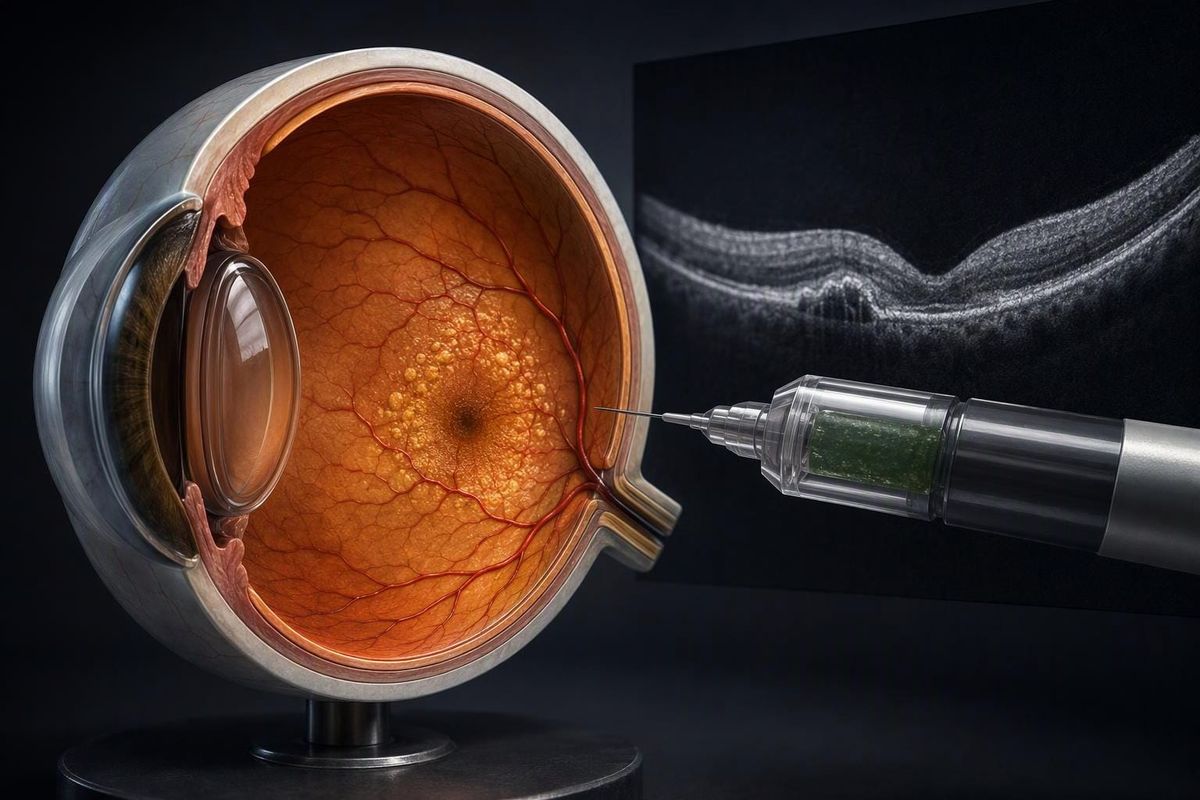
Kodiak Sciences disclosed Monday that both Zenkuda (tarcocimab tedromer) and tabirafusp-ted cleared their primary goals in the pivotal late-stage DAYBREAK trial for wet age-related macular degeneration, according to an 8-K filed with the SEC. The company plans to submit a multi-indication FDA approval application for Zenkuda before the end of 2026, drawing on data from five completed late-stage studies.
What The DAYBREAK Data Show
Zenkuda hit its primary endpoint with a p-value of 0.0007, demonstrating non-inferior vision gains versus aflibercept — the current standard of care in wet AMD — at year one. Critically, 54% of patients achieved a six-month dosing interval under strict treat-to-dryness retreatment criteria, meaning the drug maintained disease control for the majority of patients at the longest possible dosing gap the trial allowed.
Tabirafusp-ted also met its vision primary endpoint (p-value of 0.0036) and an anatomical key secondary endpoint (p-value of less than 0.0001), according to the press release. Both drugs were compared against aflibercept, and both demonstrated non-inferior vision gains at year one.
The safety picture was similarly favorable. Zenkuda posted a 0% intraocular inflammation rate and a 0.5% cataract adverse event rate, compared with 0.9% for the aflibercept arm. Tabirafusp-ted recorded a 0.4% intraocular inflammation rate and a 0% cataract rate, again versus 0.9% for aflibercept.
Charles Wykoff, chairman of research at Retina Consultants of Texas and a professor of clinical ophthalmology at Houston Methodist Hospital's Blanton Eye Institute, called the results better than he had anticipated. "The Zenkuda results exceeded my expectations, delivering the clinical profile retina specialists are seeking: rapid vision and anatomic improvements comparable to aflibercept during loading, followed by meaningfully longer intervals between treatment for a majority of patients, while maintaining optimal fluid control," he said. "This combination of immediacy, flexibility and true durability is unique and differentiated."
David M. Brown, chief medical officer of Retina Consultants of America, framed the result against the longer arc of the field. "Twenty years after Lucentis (ranibizumab) was approved for wet AMD, the holy grail remains the same: robust anatomic disease control and maximal visual gains, sustained with less frequent dosing," he said. "The DAYBREAK results with Zenkuda are truly impressive."
The Science Behind The Durability Claim
Zenkuda's extended dosing profile is built on Kodiak's proprietary antibody biopolymer conjugate platform. The drug pairs free protein for immediate disease control with an antibody conjugated to a high-molecular-weight biopolymer, giving it a mean ocular half-life of about 20 days in humans — roughly three times that of approved anti-VEGF therapies. The DAYBREAK retreatment algorithm required retreatment for any detectable fluid on optical coherence tomography, a stricter standard than many prior trials.
J. Pablo Velazquez-Martin, Kodiak's chief medical officer, put the result in the context of the company's full development timeline. "Four years and seven months after our first Phase 3 readout," he said in a statement, "Zenkuda's profile has come fully into focus through rigorous science, disciplined learning and thoughtful execution."
The DAYBREAK win is the fifth successful late-stage study for Zenkuda. The others are DAYLIGHT (also in wet AMD), GLOW1 and GLOW2 (in diabetic retinopathy, where 100% of patients reached six-month dosing at year one), and BEACON (in macular edema following retinal vein occlusion). Kodiak plans to include data from all five in the FDA approval application it intends to file in the fourth quarter of 2026.
The BLA Pipeline And What Comes Next
The planned FDA approval application for Zenkuda will cover three indications: wet AMD, diabetic retinopathy, and macular edema following retinal vein occlusion. Kodiak wholly owns global rights to Zenkuda, tabirafusp-ted, and a third late-stage asset, KSI-101, which targets macular edema secondary to inflammation.
For tabirafusp-ted, the company is accelerating development in diabetic macular edema — a high-inflammation disease — through the ongoing late-stage ALTO study, which is actively enrolling. Post-hoc analyses are also planned to identify which treatment-naive wet AMD patient subgroups may benefit from the drug's interleukin-6 inhibition mechanism.
KSI-101's first late-stage readout is expected in December 2026, with an FDA approval application planned for the second quarter of 2027. Victor Perlroth, Kodiak's chief executive, described the three-asset lineup as reflecting "the breadth of our late-stage opportunity and ambition to build a leading retinal medicines company with multiple therapies capable of providing meaningful and durable benefits to patients."
KOD shares fell about 10% to $88.75 in Friday trading, pulling back after surging sharply on Monday when the DAYBREAK results were first disclosed, according to market data.
The next concrete date on Kodiak's calendar is December 2026, when the company expects topline data from the late-stage PEAK study of KSI-101 in macular edema secondary to inflammation — and the Zenkuda FDA approval application is due before that, in the fourth quarter of 2026.
Sources
- 8-K Filing — Kodiak Sciences Inc. (KOD) — SEC EDGAR
- Exhibit d185059dex991.htm — Kodiak Sciences Inc. 8-K exhibit — SEC EDGAR
- Big Name Hedge Funds Miss Kodiak Sciences’ 178 Percent Stock Rise | Institutional Investor — institutionalinvestor.com
- Kodiak Sciences’ stock soars 166% after 2 assets match Eylea in Phase 3 trial - BioSpace — biospace.com
- Kodiak Sciences skyrockets as Zenkuda, tabirafusp excel in late-stage wet AMD trial | Seeking Alpha — seekingalpha.com
- Zenkuda and tabirafusp-ted Meet Primary Endpoints in Pivotal DAYBREAK Trial in wAMD, with Zenkuda Demonstrating a Potential New Standard-of-Care Profile with Strong Immediacy and Sustained Clinical Effect with Majority of Patients on 24-week Dosing Interval Using Strict Treat-to-Dryness Real World Retreatment Criteria. – Company Announcement - FT.com — markets.ft.com
- Kodiak Sciences Skyrockets 170%-Plus On A Big Win Against Regeneron | Investor's Business Daily — investors.com