Jabil's Suppliers Now Fund Its AI Boom: Payables Climb To $14.4 Billion From $7.9 Billion
Jabil's cash flow rose while inventory and receivables ballooned, because unpaid supplier bills grew by more than $6 billion.


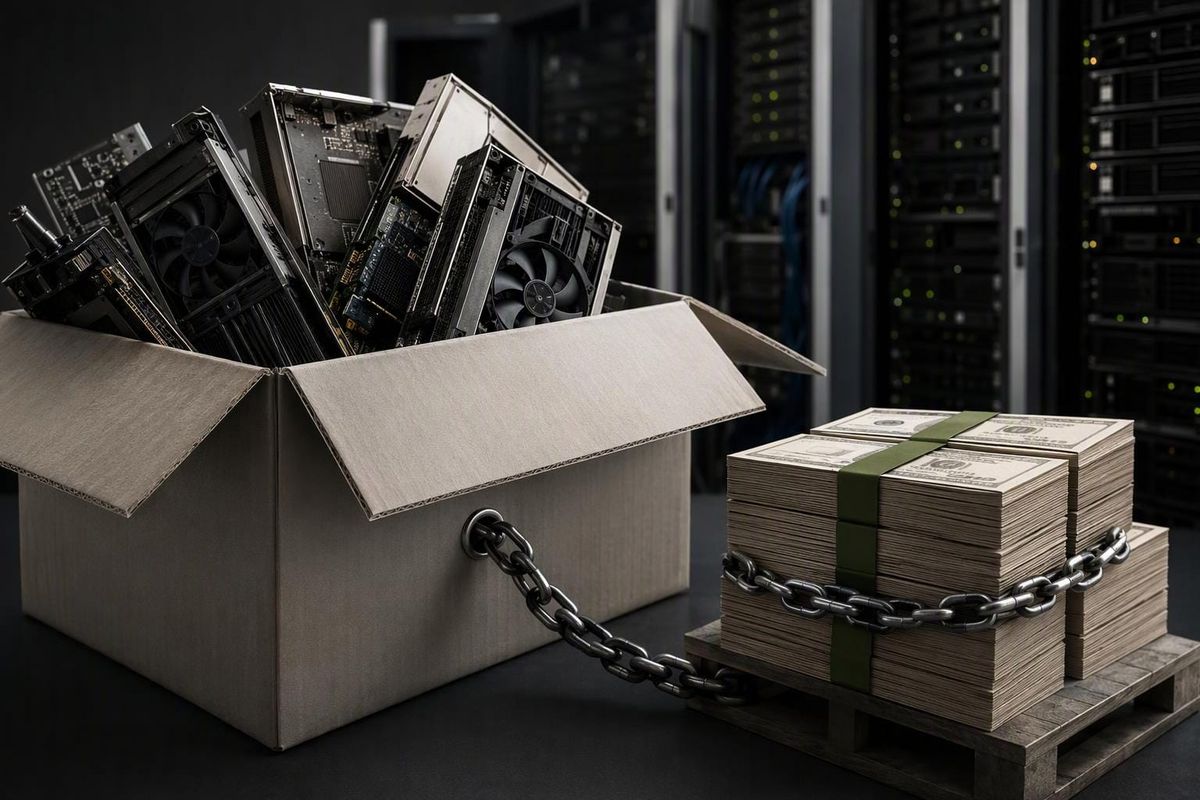
Jabil, which provides engineering, manufacturing and supply chain services to companies across many industries, ended its fiscal year with $14,444 million in accounts payable, up from $7,937 million a year earlier, its 10-K shows. That growth in what it owes suppliers largely paid for a year in which receivables and inventory swelled with AI-infrastructure demand.
Suppliers cover the working-capital build
Receivables rose to $6,513 million from $4,039 million at August 31, 2025, and inventories to $7,413 million from $4,681 million. Prepaid expenses and other current assets reached $4,559 million from $2,010 million.
Operating cash flow was $2,002 million for fiscal 2026, against $1,640 million the year before. The cash flow statement shows $7,984 million from payables, accrued expenses and other liabilities, which offset $2,394 million tied up in receivables and $2,681 million in inventory.
The company attributes the payables increase to the timing of purchases and cash payments in its Intelligent Infrastructure segment. In the quarter ended August 31, 2026, days in accounts payable were 135, versus 96 a year earlier. Days in inventory rose to 82 from 69, and the sales cycle, the span between paying suppliers and collecting from customers, shrank to 2 days from 18.
Customer A and $3.4 billion of components
Of the prepaid and other current assets, $3.4 billion is components bought for customers, up from $1.1 billion. Jabil expects to book the related revenue net once the parts are transferred to those customers.
Customer A, reported primarily in Intelligent Infrastructure, grew to 20% of net revenue from 16%, and to 33% of receivables from 24%.
An AI-driven year, with an FDA problem
Net revenue was $35,954 million, up 20.6%, and net income attributable to Jabil was $1,042 million, against $657 million a year earlier. Intelligent Infrastructure made up 50% of revenue, compared with 41% in fiscal 2025, and the company credits strong demand for certain AI infrastructure programs. The company completed its purchase of Hanley Energy Group, a data-center power business, on January 2, 2026, as it had first reported in a quarterly filing.
On August 27, 2026, Jabil received an FDA warning letter after a March 2026 inspection of its Pii drug-manufacturing site in Hunt Valley, Maryland. Management has paused manufacturing there, made leadership changes and launched a corrective plan, and says full remediation begins once the plan is approved.
Buybacks and the next debt maturity
In October 2026, Jabil entered into accelerated repurchase agreements for $281 million of its stock. As of October 20, 2026, it had bought back 1.9 million shares for $602 million, leaving $898 million under its $1.5 billion program.
It issued $1 billion of senior notes in January 2026, split between 4.200% notes due 2029 and 4.750% notes due 2033. Its $499 million of 4.250% senior notes mature on May 15, 2027.
Jabil's own filing ties the payables jump to timing in its AI business, so the $14,444 million will come due as customer shipments catch up.
Sources
- 10-K Filing — Jabil (JBL) — SEC EDGAR
- 10-K Filing — Jabil (JBL), FY2025 filed 2025-10-17 (comparison basis) — SEC EDGAR
- 10-Q Filing — Jabil (JBL), filed 2026-01-09 (earlier disclosure) — SEC EDGAR
- 10-Q Filing — Jabil (JBL), filed 2026-04-08 (earlier disclosure) — SEC EDGAR
- 10-Q Filing — Jabil (JBL), filed 2026-06-30 (earlier disclosure) — SEC EDGAR
- Earnings release (8-K Item 2.02, jbl-20260930ex991.htm) — Jabil, filed 2026-09-30 — SEC EDGAR
- The Zacks Analyst Blog Highlights Sanmina and Jabil — Yahoo Finance
- Buy 2 Undervalued AI EMS Stocks Amid Massive Short-Term Price Upside — Yahoo Finance
- Another global firm sets up plant in Batu Kawan — The Edge Malaysia
- Jabil Inc. (NYSE:JBL) : Cases :: Law360 — law360.com