Intel Can't Yet Price Its Israel Fab Shutdown, And War Losses There Are Self-Insured
An October accident halted Kiryat Gat, and Intel's 10-Q also says client weakness will worsen in the fourth quarter of 2026 and persist in 2027.


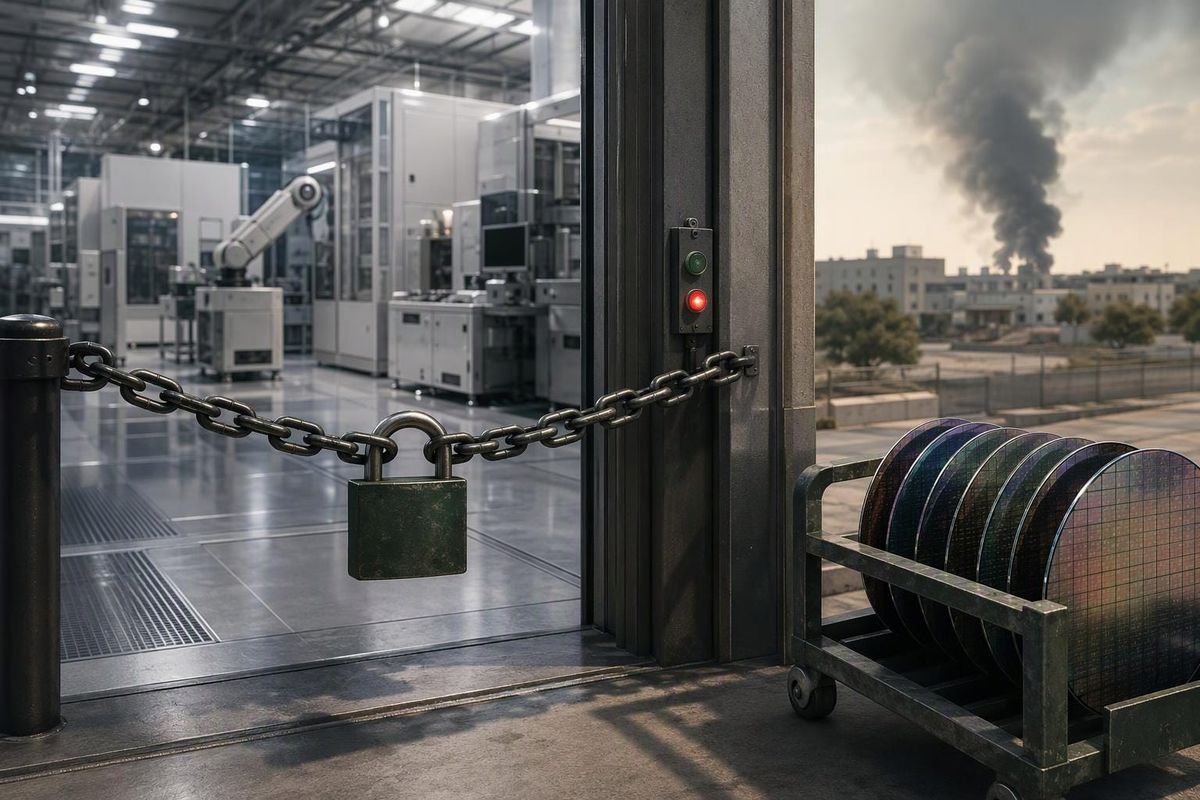
Intel said in its quarterly report that a mid-October accident at its Kiryat Gat, Israel, fab halted manufacturing and that it is "currently unable to reasonably estimate the financial impact." The same filing says Intel is not insured for business interruption from war or political violence, and that a significant share of its revenue comes from Intel 7 products made at that plant.
A halted fab with no price tag
The accident caused employee casualties and injuries, the filing says. The plant has been idle about two weeks, with a restart expected by late October.
Intel expects charges in the fourth quarter for scrapped inventory, cleanup and under-used capacity. Weaker manufacturing costs, gross profit and operating results could last through the first half of 2027.
The company says it carries insurance for certain losses from the incident and is weighing recoveries, but cannot estimate the amount. Separately, the filing says its Israeli plant, property and equipment are self-insured against war or political violence. It notes that Iran published a list of US companies with Middle East operations it said it would target, with Intel near the top.
Client demand outlook flips
The prior quarter's 10-Q expected supply constraints to ease in the second half. The new one says client-market weakness, tied to higher memory prices, tight IT budgets and leaner inventories, will worsen in the fourth quarter of 2026 and persist in 2027.
Client revenue fell to $6.9 billion, down $424 million from a year earlier, on a 14% drop in volume. A 9% rise in average selling prices partly offset it. The prior filing had shown second-quarter client revenue up $1.1 billion.
Data center demand stays strong. Intel expects it to continue, though substrate and memory shortages are expected to persist into next year.
Bigger commitments, more cash raised
After the quarter, Intel signed two substrate supply agreements with total funding needs estimated at $5.3 billion to $6.1 billion. About $3.3 billion of that is payable by the end of 2027. Capital-spending commitments reached $19.6 billion, from $12.8 billion at the end of 2025.
Intel's August 12 share sale at $95.00 netted $22.6 billion. Borrowing capacity under its credit facilities reached $15.0 billion on October 1.
The fair value of the liability for shares held in escrow for the US government was $13.7 billion at quarter-end. It moves with Intel's stock price and drove a $12.6 billion nine-month loss. Intel also agreed in October to buy Classiq Technologies for about $1.9 billion, with up to $350 million more contingent, and expects to close in the first half of 2027. Its Mobileye unit's estimated fair value exceeds carrying value by less than 10%.
Intel expects Kiryat Gat to resume by the end of October, with the fourth-quarter charges still to be booked.
Sources
- 10-Q Filing — Intel (INTC) — SEC EDGAR
- 10-Q Filing — Intel (INTC), Q2 FY2026 filed 2026-07-24 (comparison basis) — SEC EDGAR
- Earnings release (8-K Item 2.02, q326earningsrelease.htm) — Intel, filed 2026-10-29 — SEC EDGAR
- Intel shares tumble after hours, hit by chip supply woes — rte.ie
- Intel (INTC) Q3 earnings report 2026 — CNBC
- Intel sees 58% growth in its foundry business — and losses are narrowing — MarketWatch
- Intel Earnings: PC Winter Has Arrived, Offsetting Healthy AI Growth; FVE to $85 From $105 — morningstar.com
- Intel: Q3 Earnings Snapshot — Associated Press