Harrow Plans To Promote Eye-Drug Findings Despite Missing Study's Main Goal
Management emphasized post-injection comfort and plans no repeat study, while lowering its full-year adjusted earnings outlook.


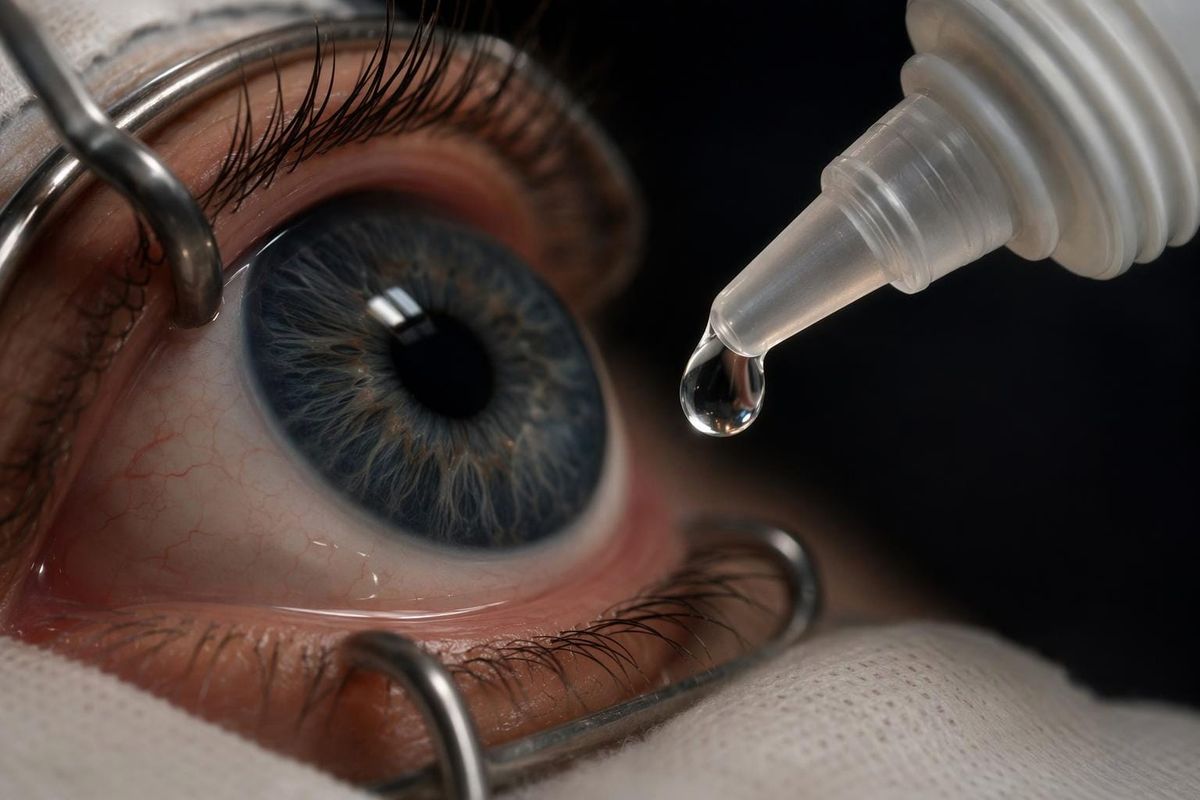
Harrow, which sells eye medicines to eyecare professionals, plans to use findings from an IHEEZO study in medical communications even though the trial missed its main goal. Founder, Chairman and Chief Executive Officer Mark L. Baum defended that approach on the company's earnings call Tuesday, emphasizing patients' comfort after eye injections.
The Anesthesia Test Fell Short
QUELL tested whether IHEEZO provided anesthesia at least as effectively as routine treatment for injections into the eye. Monday's results release described a randomized, double-masked study involving 231 patients; the analysis covered 228 after three discontinued.
Successful anesthesia required patients to report either no pain or only pressure immediately before and after the injection. IHEEZO's success rate was 55.2%, against 59.7% for proparacaine drops followed by a lidocaine injection beneath the conjunctiva.
Chief Scientific Officer Amir Shojaei called the main result "inconclusive" on Tuesday's call. The study assumed an 88% success rate in each group, but the observed overall rate was about 57%. He said the sample could not produce a sufficiently narrow statistical range to meet the prespecified 12-percentage-point margin; the study established neither that IHEEZO was inferior nor that it met the required non-inferiority test.
An analyst at Lake Street questioned those assumptions. Shojaei said Harrow had borrowed estimates from a different procedure because comparable injection data were unavailable. Baum said IHEEZO's earlier studies involved cataract surgery.
Comfort Becomes The Sales Argument
Baum described the investment's central purpose as "medical messaging," including giving the sales force evidence specific to eye injections. He emphasized exploratory secondary findings and safety results rather than the failed main test.
Pain scores accumulated immediately around the injection were identical at 2.0. Through 24 hours, however, cumulative scores were 2.9 for IHEEZO and 3.7 for routine anesthesia. Eye-surface staining increased by an average of 1.7 versus 3.2, and adverse-event rates were 27% versus 47%. Neither group experienced serious adverse events.
Shojaei also said IHEEZO patients reported less worsening of dryness on injection day and improvement from baseline by 24 hours. These were secondary observations, not a successful result on the trial's main measure.
An analyst at William Blair asked whether another study was necessary or labeling plans would change. Shojaei answered: "currently we don't have any plans for a second study or further study in this line." He said investigator-initiated studies remain underway and that Harrow plans to pursue peer-reviewed publication of QUELL.
Development Spending Meets A Profit Cut
The clinical discussion came alongside a lower earnings outlook. President and Chief Financial Officer Andrew Boll said Harrow now expects more than $40 million in full-year adjusted EBITDA—an earnings measure excluding interest, taxes, depreciation, amortization and certain other costs—against its previous $80 million–$100 million range.
Boll cited earlier revenue shortfalls, lower-than-expected margins and accelerated development spending. Harrow's first-half revenue was about $28 million below its guidance midpoint; it attributed most of that gap to overly optimistic expectations for VEVYE's expanded insurance coverage.
Third-quarter revenue rose 39% from a year earlier and 41% from the prior quarter to $99.3 million. Adjusted EBITDA was $21.2 million, versus $22.8 million a year earlier. Harrow retained its $350 million–$365 million annual revenue forecast and expects more than $33 million in fourth-quarter adjusted EBITDA.
IHEEZO generated $25.3 million in quarterly revenue, up 15% year over year. Harrow also sells the dry-eye drug VEVYE and steroid injection TRIESENCE; third-party manufacturers produce its branded medicines, while ImprimisRx prepares customized eye medications.
Boll said bringing forward the G-MELT FDA approval application, clinical programs and TYRVAYA integration costs would affect near-term profitability. Shojaei expects the G-MELT application in late November or early December.
Harrow expects to present the full QUELL results at the Hawaiian Eye & Retina Conference in January 2027.
Sources
- Harrow results release (Form 8-K, EX-99.1) — SEC EDGAR
- Harrow (HROW) Reports Q3 Earnings: What Key Metrics Have to Say — Yahoo Finance
- Harrow Shares Gain on 3Q Revenue Beat — MarketWatch
- Harrow Health GAAP EPS of $0.25 beats by $0.06, revenue of $99.3M beats by $0.71M (HROW:NASDAQ) | Seeking Alpha — seekingalpha.com
- Document — sec.gov
- Harrow (HROW) Q3 Earnings Lag Estimates — Yahoo Finance