Fortinet's Chip Purchase Commitments Hit $1.93 Billion, With $785 Million Reaching Beyond 2026
Inventory rose to $591.2 million and product margin fell 3.3 points as memory-chip costs bit, the quarterly filing shows.


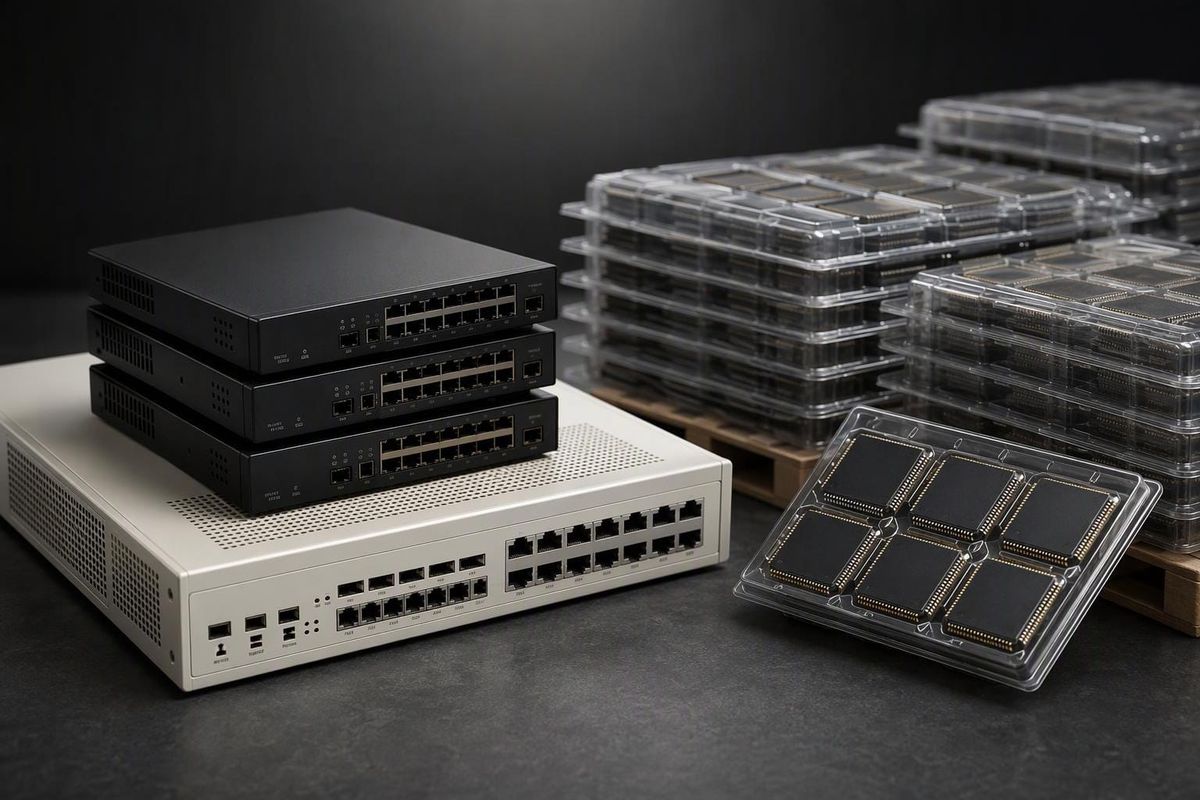
Fortinet, which sells networking and security products built around its FortiGate firewalls, has locked in $1.93 billion of non-cancelable inventory purchases from contract manufacturers, according to its 10-Q filed Friday. That is up from $1.67 billion a quarter earlier, and the same filing warns that memory-chip costs may outrun the company's price increases.
A longer tail of commitments
As of September 30, $1,144.5 million of the commitments falls due in 2026 and $785.0 million comes after. The prior quarter's filing put the total at $1.67 billion, with $1,337.5 million in 2026 and $329.6 million thereafter, so the multi-year portion more than doubled.
The 10-Q puts the total $1.12 billion above the $810.6 million at December 31, 2025. Some of these deals are meant to secure supply and pricing on components for multiple years, and the company says the year-by-year split can shift with actual delivery timing.
Fortinet has set aside $30.3 million for commitments that exceed its demand forecasts, up from $26.7 million at year-end. Management says it believes the commitments fit current and expected demand.
Inventory swells as margin slips
Inventory on the balance sheet stood at $591.2 million, against $426.3 million at June 30 and $399.5 million at December 31. Finished goods account for $464.3 million of it.
Product gross margin fell 3.3 percentage points in the third quarter to 64.4%, from 67.7% a year earlier. The filing blames higher memory-chip costs and inventory reserve expense, partly offset by price increases. The company says an AI-driven global shortage of memory chips is constraining supply, and that its price increases may not be sufficient or timely, and could dampen demand.
Demand is still running hot
Revenue rose 20% to $2.08 billion in the quarter, and product revenue climbed 37% to $765.0 million. The 10-Q credits higher average selling prices, demand for higher-performance products, recent pricing actions and more units shipped. Fortinet expects product revenue to keep growing through the rest of 2026.
Operating margin widened to 33.9% from 31.7%. Fortinet raised its 2026 revenue guidance in its earnings release on Wednesday, and the filing says full-year product gross margin may decline from 2025 on continued higher hardware component costs.
Cash, buybacks and a Tokyo property
Cash and investments totaled $5.32 billion. In October the board added $1.23 billion to the buyback authorization, and about $2.0 billion remained as of October 29. The company also signed a deal that month to buy about 204,000 square feet of Tokyo real estate for $136.8 million in cash.
The filing says Fortinet expects enough liquidity to cover its supply obligations, capital spending and repurchases.
The 10-Q shows the price of securing chips is a bet that product demand holds up: $1.93 billion is committed, and the company's own filing says it may have to pay for components regardless of its sales in a given period.
Sources
- 10-Q Filing — Fortinet (FTNT) — SEC EDGAR
- 10-Q Filing — Fortinet (FTNT), Q2 FY2026 filed 2026-07-30 (comparison basis) — SEC EDGAR
- Earnings release (8-K Item 2.02, ftntq3-2026ex991.htm) — Fortinet, filed 2026-10-28 — SEC EDGAR
- Fortinet Q3 Earnings & Revenues Beat Estimates, Increase Y/Y — Yahoo Finance
- Fortinet stock slumps after earnings, and other early market movers — MarketWatch
- These Analysts Slash Their Forecasts On Fortinet After Q3 Results — benzinga.com
- Fortinet: Q3 Earnings Snapshot – WTOP News — wtop.com
- Fortinet (FTNT) Q3 Earnings: Taking a Look at Key Metrics Versus Estimates — Yahoo Finance