Ford's F-150 Supplier Snag Is 'Containable,' Company Says, As Super Duty Posts Best Quarter In 19 Years
A late-September production disruption at F-150 plants fits within Ford's full-year adjusted EBIT guidance of $10.0 billion to $11.0 billion, the company said Friday.


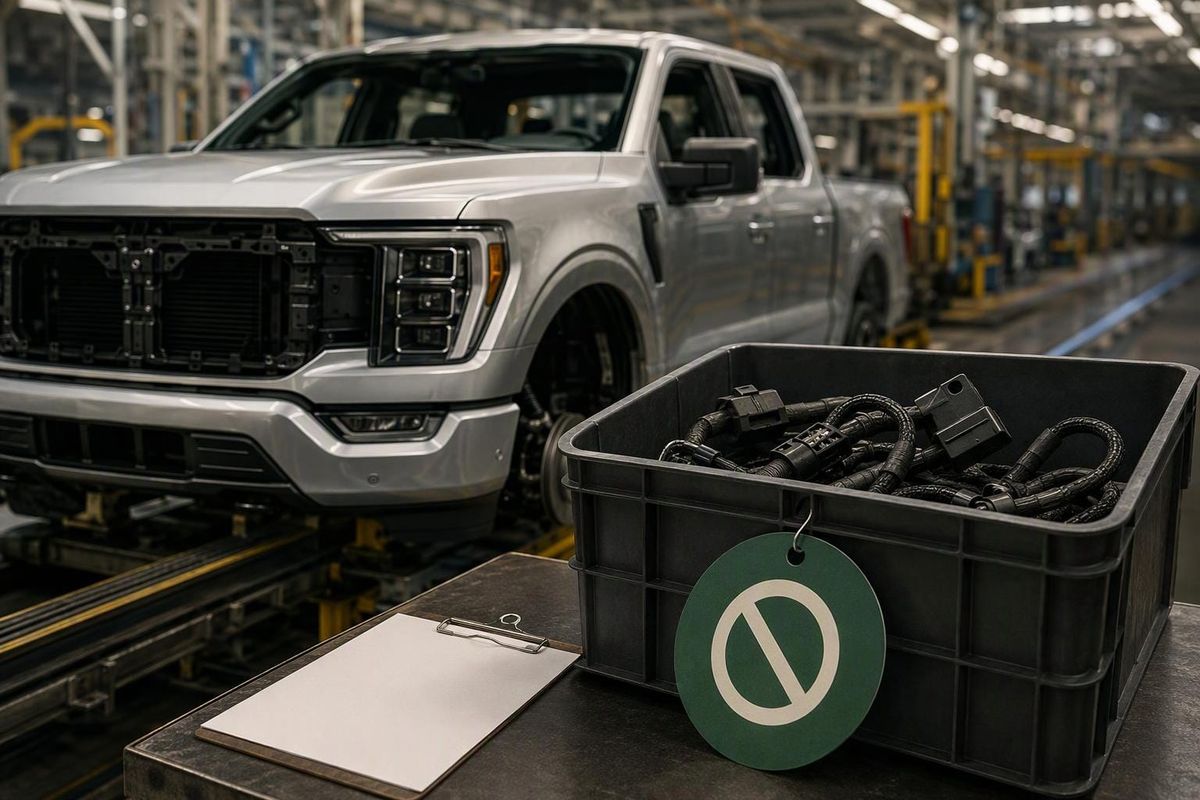
Ford disclosed Friday that a short-term supplier problem — unrelated to aluminum — disrupted F-150 production at the end of September, but said the financial damage fits inside its existing full-year profit target, pairing the warning with a third-quarter sales report that showed record Super Duty output and retail share gains. F shares rose about 2% to $12.28 in Friday trading after the 8-K filing landed.
What The Filing Says
The 8-K, filed Friday under Regulation FD, states the matter plainly: "The expected financial impact of a short-term supplier issue that affected production of F-150 trucks at the end of September is containable within Ford's existing full-year 2026 adjusted EBIT guidance." That guidance band — $10.0 billion to $11.0 billion in adjusted earnings before interest and taxes — was first set on July 28, 2026, and Ford reaffirmed it without revision Friday.
The filing does not name the supplier or quantify the production shortfall. It specifies only that the issue is unrelated to aluminum, a notable carve-out given the industry's sensitivity to commodity-supply disruptions.
The disclosure was structured carefully: the F-150 supplier language appears under Item 7.01 (Regulation FD) and is explicitly excluded from the incorporated-by-reference portion of the accompanying sales release, meaning Ford treated it as furnished rather than filed — a distinction that limits certain legal exposure under securities law.
The Quarter's Truck Numbers
The supplier disclosure arrived alongside a third-quarter sales report that gave investors something to offset the production news. Total vehicle sales came in at 509,764, down about 7% year over year — but Ford said that headline drop is almost entirely a function of the deliberate wind-down of the Escape and Corsair. Strip those two models out, and Ford's volume was essentially flat against an industry that itself declined about 1%.
Retail share, adjusted for the same phase-out, rose approximately 0.4 percentage points year over year to 12.1%.
The standout number in the release was Super Duty production: 110,275 trucks in the third quarter, up about 4% and the best quarterly output figure in 19 years. Maverick Hybrid sales reached 27,793 trucks in the quarter, up about 60% year over year and a third-quarter record for the model. Mustang sales rose 7.5% in the quarter and 17.9% through September.
Bronco delivered 114,956 SUVs sold through September — a year-to-date record for the model. Overall F-Series production climbed 4.5% in the third quarter to 266,777 trucks, with September F-Series sales up 2.4%, keeping the nameplate on pace for a 50th consecutive year as the country's best-selling truck.
The Portfolio Shift Behind The Numbers
Ford's third-quarter results reflect a deliberate strategic pivot: the company is exiting lower-margin passenger-car and crossover segments to concentrate on trucks, large SUVs, and commercial vehicles. The Escape and Corsair phase-out is the most visible expression of that shift, and it is the primary reason headline volume looks soft even as the underlying truck business is strengthening.
Through September, cumulative F-Series sales reached 561,508 trucks, extending Ford's lead over the Chevrolet Silverado to more than 140,000 units. In the Class 1-7 commercial truck and van segment, Ford held a 41% share based on the most recent registration data through July, the company said.
Connected-services revenue is a growing piece of the strategy alongside the vehicle business. Active paid software subscriptions crossed 1.7 million through September, growing more than 40% year over year — a metric Ford has been highlighting as it pushes recurring revenue streams beyond the initial vehicle sale.
What To Watch
The next hard test of Ford's guidance reaffirmation is the third-quarter earnings report, which will show whether the F-150 supplier disruption and the costs of the portfolio transition stayed inside the $10.0 billion to $11.0 billion adjusted EBIT band management reaffirmed Friday.
Investors will also be watching fourth-quarter order momentum for the new F-150 Carhartt Edition and upcoming Bronco special editions, to gauge whether fresh demand can offset any lingering production shortfall from the late-September supplier issue.
Ford's third-quarter earnings report will be the first look at whether the F-150 supplier hit and portfolio-transition costs held within the $10.0 billion to $11.0 billion adjusted EBIT range the company reaffirmed Friday.