Darling Blames About $30 Million Core Earnings Miss On Diamond Green Diesel Timing, Guides Whole Company
CFO Bob Day says items totaling about $30 million explain weaker core ingredients earnings, and the company guided combined EBITDA of $2.2 billion to $2.3 billion.


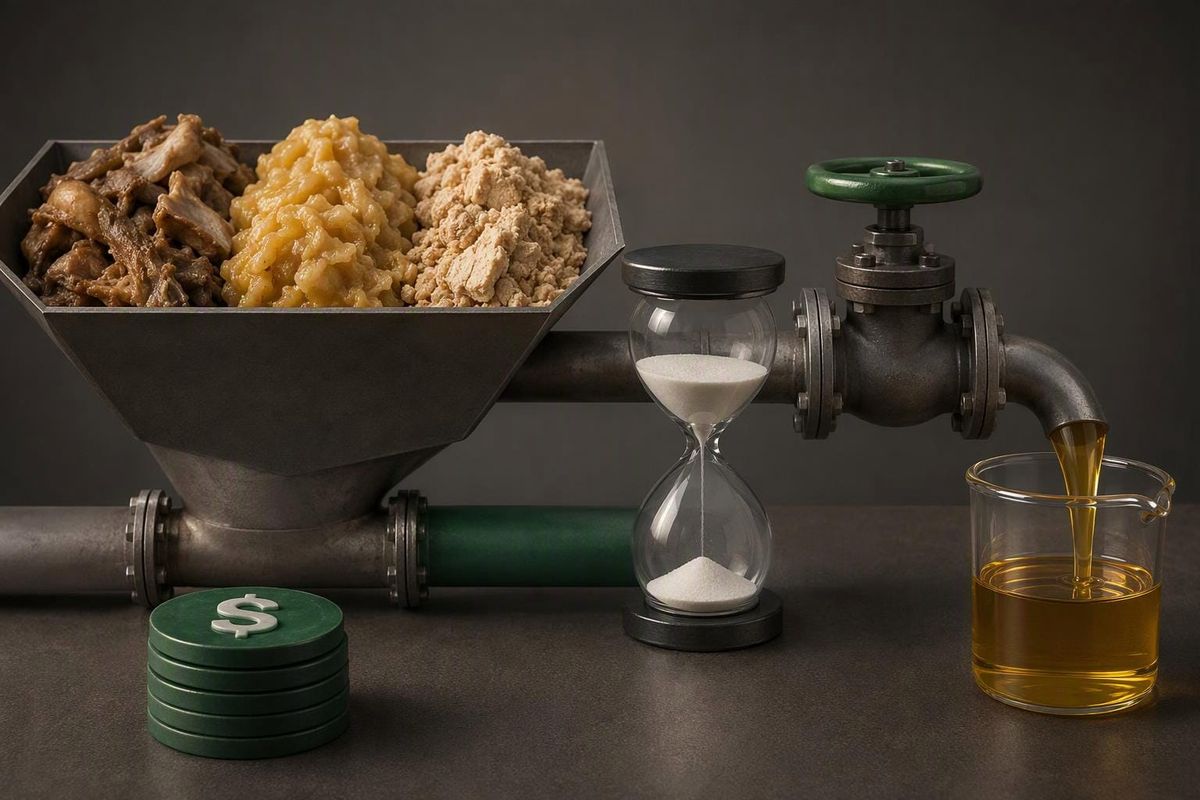
Darling Ingredients, which collects animal by-products, used cooking oil and bakery leftovers and turns them into fats, proteins, collagen and fuel feedstocks, says items totaling about $30 million explain why its core ingredients earnings fell short of what had been expected, CFO Bob Day said on the company's third-quarter earnings call. Day said hedge losses and deferred profit should reverse in the fourth quarter, and core EBITDA still landed at the high end of guidance, near $340 million.
Where the $30 million went
Day said about $15 million of the shortfall came from two accounting items in the feed segment. Because Darling owns 50% of the Diamond Green Diesel joint venture, accounting rules make it defer half the margin on feedstock sold to the venture until the fuel is processed and sold. A lower-of-cost-or-market adjustment also turned negative late in the quarter, because an unusually high volume of product was in transit and its margins cannot be booked until title transfers.
The rest tied to long-term incentive accruals, which rose on strong results at both core ingredients and Diamond Green Diesel. Day said that accrual will not come back, while the other $15 million could flow back depending on where market prices end the year.
Day said the deferred profit is "purely a timing issue" and will reach Darling's bottom line once the venture sells the fuel in the fourth quarter.
Why guidance covers the whole company
Asked by a JPMorgan analyst for a fourth-quarter view of the core business, CEO Randall Stuewe said Valero reported its Diamond Green Diesel results on the 22nd and Darling could not match it given accounting cutoffs. Management expected investors to question the run rate, he said, so it put out full-year combined adjusted EBITDA of $2.2 billion to $2.3 billion, which he called a conservative number.
Day said investors had asked for core-only guidance, but this quarter core earnings were swayed by events at the venture, so it "didn't serve the purpose that it normally would." Stuewe said the math assumes core EBITDA around $1.25 billion for the year, plus or minus, and Diamond Green Diesel margins of $1.50 to $2 a gallon on 1.2 billion gallons.
Third-quarter combined adjusted EBITDA was $514 million, about $310 million from ingredients and $204 million from Diamond Green Diesel, against $245 million a year earlier. Net income was $267 million.
Hedging defense and a $1.30 margin
Diamond Green Diesel's average margin was around $1.30 a gallon on 315 million gallons sold, below replacement margins, Day said. He cited hedge losses, weather at Port Arthur that forced more foreign feedstock and less production tax credit value, a RIN that fell from about $2.45 to below $2, and a hydrogen outage at Norco.
On hedging, Day said "we do not use mark to market accounting," and that "we're not concerned at all with the hedging and our ability to limit risk." A hedge loss realized in one quarter comes back as a gain once the feedstock becomes fuel, he said.
Darling received about $170 million in cash from the venture, cut net debt by about $420 million and bought back about $76 million of shares. Leverage fell to about 1.7 times from 2.9 times at the end of last year.
Stuewe said Diamond Green Diesel should produce about 325 million gallons in the fourth quarter, and that net debt should reach $3 billion or below by year end.
Sources
- Document — sec.gov
- Darling Ingredients sees DGD timing benefits in Q4 (DAR:NYSE) — seekingalpha.com
- Darling Ingredients Inc. Reports Third Quarter 2026 Results — Yahoo Finance
- Darling Ingredients (DAR) Q3 Earnings and Revenues Surpass Estimates — Yahoo Finance
- Here's What Key Metrics Tell Us About Darling (DAR) Q3 Earnings — Yahoo Finance
More on Darling Ingredients
- Darling CEO Calls Stock Multiple 'Way, Way Too Low' As Board Weighs Dividend Or Bigger Buyback
- Darling Ingredients Earns $267.0 Million In Third Quarter As Diamond Green Diesel Flips To Profit
- Darling Ingredients Guides 2026 Combined Adjusted EBITDA To $2.2-$2.3 Billion, Blames Timing For Diamond Green Diesel Quarter