CorMedix Suspends DefenCath Forecast As Its CEO Rejects Quarterly Therapy Switches
Medicare payments will reset quarterly in 2027, complicating pricing even as management expects reimbursement above the current rate.


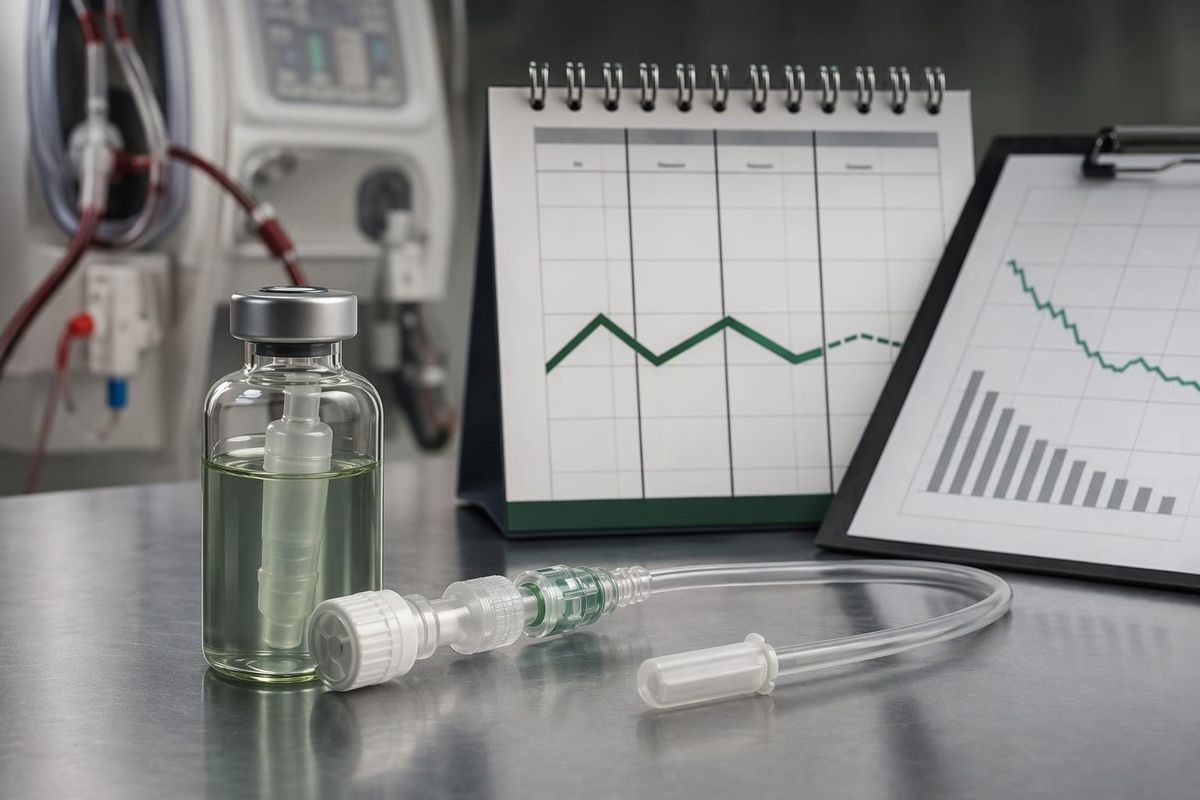
CorMedix, which develops and sells treatments for life-threatening conditions, suspended its 2027 DefenCath revenue forecast as Medicare reimbursement shifts to quarterly resets, according to Thursday's earnings release. On the company's earnings call Thursday, Chairman and Chief Executive Officer Joe Todisco pushed back against changing stable patients' preventive therapy each quarter to match those payments.
Higher payments, harder pricing
The Medicare reimbursement add-on for DefenCath starts at $8.32 in the first quarter of 2027, compared with $2.37 currently. But the Centers for Medicare & Medicaid Services will recalculate it quarterly using recent pricing and utilization information.
Todisco expects the full-year average to fall below $8.32, while remaining at least double the current rate. He expects every quarter's add-on to exceed $2.37, with a decline in the second quarter followed by a possible increase in the third quarter, fourth quarter or both. Those expectations depend on how the agency applies its methodology.
CorMedix is discussing pricing with dialysis customers that would track the quarterly payment changes while keeping fee-for-service patients on DefenCath throughout the year. Its largest outpatient dialysis customers largely maintained use during the third quarter at the current reimbursement rate.
Asked by an H.C. Wainwright analyst whether operators could raise and lower utilization quarterly, Todisco rejected that approach for stable patients. "I think they'd be irresponsible to make changes quarter to quarter like that," he said.
Rebates complicate the payment math
Reported net prices do not necessarily line up with the prices Medicare uses to calculate reimbursement. Answering an Oppenheimer analyst, Todisco said the calculation is "based on the timing of when rebates are paid as opposed to when they're accrued."
Some volume-incentive rebates are paid well after the associated sales. That can move their effect on Medicare's average-sales-price calculation into a different period from the one outside observers might expect from CorMedix's financial results.
Todisco said the company supplies the sales information used in those calculations and has not shared it with customers or third parties. He cautioned that outside projections of the quarterly payment path face significant uncertainty.
DefenCath is a catheter lock solution used to reduce catheter-related bloodstream infections in adults with kidney failure receiving chronic hemodialysis. It is CorMedix's biggest net-sales contributor, sold primarily to outpatient dialysis clinics and hospitals.
Separate payment remains the hurdle
CorMedix is seeking contracts with major Medicare Advantage plans that would pay for DefenCath separately from the existing bundled reimbursement. Todisco said the contractual framework is largely settled, but agreement on implementation remains the obstacle.
He argued that preventing infections can reduce downstream costs for the plans. He also clarified that his comments about slow-moving negotiations concerned the insurers, rather than dialysis operators' treatment protocols.
Todisco identified Fresenius, U.S. Renal Care and IRC as the company's three largest customers. Their protocols were already in place and, to management's knowledge, had not changed in recent months.
Management wants better visibility into both customer pricing and Medicare Advantage contracting before forecasting DefenCath sales. The company deferred guidance until early 2027, when it expects a clearer view of utilization, pricing and potential additional revenue from those contracts.
Lower prices reach the results
Third-quarter consolidated revenue fell to $54.5 million from $104.3 million a year earlier. CorMedix attributed the DefenCath decline largely to lower net prices following its July 1 transition out of the earlier reimbursement period.
DefenCath generated $17.2 million, including a favorable $5 million sales-allowance adjustment. Executive Vice President and Chief Financial Officer Susan Blum said Medicaid utilization and product returns were lower than previously estimated. The remaining portfolio contributed $37.3 million, including $31.4 million of product sales and approximately $5.9 million of contract revenue and grant income under its BARDA agreement.
Adjusted earnings before interest, taxes, depreciation and amortization fell to $3.1 million from $71.9 million. That measure excludes the favorable allowance adjustment. The $14.7 million net loss included an $11.5 million non-cash expense tied to revaluing payments owed under the Melinta acquisition; the prior-year $108.6 million profit benefited from a $59.7 million tax item.
Blum narrowed the 2026 adjusted earnings outlook to $130 million–$140 million from $125 million–$140 million. Cash operating-expense guidance fell to $140 million–$145 million from $145 million–$155 million, while consolidated revenue guidance remained $325 million–$345 million.
Heron would broaden the revenue base
CorMedix bought Melinta Therapeutics on August 29, 2025, adding infectious-disease products and the cardiovascular drug TOPROL-XL. The third-quarter comparison includes a full quarter of Melinta operations in 2026 against one month in 2025.
Heron's assets would pass to CorMedix in exchange for 14,583,333 shares and an upfront cash payment of $145 million, subject to adjustments, under the purchase agreement reached on Monday. The pending purchase would expand its hospital and infusion-center portfolio and reduce reliance on DefenCath under management's diversification strategy.
CorMedix anticipates closing in the first quarter of 2027. Management expects the acquired products to contribute $125 million–$150 million in full-year 2027 revenue and roughly double annual product revenue outside DefenCath.
The company ended September with $355.2 million in cash, excluding restricted cash. Operating cash flow for the first nine months reached $218.3 million, compared with $80.6 million a year earlier.
Todisco hopes to update investors on Medicare Advantage contracting before year-end. Getting the plans to agree on how to implement separate payment remains the task ahead.
Sources
- CorMedix results release (Form 8-K, EX-99.1) — SEC EDGAR
- CorMedix: Q3 Earnings Snapshot – WTOP News — wtop.com
- Heron sells assets to CorMedix for $145M upfront; Faeth’s stock tumbles — endpoints.news
- CorMedix Inc. Form 8-K filed November 9, 2026 — sec.gov
- EX-99.1 — sec.gov
- https://www.sec.gov/Archives/edgar/data/1410098/000121390026117213/ea031142301ex99-1.htm — sec.gov