Carvana CEO Says AI Shopping Agents Will Expose Rivals' Physical Friction — Analysts Ask If Bots Even Find It
Ernie Garcia pitched AI shopping agents as a gift to Carvana, then fielded questions on search visibility and refinancing risk.


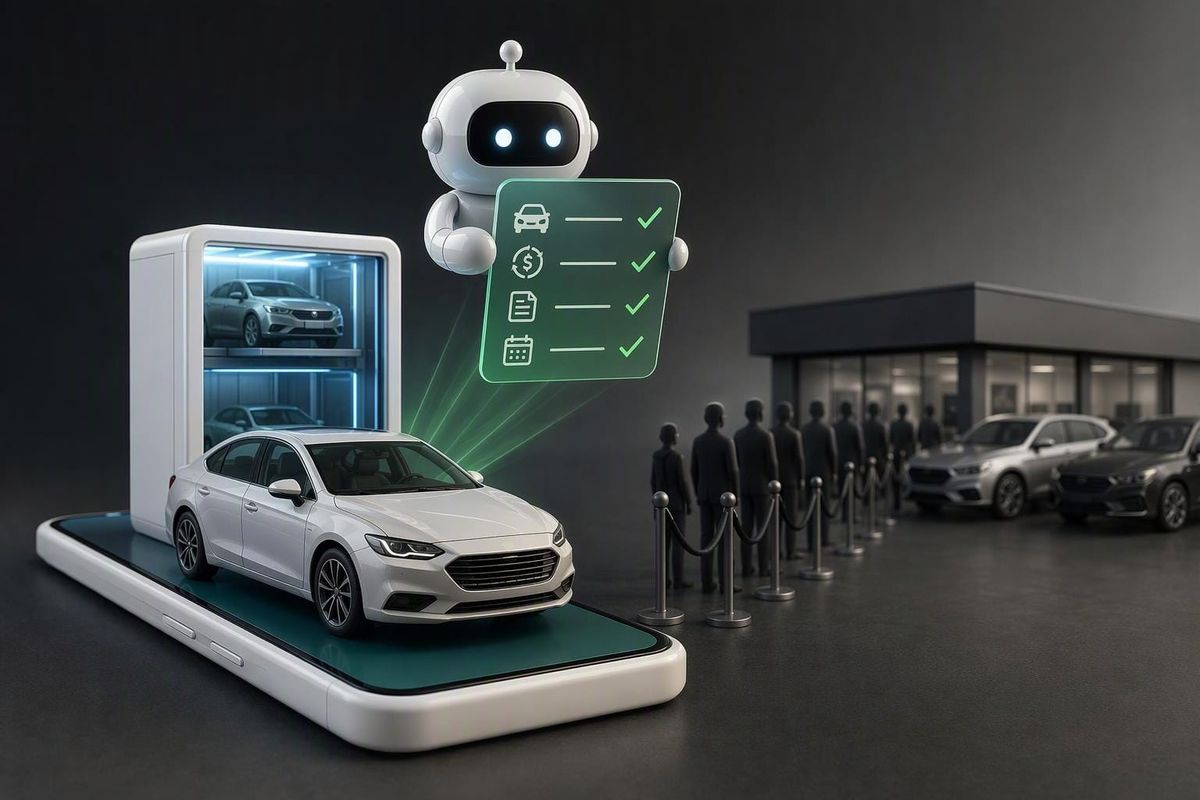
Carvana CEO Ernie Garcia said on the company's third-quarter earnings call that AI shopping agents will erase online friction while laying bare the in-person hassles of dealerships. Analysts pressed him on whether bots even surface Carvana and whether they could push customers to refinance. Carvana runs an e-commerce platform for buying and selling used cars, delivering to the home or to its car vending machines.
The pitch: zero digital friction
Asked by a Morgan Stanley analyst how Carvana is positioned, Garcia said agentic AI has the capacity to "effectively reduce digital friction to zero while leaving physical friction largely unchanged." He described an agent returning a car, a trade-in value, financing terms and a down payment, with delivery offered today, tomorrow or in two days.
A dealer visit, he said, would look different: the agent would flag doc fees and add-ons, so the technology is "fully revealing and articulating the physical friction." He called that a "huge advantage" for Carvana, while saying it is "very early days."
In his opening remarks he added that if Carvana were starting from scratch today, "we would build Carvana."
Do the bots find Carvana?
A D.A. Davidson analyst said a random sample of bots asked for a used car turns up Carvana "sometimes," while competitors still appear "quite a bit." Garcia replied that Carvana must push its data out in ways bots can read, and that the bigger it gets, the more often it will show up.
He said there is "really not a lot of fundamental things" to change in the business, because the customer-facing system is deterministic and can serve every part of a transaction through an API.
Garcia also said he had his personal AI agent search Carvana's calls and communications over the last several years and it found management said "fundamental gains" 350 times.
Refinancing risk and the quarter
A Bank of America analyst asked whether agents could drive more competition on financing. Garcia called the frame reasonable and said higher prepayments are a reasonable assumption, but that market evolution is unlikely to be as dramatic as a simple model suggests. He argued that if every improving borrower refinanced, the lender would be left with worse credits and the business would not function, so fees or other fixes would emerge.
The backdrop was a record quarter: Chief Financial Officer Mark Jenkins said retail units sold totaled 217,385, up 39%, and revenue was $8.04 billion, up 42%. Net income was $483 million and adjusted EBITDA, a profit measure that excludes some costs, was a record $800 million. Jenkins said Carvana expects full-year 2026 adjusted EBITDA at the higher end of its previously communicated $2.7 billion to $3.0 billion range, as long as the environment remains stable.
Carvana's market value stood at $65.2 billion after the Wednesday report, and the D.A. Davidson analyst's question, whether agents actually steer shoppers to its listings, is still open.
Sources
- Carvana Q3 2026 Earnings Call Transcript — benzinga.com
- Carvana Reaches Sales Milestone but Earnings Come in Short — Barron's
- Carvana Co. (CVNA) Stock Price, News, Quote & History - Yahoo Finance — Yahoo Finance
- Compared to Estimates, Carvana (CVNA) Q3 Earnings: A Look at Key Metrics — Yahoo Finance
- Carvana (CVNA) Misses Q3 Earnings Estimates — Yahoo Finance