Carlsmed Raises Outlook To $78 Million–$80 Million But Defends Caution On Faster Growth
Analysts pressed management on reimbursement gains and new spine products as procedure volume grew 76% from a year earlier.


Carlsmed, which develops personalized surgical plans and implants for spine fusion, raised its annual revenue forecast to $78 million–$80 million from $74 million–$78 million but resisted pressure for a more aggressive outlook on Tuesday's earnings call. Chairman and Chief Executive Officer Mike Cordonnier defended forecasting caution even as procedure volume grew 76% from a year earlier.
A Higher Forecast, Still Cautious
A Piper Sandler analyst questioned why the outlook implied only a modest increase from the third quarter despite the company's expanding business. Cordonnier answered that, as a newly public company, “we continue to be prudent with our guidance.”
A Truist analyst pressed the same point, describing the expected fourth-quarter increase as smaller than in the past two years. Cordonnier pointed to new hospital contracts, surgeon additions and increasing use by existing surgeons. In response to a Needham & Company analyst, he said hospital contracting picked up toward the end of the third quarter and continued into the fourth.
Chief Financial Officer Rich Heppenstall tied the higher forecast to procedure growth during the first nine months and fourth-quarter expectations. The company expects annual revenue growth of more than 56% at the forecast's midpoint.
Third-quarter revenue rose 65% to $21.6 million from $13.1 million a year earlier. Cordonnier said the trained surgeon user base expanded more than 60%, while cervical procedures contributed to the 76% volume increase. Heppenstall said revenue per procedure was consistent with prior quarters.
More Procedures, More Hospital Access
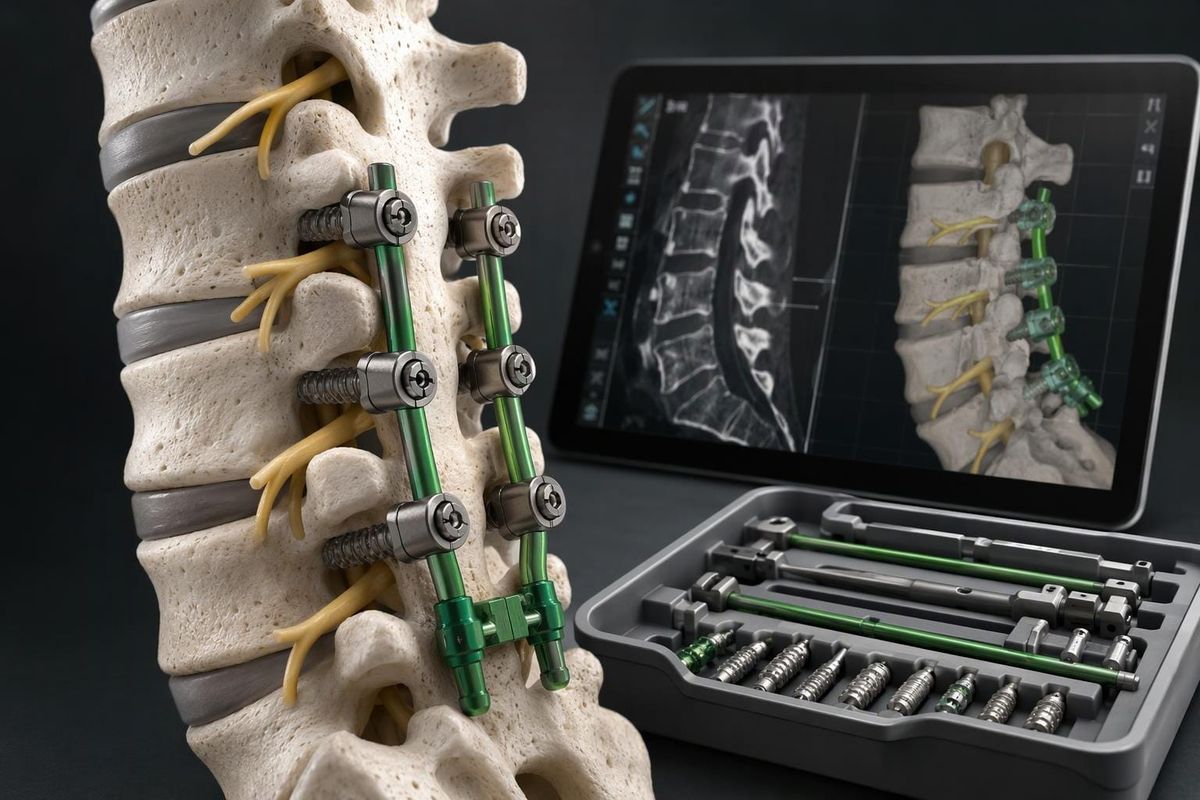
Carlsmed's aprevo platform uses AI and patient imaging to design surgical plans and implants fitted to individual anatomy. Hospitals and ambulatory surgical centers buy kits containing the personalized implants and single-use instruments; the company focuses commercially on the U.S.
Lumbar procedures accounted for 88% of quarterly revenue and cervical procedures for 12%. The cervical offering launched in the fourth quarter of 2025. Cordonnier said medical education, initially focused on adult spinal deformity, now also covers minimally invasive posterior procedures, with early- and mid-career surgeons central to adoption.
Higher hospital reimbursement for inpatient aprevo lumbar procedures took effect on October 1, 2026. The company also launched its bilateral posterior lumbar system in October, targeting what it estimates are approximately 30,000 U.S. procedures annually.
Carlsmed plans to commercially launch its FDA-cleared CORA cervical plating system within weeks. Cordonnier expects the offering to increase use among existing surgeons and attract new users in 2027. He said approximately 60% of U.S. cervical fusion procedures performed through the front of the neck use fixation plates.
Better Margins, Continuing Losses
Gross margin reached 77.3%, compared with 75.9% a year earlier. Heppenstall attributed the improvement mainly to lower manufacturing costs per unit and greater production efficiency, partly offset by product mix.
Heppenstall called it “the first quarter where our sales growth and strong gross margins generated positive operating leverage on our profitability.” The company's adjusted loss before interest, taxes, depreciation and amortization narrowed to $7.3 million from $8.2 million.
The standard-accounting net loss widened to $12.2 million from $8.5 million. Operating expenses rose to $29.4 million from $19.0 million, including $2.8 million associated with executive transitions and the expected resolution of certain legal matters.
Cash, restricted cash and investments totaled $80.3 million at September 30, 2026. Heppenstall said quarterly cash burn was $9 million, with $15.6 million of term-loan debt under a $50 million facility maturing in October 2030.
Management expects gross margin to stay in the high 70s as it prepares the CORA launch and continues investing in product development and surgeon adoption.
Sources
- Carlsmed results release (Form 8-K, EX-99.1) — SEC EDGAR
- Carlsmed® Reports Third Quarter 2026 Financial Results and — globenewswire.com