Baidu's Advertising Revenue Falls 22% Even As AI Cloud Growth Hits 94%
AI supplied 53% of General Business revenue, but capital spending exceeded operating cash flow and adjusted net income fell.


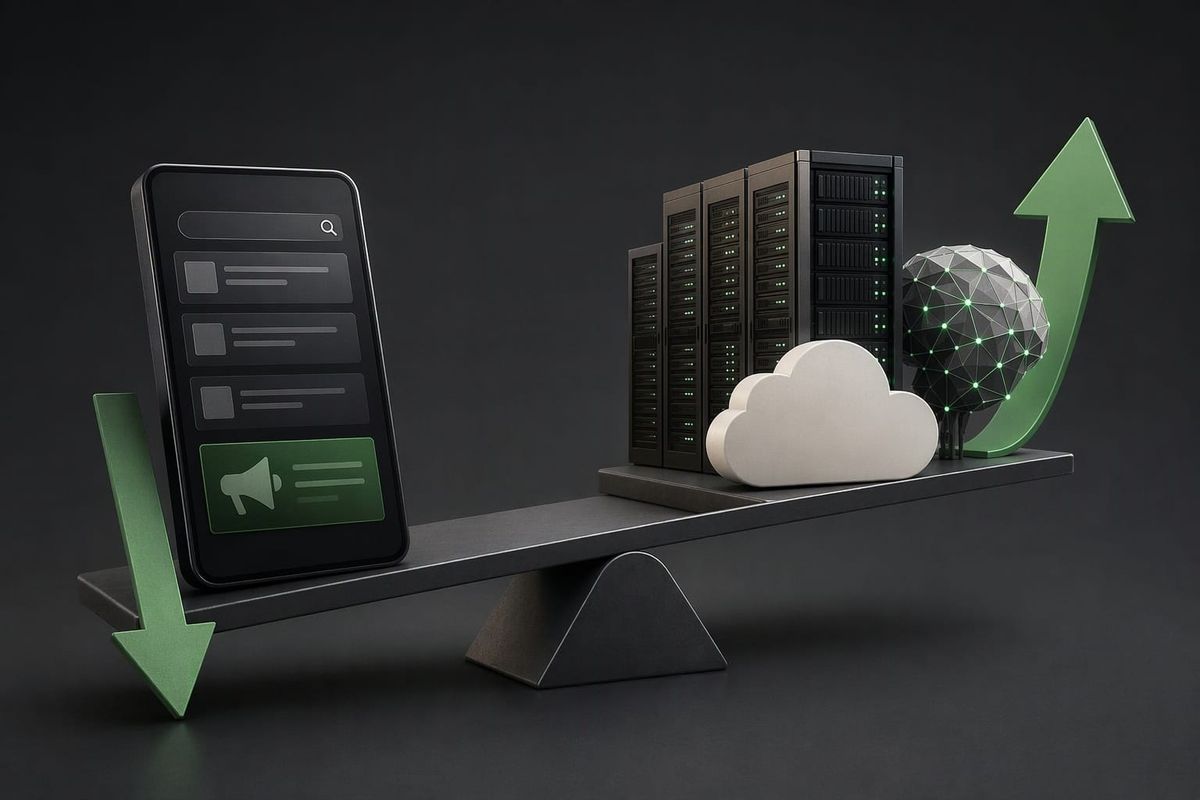
Baidu, which provides search, advertising, AI cloud services and driverless rides, reported a 22% year-over-year fall in advertising revenue Monday, even as AI cloud infrastructure revenue grew 94%. Its third-quarter results announcement put cloud infrastructure sales at RMB8.2 billion, but consolidated revenue fell 1% to RMB30.8 billion.
Cloud gains meet shrinking advertising
Online marketing brought in RMB11.9 billion, down from RMB15.3 billion a year earlier. Chief Financial Officer Haijian He credited cloud infrastructure growth with offsetting part of that weakness: General Business revenue rose 1% to RMB25.0 billion.
GPU Cloud grew faster still, with revenue up 191% from a year earlier and 43% from the second quarter. Baidu said cloud customers were making more prepayments and moving toward longer contracts.
AI-powered businesses supplied 53% of General Business revenue, compared with 50% in the second quarter and 39% in the third quarter of 2025. Their combined revenue rose 37% year over year to RMB13.2 billion.
“Our long-term investments in full-stack AI are translating into meaningful growth at scale,” Baidu co-founder and Chief Executive Officer Robin Li said in the results announcement.
The gains were uneven across AI products. AI applications generated RMB2.6 billion, approximately flat year over year, while AI-native marketing services fell 15% to RMB2.4 billion. Baidu attributed that decline to the economic environment, competition and its decision to favor user experience over immediate monetization during its AI Search transformation.
Spending outpaces cash generation
Baidu generated RMB2.8 billion from operations, but capital spending of RMB7.3 billion left free cash flow negative at RMB4.6 billion. The year-earlier free-cash-flow deficit was RMB2.1 billion; the second-quarter deficit was RMB8.0 billion.
Adjusted net income attributable to Baidu fell to RMB2.4 billion from RMB3.8 billion a year earlier. Adjusted diluted earnings per American depositary share declined to RMB6.78 from RMB11.12.
Cost of revenue rose 9% to RMB19.9 billion. Baidu attributed the increase mainly to cloud-related costs and spending to attract traffic, partly offset by lower content costs. Research and development spending fell 7% year over year to RMB4.8 billion.
Operating income was RMB626 million, with a 2% margin. Adjusted operating income fell to RMB1.7 billion from RMB2.2 billion a year earlier, while its margin narrowed to 6% from 7%.
An AI build-out and dividend plans
Baidu earns money from sponsored search links, cloud services and paid autonomous rides, primarily in mainland China. Its controlled online-video business, iQIYI, generated RMB6.0 billion in third-quarter revenue, down 10% year over year. Baidu App had 604 million monthly active users in September 2026.
Apollo Go, Baidu's autonomous ride-hailing service, operated across 30 cities as of October 2026. Its fleets logged approximately 34 million autonomous kilometers during the quarter, while fully driverless rides in Shenzhen increased approximately 170% from the second quarter.
Baidu had returned US$373 million through share repurchases since the beginning of 2026. It adopted a dividend policy for ordinary shares in February and expects its first declaration before the end of 2026, subject to board approval and market conditions.
Baidu also expects Kunlunxin M100, its chip optimized for large-scale AI inference, to be ready for volume production by year-end.
Sources
- Form 6-K — Baidu Announces Third Quarter 2026 Results — SEC EDGAR
- Baidu Announces Third Quarter 2026 Results — prnewswire.com