Amprius Technologies Signs Up To $75 Million Pentagon Deal To Build Drone Batteries Domestically
The fixed-price agreement obligates $22.3 million upfront, with the remainder tied to milestone completions and future congressional appropriations.


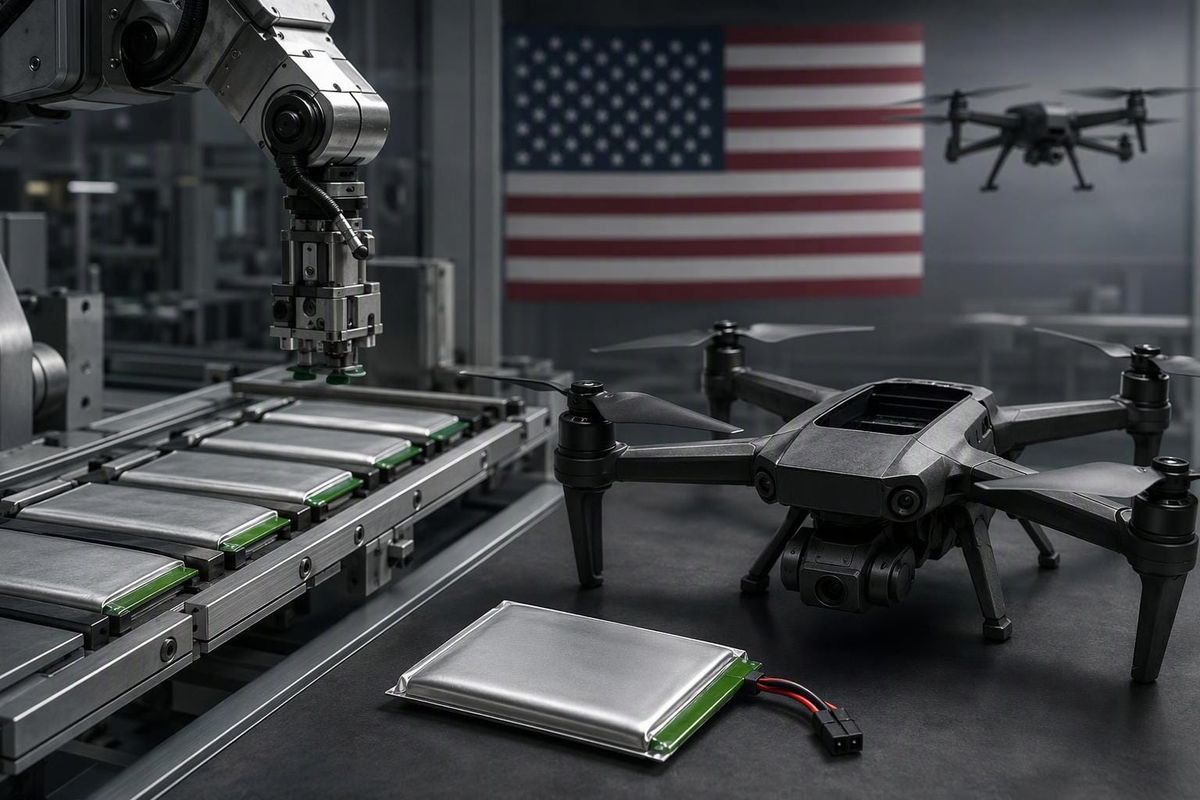
Amprius Technologies signed a fixed-price agreement with the U.S. government on Wednesday worth up to $74,793,173 to establish a domestic manufacturing line for silicon-anode batteries powering small military drones — with $22.3 million obligated immediately and the rest contingent on hitting milestones and securing future congressional funding. The deal, disclosed in an 8-K filed Monday, positions Amprius as the prime performer under the Army's Cornerstone Other Transaction Authority framework, with a base period running through September 22, 2028.
What The 8-K Says
The agreement, formally titled Project acCELLerate, was entered on Wednesday under 10 U.S.C. § 4022 — the statute governing Other Transaction Authority agreements, a contracting mechanism that sits outside the standard federal acquisition rules and does not require Amprius to contribute any cost share.
The full contract value is $74,793,173.11, all of it the government's share. Of that, $22,300,000 was obligated at signing using Fiscal Year 2025 Research, Development, Test, and Evaluation funding. The remaining $52,493,173.11 is unfunded and depends on future congressional appropriations and the government's acceptance of completed milestones — payments flow only after Amprius formally submits deliverables and the government signs off.
The project's stated objective, drawn from the agreement itself, is to build a high-volume, commercially viable domestic manufacturing capability for advanced silicon-anode, high-energy-density lithium-ion pouch cells and associated battery systems tailored for small unmanned aerial systems across Groups 1, 2, and 3 — the Pentagon's classification tiers for smaller battlefield drones.
The work program is structured into a base period and two separately priced option periods. The base period covers tasks including a project start-up phase, a pouch cell facility retrofit, and procurement and installation of production line equipment. Amprius serves as consortium lead and single accountable interface to the government, and is responsible for flowing applicable terms down to a designated partner whose name has been redacted from the public filing.
The Supply-Chain Logic Behind The Deal
The agreement is explicitly designed to satisfy Section 842 of the National Defense Authorization Act, which bars the Pentagon from procuring batteries sourced from Foreign Entities of Concern — a category that covers China, Russia, Iran, and North Korea. The filing describes the base period as directly addressing what it calls an "urgent" requirement under the fiscal year 2026 and 2027 NDAA prohibitions against adversary-sourced batteries.
Small military drones have historically relied on high-energy-density cells dominated by foreign manufacturers, and the Defense Department's use of the Cornerstone Other Transaction Authority framework — administered through the Army — reflects an effort to build a parallel domestic supply chain rather than wait for the commercial market to reorient on its own.
Amprius self-certified as a Nontraditional Defense Contractor to qualify under the statute, a designation that allows the agreement to proceed outside standard procurement rules. The company's responsibilities under the deal include providing advanced silicon-anode chemistry, cell design specifications, process transfer, and technical quality certification for five standardized cell types, as well as managing the facility retrofit, equipment procurement, factory and site acceptance testing, line integration, and product validation.
The Risks The Filing Names
The 8-K's forward-looking statement section is direct about where the deal could fall short. The majority of the total award remains unfunded, and payments depend entirely on the government accepting completed milestones — which, the filing warns, Amprius may not achieve on the expected timeline or at all.
The company also flags its reliance on third-party partners for portions of the work: if those partners fail to perform or experience delays, Amprius's ability to meet its obligations under the agreement could be compromised. The filing notes that either party may terminate the agreement for convenience with at least 30 calendar days' written notice, subject to good-faith settlement negotiations.
The agreement also carries standard provisions on intellectual property — including U.S. government license rights in technical data developed under the deal — along with restrictions on foreign participation, information security and cybersecurity compliance obligations, and equipment title requirements.
AMPX shares edged up about 1% to $9.67 in Friday trading, according to market data.
What To Watch
The roughly $52.5 million in unfunded award value is the number that matters most from here. Unlocking it requires Amprius to complete and submit milestones that the government then formally accepts — a sequential process across a base period that runs to September 22, 2028. Congress also has to appropriate the additional funds; without that, the ceiling stays theoretical.
The 8-K was signed by Ricardo C. Rodriguez, Amprius's chief financial officer, and filed Monday with the SEC.
The base period closes September 22, 2028 — and every dollar beyond the initial $22.3 million obligated at signing depends on milestone completions the government must formally accept before payment flows.