Allogene Projects Funding Into 2029 With $388.9 Million As Trial Readouts Approach
The cell-therapy developer expects autoimmune-disease results Monday and a lymphoma trial update in mid-2027.


Allogene Therapeutics, which develops donor-derived cell therapies for cancer and autoimmune diseases, ended the third quarter with $388.9 million in cash, cash equivalents and investments and projects that funding will support operations into 2029. The company reported its results Thursday in an SEC filing, with expanded autoimmune-disease trial results scheduled for Monday and a lymphoma update anticipated in mid-2027.
A Wider Loss, Lower Per-Share Loss
Allogene reported a third-quarter net loss of $50.4 million, including $7.0 million in non-cash stock compensation. The year-earlier loss was $41.400 million, yet the per-share loss narrowed to $0.15 from $0.19: the weighted-average share count used in that calculation rose to 346,092,814 from 222,038,680.
Research spending reached $41.9 million, compared with $31.164 million a year earlier, and included $2.9 million in non-cash stock compensation. Administrative expenses were $12.9 million, versus $13.737 million, including $4.2 million in stock compensation.
For 2026, management expects approximately $225 million in standard-accounting operating expenses, including about $35 million in non-cash stock compensation. Allogene also gives a separate operating-expense forecast of approximately $165 million; both estimates exclude potential business-development activities.
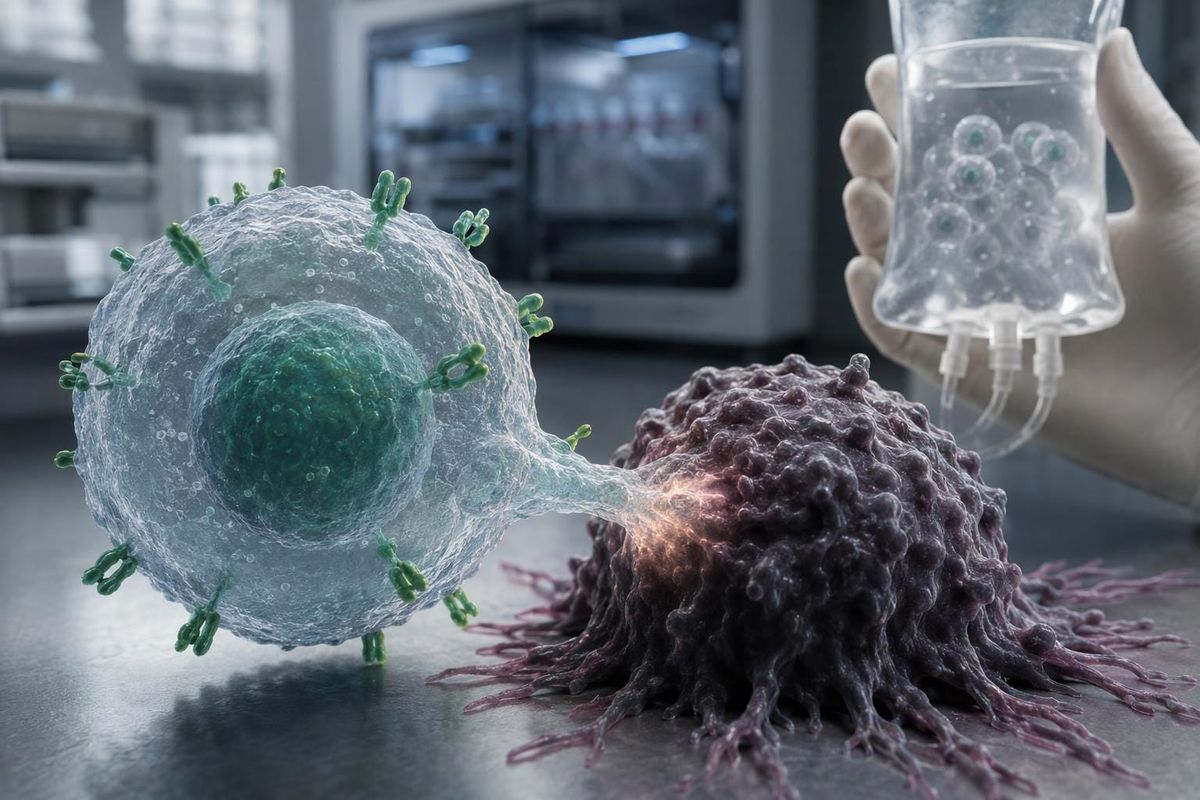
Allogene has no approved products. Its therapies use genetically engineered T cells from healthy donors, intended to be available off the shelf rather than prepared individually for each patient. The company manufactures clinical-trial supplies at its Newark, California, facility.
Lymphoma Treatment Closer To Patients
The pivotal cema-cel lymphoma trial tests whether treating patients with signs of residual cancer after first-line therapy can delay or prevent relapse. Allogene continues to anticipate a mid-2027 update and expects enrollment to finish by year-end 2027.
Enrollment is benefiting from more participating sites, increased screening for residual disease and brisk recruitment in Asia-Pacific, the company said. The network includes community oncology practices, where most patients with large B-cell lymphoma receive treatment. Early clinical experience has shown that outpatient administration is feasible, including at practices with little or no prior experience delivering CAR T cell therapy.
For possible commercialization, Allogene appointed Rocio Manghani as vice president of Market Access, Evidence & Strategy to lead insurance coverage, reimbursement and treatment-site preparations. Manghani has cell-therapy commercialization experience at Kite, Gamida Cell and Orca Bio.
Allogene also plans an event at the American Society of Hematology meeting about cema-cel's potential to widen access. A November abstract draws on a survey of 152 U.S. hematologists and oncologists examining obstacles to CAR T adoption.
Testing Less Chemotherapy Before Cell Therapy
Monday's American College of Rheumatology presentation will expand beyond a published nine-patient abstract, adding patients and longer follow-up for ALLO-329 across three dose levels. The early-stage autoimmune-disease trial includes scleroderma, myositis and lupus.
The trial compares preparation without chemotherapy, cyclophosphamide alone, and fludarabine with cyclophosphamide. That design aims to separate the cell therapy's contribution from chemotherapy's effects and identify a regimen that reduces treatment burden without compromising effectiveness. Enrollment and dose escalation continue, with Monday's results emphasizing scleroderma responses.
Zachary Roberts, Allogene's president and chief executive officer, said the results would address “whether we can deliver meaningful clinical benefit with less reliance on chemotherapy-based conditioning.”
ALLO-329 targets CD19 and CD70 and uses Allogene's Dagger technology to counter rejection of donor cells. The company is also developing ALLO-316 for kidney cancer. At the Society for Immunotherapy of Cancer meeting Thursday, Jeff McLeroy, vice president and head of Safety and Pharmacovigilance, discussed early-stage findings including durable responses and evidence that treatment cells expanded and entered tumors.
Roberts is scheduled to discuss the broader platform Friday. Allogene also plans preclinical results for a DLL3/CD70 candidate aimed at small cell lung cancer and other neuroendocrine tumors; those laboratory findings remain distinct from evidence of benefit in patients.
Monday's expanded ALLO-329 results are the next scheduled test of whether Allogene can reduce chemotherapy preparation while preserving treatment response.
Sources
- 8-K Filing — Allogene Therapeutics, Inc. (ALLO) — SEC EDGAR
- Exhibit allo-20260930xexx991q326.htm — Allogene Therapeutics, Inc. 8-K exhibit — SEC EDGAR
- Allogene Therapeutics Inc (ALLO) (Q3 2026) Earnings Call Highlights: Alpha 3 Momentum Builds as ... — Yahoo Finance
- Allogene Therapeutics Reports Third Quarter 2026 Financial — globenewswire.com
- Allogene Highlights Clinical Progress and Next-Generation — globenewswire.com