Absci Keeps Its Thicker-Hair Benchmark As It Makes The Case For Counting Fine Hairs
December's interim results will assess early activity, while management plans to use the full 26-week results to choose late-stage doses.


Absci, which uses AI and laboratory testing to develop antibody drugs, defended counting fine hairs on Thursday's earnings call while keeping its commercial benchmark tied to thicker regrowth. The company expects interim results for experimental hair-loss treatment ABS-201 in December, followed by full results in early 2027.
Thicker hairs still set the bar
Absci's consumer research tested a hypothetical treatment delivering 30 to 35 additional thicker hairs per square centimeter at 26 weeks. Zach Jonasson, Absci's chief financial officer and chief business officer, clarified that benchmark after an analyst asked whether it covered total hair growth. Fine-hair gains would come on top of it.
Jonasson said that efficacy, combined with the company's convenience and durability targets, supports an estimated $25 billion U.S. market. That estimate rests on a hypothetical product profile, not clinical results for ABS-201.
Sean McClain, Absci's founder and chief executive officer, rejected a Guggenheim analyst's suggestion that emphasizing total hair counts represented a shift. He called it "Definitely not a change."
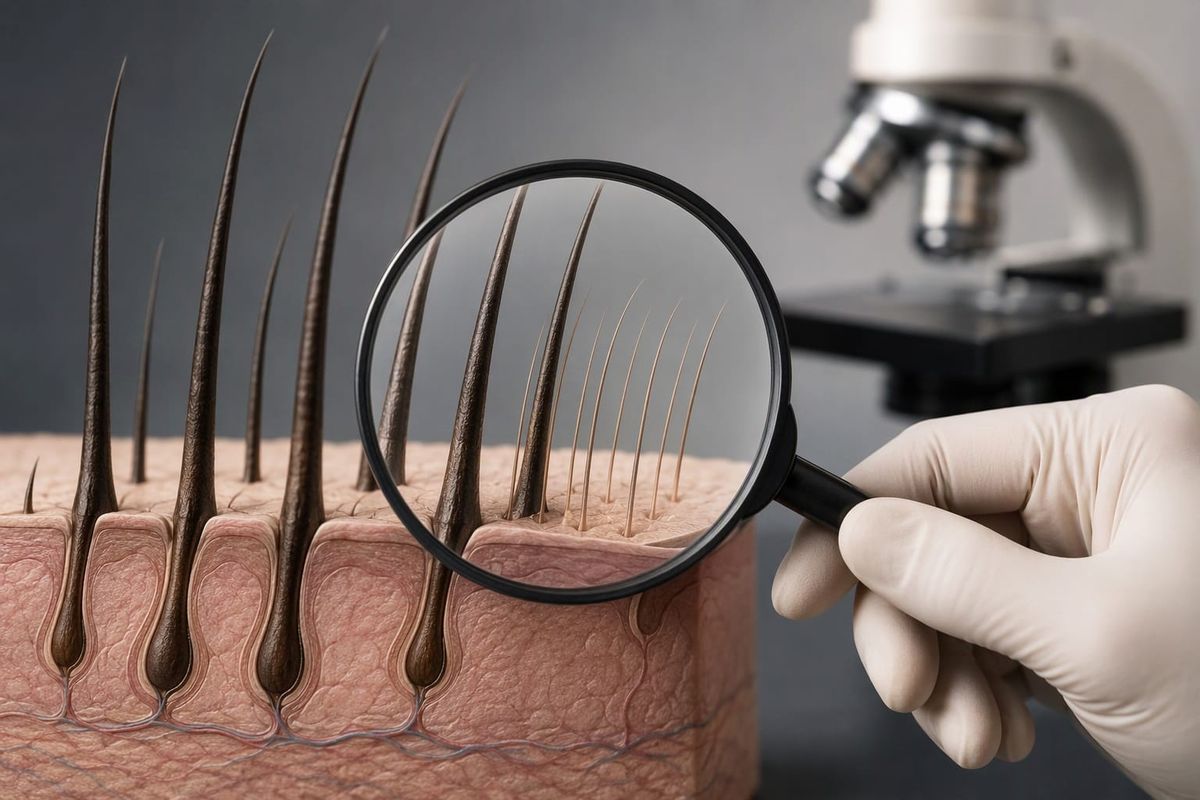
Ransi Somaratne, Absci's chief medical officer and head of R&D, explained that the conventional count includes hairs at least 30 microns wide. He described the division between fine and thicker hairs as "a numerical cutoff" and said follicles restarting growth might initially produce thinner hairs.
Management's argument is that counting both types could capture biological activity before those new hairs become thicker. Absci still plans to report the conventional thicker-hair count alongside total count and hair width.
December offers an early test
McClain told a BTIG analyst that the 13-week update would be a "directional readout." He pointed to animal findings as the basis for management's expectation that growth could accelerate between weeks 13 and 26, potentially continuing beyond that point.
December's update is expected to cover all participants at the 300-milligram dose, a majority at 600 milligrams and potentially an early look at 1,200 milligrams. Somaratne said enrollment in the highest-dose cohort was finished and the interim analysis would not change how the ongoing trial is conducted.
Safety results will combine drug and placebo recipients within each dose group. Management said retaining that blinding would help avoid bias in safety reporting; the update therefore will not isolate drug-specific safety outcomes.
Hair darkening will be assessed at 26 weeks and beyond using software analysis of photographs, rather than reported in December. Somaratne said the full 26-week results will guide doses for the planned late-stage hair-loss trial.
Absci has also begun exploratory female hair-loss cohorts at 300 and 1,200 milligrams. Those cohorts are open-label, with no placebo group; Somaratne said the dose choices were not based on male efficacy results.
The infrequent-injection bet
Absci's proposed treatment combines regrowth with a limited course of injections. In June, blinded early-stage findings suggested the study medication was well tolerated. An estimated half-life of at least 65 days—the time needed for its concentration to fall by half—supported the target of two or three injections over six months.
Somaratne said Absci is designing the program so patients stop after those doses. Durability remains part of the intended product, with longer follow-up meant to assess how long regrowth lasts.
Absci develops its own medicines and works on drug discovery with pharmaceutical and biotechnology partners. It is also developing ABS-201 for endometriosis, with a mid-stage trial planned for mid-2027.
The company reported cash, cash equivalents and marketable securities of $173.7 million at September 30, down from $201.1 million at June 30. It expects those resources to fund its operating plans into the second half of 2028.
December will provide the early hair-growth measurements. Absci plans to choose its late-stage doses from the fuller results expected in early 2027.
Sources
- Absci results release (Form 8-K, EX-99.1) — SEC EDGAR
- Absci Corp. (NasdaqGS:ABSI) : Articles :: Law360 — law360.com
- Absci Reports Business Updates and Third Quarter 2026 — globenewswire.com