AbCellera Prepares Longer-Lasting Hot-Flash Drug To Get Ahead Of Potential Competitors
The successor could mean fewer injections and lower production costs, while the lead treatment remains on track for late-stage testing.


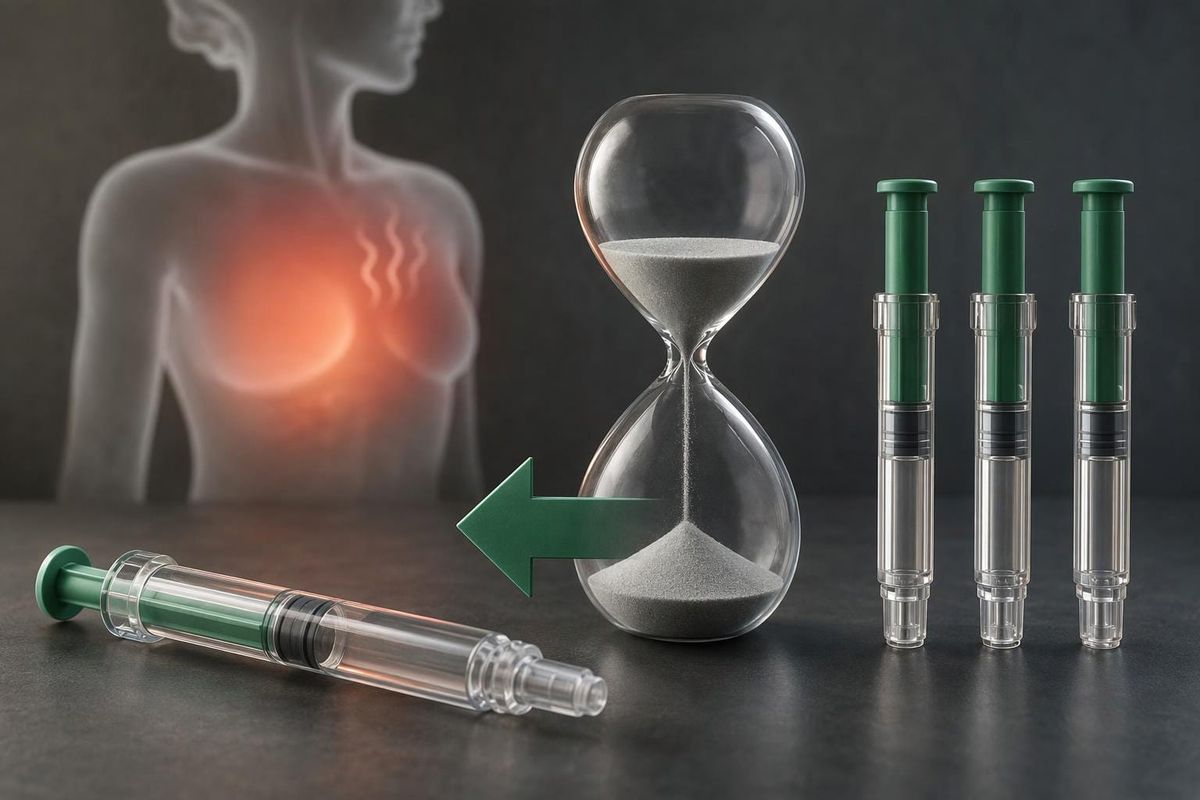
AbCellera Biologics, which discovers and develops antibody medicines, is preparing a longer-lasting hot-flash treatment to get ahead of anticipated competitors, President and Chief Executive Officer Dr. Carl Hansen said on the company’s earnings call Monday. The investigational successor, ABCL992, could permit substantially fewer injections, but AbCellera still expects to take its lead treatment, ABCL635, into late-stage studies in 2027.
Fewer Shots, More Patients
Hansen told a Goldman Sachs analyst that ABCL992 could allow injection intervals twice, perhaps three times or more as long as those for ABCL635. He cautioned that further studies are needed to establish the interval; the lead drug was originally designed for monthly dosing.
AbCellera had the successor ready when its lead drug produced positive results, allowing it to begin work needed before human testing during the third quarter. Hansen expects other developers to pursue longer-lasting alternatives. He described getting ahead of that response as part of “shoring up our position” on the earnings call.
In response to a Cantor Fitzgerald analyst, Hansen said fewer injections would lower manufacturing costs per patient and make it easier to supply more patients. Early market research also found a majority preference for a monthly injection, with enthusiasm among respondents who believed a three-month option was feasible.
Asked by a JPMorgan analyst about the successor’s role, Hansen emphasized: “We are all in on 635.” He said the longer-lasting candidate would support, rather than divert the company from, the lead program.
The Four-Week Results Behind The Bet
The mid-stage ABCL635 study tested a single 600-milligram injection for non-hormonal treatment of moderate to severe hot flashes. At four weeks, 37% of treated participants had complete resolution of those events, versus 2.2% receiving placebo. Daily events fell 83% from baseline in the treatment group, compared with 33% on placebo.
Hansen reported no serious or severe adverse events in the treatment group. Headaches occurred more often with ABCL635 and were mostly mild and temporary; fatigue was also more frequent, with all reported events mild.
AbCellera announced the results on August 10 and subsequently completed a $200 million financing to support advanced testing and investment in other candidates. Hansen recalled that a little over a year ago, the company was still doing preclinical work and building its clinical-development capabilities.
AbCellera develops medicines for its own pipeline and for pharmaceutical and biotechnology partners. Its partnership business earns research and access fees, intellectual-property payments, development milestones and royalties on drug sales.
A Lead Program Advances, Another Stops
AbCellera expects additional ABCL635 data through 12 weeks and results from its extension study in early 2027. Chief Medical Officer Dr. Sarah Nunberg explained that the study’s later weeks track how benefit declines as the single dose wears off, helping select doses for advanced trials. The extension examines repeat dosing and treatment of participants originally assigned placebo.
Management also expects to begin studies in 2027 for hot flashes associated with hormone suppression during breast and prostate cancer treatment.
The company is taking a different course with ABCL575, its investigational antibody for atopic dermatitis. Although its early-stage study met its goals, Hansen said disappointing external results in the same drug class led AbCellera to abandon development for that skin condition. It currently has no plans to advance ABCL575 beyond early-stage testing.
Other candidates, ABCL688 and ABCL386, have timelines that could bring them into human testing in 2027. The company also added oncology candidate ABCL385 and ABCL646, an antibody aimed at an ion-channel target, to its pipeline.
ABCL992 will not enter human testing in 2027, Hansen said; it could reach that stage in 2028. For now, ABCL635 carries the company’s planned move into late-stage development.
Sources
- AbCellera Biologics Q3 2026 Earnings Call Transcript — benzinga.com
- AbCellera Biologics Inc. (ABCL) Reports Q3 Loss, Tops Revenue Estimates — Yahoo Finance
- AbCellera to Report Third Quarter 2026 Financial Results on November 9, 2026 – Company Announcement - FT.com — Financial Times
- AbCellera (ABCL) Stock May Look Fully Priced On Book Value — Yahoo Finance
- AbCellera Reports Q3 2026 Business Results — businesswire.com